Mule Deer and Whitetail Hybridisation
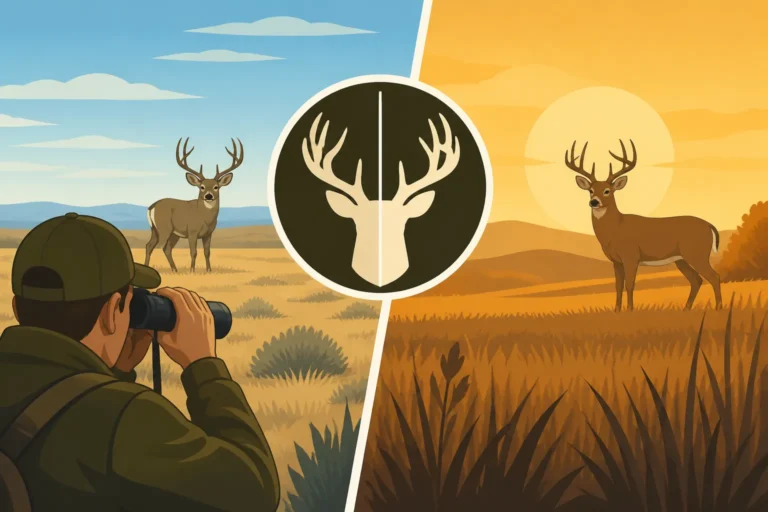
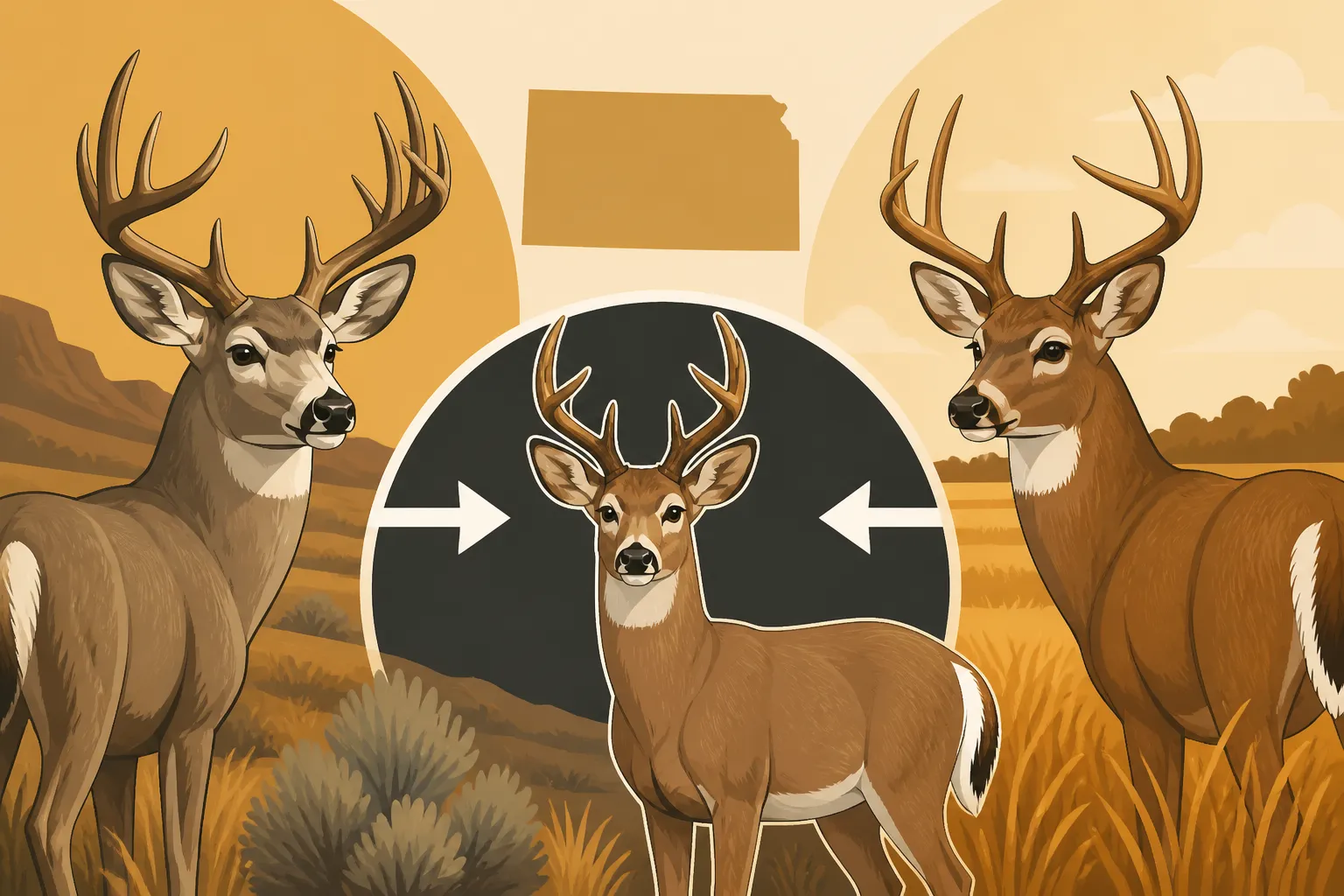
It's an interesting phenomenon that many Kansas hunters, especially those of us venturing into the western reaches, have started to notice: deer that just don't seem to fit neatly into the "whitetail" or "mule deer" box. You see a tail that looks almost mule deer-ish, but the antlers branch in a way that makes you scratch your head, or a deer that bounds like a muley but has a distinctly whitetail face. This blending of traits, often referred to as hybridisation, is a fascinating and sometimes challenging aspect of deer management and hunting in areas where these two distinct species share territory. This guide will dive deep into what mule deer and whitetail hybridisation means for Kansas hunters, how to identify these unique deer, and the factors contributing to their presence.
The Overlap: Where Whitetails and Mule Deer Meet in Kansas
For generations, mule deer were the undisputed kings of the vast, open plains of western Kansas, while whitetails thrived in the timbered creek bottoms and agricultural fields of the east and central regions. However, those lines have become increasingly blurred, creating zones where encounters between the two species are not just possible, but quite common, leading to a complex dynamic that influences everything from genetics to hunting strategies.
Understanding the Geographic Divide
Traditionally, when you talk about Mule Deer Range in Western Kansas, you're thinking of the high plains counties, particularly in the extreme northwest. These are the vast, treeless landscapes, the breaks, and the canyons that mule deer call home. Their numbers have always been lower than whitetails in the state, making them a prized draw for those seeking a unique western hunting experience. Whitetails, on the other hand, are ubiquitous across Kansas, found in every county, from the dense timber of the eastern border to the smallest creek bottom or shelterbelt out west.
The "divide" used to be a fairly clear one, often following major river systems or the general shift from timber-rich country to wide-open plains. But whitetails are incredibly adaptable and, spurred by changes in habitat and agriculture, they've been steadily expanding their reach westward. This means that areas once exclusively mule deer territory now see a healthy, if not dominant, whitetail presence. This expansion creates significant overlap zones, especially along major river drainages like the Republican or Smoky Hill, and in areas where CRP grasslands offer both species a place to hide and feed. In these transitional zones, the chances of seeing both species, and potentially their mixed offspring, increase dramatically. It's this dynamic Kansas Mule Deer and Whitetail Overlap that truly sets the stage for hybridisation.
Habitat Preferences and How They Influence Encounters
It's not just about geography; it's also about what each deer species looks for in its environment. Whitetails are creatures of cover. They love dense timber, thick plum thickets, brushy creek draws, and the edges of vast crop fields. Their survival strategy often involves hiding and sneaking, using every available piece of concealment to evade predators or hunters. They thrive in agricultural landscapes where food is abundant and escape cover is nearby. You'll often find them bedded down deep in a cedar thicket or the middle of a standing cornfield.
Mule deer, conversely, are built for the wide-open spaces. Their large ears, keen eyesight, and bounding gait are all adaptations for surviving in more exposed terrain. They prefer broken country, rolling hills, rugged canyons, and expanses of native grass or sagebrush. When spooked, a mule deer often doesn't run far, but rather bounces away over a ridge, stopping to look back from a safe distance. Their strategy relies on seeing danger from afar and using terrain to disappear. However, in Kansas, particularly along the western river breaks and larger creek systems, these distinct habitat preferences can merge. Whitetails move into the river bottom timber, while mule deer utilize the adjacent bluffs and grasslands. When these two worlds collide in a patchwork of crops, timbered draws, and CRP, the opportunity for both species to interact, and eventually interbreed, grows exponentially.
Identifying the Differences: Classic Traits of Each Species
Before we can even begin to talk about hybrids, it's crucial to have a solid grasp on what makes a pure whitetail a whitetail, and a mule deer a mule deer. While seasoned hunters might feel confident in their identification skills, sometimes in the field, with adrenaline pumping and fleeting glances, even the most experienced among us can second-guess ourselves. Understanding the classic traits is your first line of defense against misidentification and the key to spotting those subtle hybrid characteristics.
Key Physical Distinctions
The most obvious features usually jump out first, but looking closer can reveal even more.
- Antlers: This is often the primary identifier for bucks. Whitetail bucks typically grow a main beam that sweeps forward, from which individual tines (points) branch off, rarely forking again. Think of a candelabra or a coat rack. Mule deer, however, are known for their dichotomous branching. Their antlers fork, and then those forks fork again, creating a more symmetrical, Y-shaped structure. This Mule Deer Antler Shape Differences is usually quite distinct. However, abnormal points or non-typical racks can sometimes confuse the issue, especially on younger bucks.
- Ears: The name "mule deer" isn't accidental. Their ears are notably larger, often appearing disproportionately large compared to their head, much like a mule's. Whitetail ears are smaller, more proportional to their head size. In the field, especially at a distance, if those ears look like they belong on a donkey, you're likely looking at a mule deer.
- Tail: This is another major giveaway. A whitetail's tail is broad, typically reddish-brown on top, and pure white underneath. When a whitetail is alarmed, it raises its tail straight up, "flagging" that bright white underside as it runs, a classic visual signal. Mule deer, conversely, have a much narrower, rope-like tail. The tail is usually light-colored (tan or off-white) at the base and has a distinctive, prominent black tip. They don't typically "flag" their tail high like a whitetail; it might be carried low or slightly elevated when they bolt.
- Coloration and Body Shape: Whitetails tend to have a reddish-brown coat in summer, transitioning to a grayer, thicker coat in winter. They often appear more streamlined and slender. Mule deer tend to be a more uniform grayish-brown year-round, often with a white rump patch that extends up past the tail, and a distinct white patch on the throat. They also often appear stockier and more robust in build.
For a quick reference, here's a table comparing these features:
| Feature | Whitetail Deer | Mule Deer | Potential Hybrid Traits |
|---|---|---|---|
| Antlers | Main beam with tines branching off it (non-forking) | Dichotomous (forking, then re-forking) | Irregular branching, tines off forks, or main beam with forking tips |
| Ears | Proportionate to head, smaller | Very large, mule-like | Intermediate size, larger than whitetail but not fully mule |
| Tail | Broad, brown on top, white underneath, flags | Narrow, rope-like, white base, prominent black tip | White tail with black tip, small flag, or mostly black tip |
| Rump Patch | Minimal or absent | Large, distinct white patch | Smaller or less defined white rump, sometimes absent |
| Color | Reddish-brown (summer), grayish-brown (winter) | Generally grayish-brown year-round, often paler face | Mix of colors, potentially inconsistent patches |
| Gait | Runs, "flags" tail | "Stotting" (all four feet together bounce), no flagging | Combination of running and bounding, inconsistent tail carry |
Behavioral Cues: How They Move and React
Beyond the physical appearance, the way a deer moves and reacts can provide significant clues. This is often where Telling a Mule Deer From a Whitetail truly becomes an art form, as you watch them navigate their environment.
Whitetails are often described as fluid and stealthy. When startled, they typically run with a graceful, low-to-the-ground stride, their white tail held high and waving like a flag. This "flagging" is a clear signal to other deer of danger and is iconic to the species. They prefer to weave through dense cover, using obstacles to break lines of sight, often pausing just behind a tree or brush pile to assess the threat before continuing their flight. They are masters of the quick dart and hide.
Mule deer, on the other hand, have a distinctive bounding gait known as "stotting" or "pronking." When alarmed, they spring all four feet off the ground simultaneously, landing on all four feet at once, often covering significant ground with each leap. It looks a bit like a pogo stick. They don't typically "flag" their tail in the same dramatic way as a whitetail; their tail might be held down or only slightly elevated, emphasizing that black tip. Mule deer tend to run for a short distance, often uphill or to a high point, and then stop to look back at the perceived threat. This behavior is rooted in their open country habitat, where seeing potential danger and then assessing it from a vantage point is a more effective survival strategy than trying to hide in non-existent cover. A deer that shows a mix of these behaviors – perhaps a few bounds followed by a low run, or a partial tail flag with a black tip – could very well be a hybrid.
The Reality of Hybridization: "Muleys" and "Whitetails"
The idea of two distinct species interbreeding can sound like something out of a science fiction movie, but in the natural world, and specifically with deer, it's a documented phenomenon. In Kansas, where the ranges of whitetails and mule deer now significantly overlap, the potential for such genetic mixing has certainly increased. It creates a fascinating, if sometimes problematic, scenario for wildlife biologists and hunters alike.
What is a Hybrid Deer and How Common Are They?
A hybrid deer, in this context, is the offspring resulting from the mating of a whitetail deer and a mule deer. Genetically, they carry a mix of chromosomes from both parent species. While it's certainly not an everyday occurrence across the entire deer population, these "intergrades" or "muley-whitetail crosses" are not as rare as some might think, particularly in the western fringes of Kansas where the two species coexist. The rarity of full-blown, fertile hybrids that successfully reproduce generation after generation is higher, as hybrids can sometimes experience reduced fertility or even sterility, a common issue in interspecies breeding. However, first-generation hybrids are increasingly being documented.
Historically, the geographic separation and distinct behavioral patterns of the two species acted as natural barriers to interbreeding. But as whitetail populations have expanded westward, pushing into traditional mule deer strongholds, and as habitat changes (like extensive CRP plantings providing cover in open country) bring the two species into closer contact, these barriers have weakened. The exact prevalence of hybrids is difficult to quantify, as identifying them can be challenging, but anecdotally, hunters in units like Kansas Deer Units 1 Through 19 that border or include mule deer range report seeing them more frequently. These are not a new species, but rather a testament to nature's adaptability and the pressure points created by shifting ecological dynamics.
Recognizing Hybrid Characteristics in the Field
Spotting a hybrid in the field can be tough, as they often display a mosaic of traits from both parents, rather than a clear 50/50 split. It's like trying to find that one specific shade of paint in a gradient. You'll often see something that makes you do a double-take, something "off" from what you'd expect from a purebred.
- Antler Abnormalities: This is one of the most common indicators in bucks. You might see a deer that has a main beam like a whitetail, but then some of the tines off that beam show secondary forks, a characteristic usually associated with mule deer. Or, conversely, a buck that generally has dichotomous branching but also has a couple of distinct points coming directly off the main beam, not a fork. It’s a mix-and-match rack. These antler patterns are a strong clue and often lead hunters to report a deer that looks like "it just couldn't decide what it wanted to be."
- Tail Features: Perhaps the most striking and easy-to-spot hybrid trait is the tail. Imagine a whitetail-shaped tail (broad, fanned) but with a black tip like a mule deer. Or a mule deer-like rope tail that, when raised, shows a good amount of white, almost like a miniature flag. These intermediate tail characteristics are a clear signal that you're likely looking at a hybrid.
- Intermediate Physical Traits: Beyond antlers and tails, you might observe other blended features. The ears could be larger than a typical whitetail's but not quite as massive as a full-blooded mule deer's. The rump patch might be present but less defined than a mule deer's, or a whitetail might have an unusually pale face. Body coloration might also be a mix, perhaps a whitetail-like reddish hue combined with the grayer tones of a mule deer. It's truly a spectrum of possibilities.
When you're out there Scouting Kansas Walk-In Tracts Before the Opener or Hunting Western Kansas Plains Hunting Country, keep an eye out for these subtle discrepancies. Often, it's a combination of these "odd" features that will tip you off to a hybrid.
Factors Contributing to Hybridization in Kansas
The increase in hybrid deer isn't just a random occurrence; it's a direct result of several ecological and demographic shifts in Kansas.
- Whitetail Population Expansion: This is arguably the biggest driver. As the Kansas Whitetail Deer and Why They Grow Big population has exploded over the decades, they've pushed into marginal habitats and expanded their range westward. They are incredibly adaptable, thriving even in relatively open country if there's sufficient food and scattered cover. This puts them in direct contact with mule deer populations more frequently than ever before.
- Habitat Alteration: Land use changes play a significant role. The proliferation of Conservation Reserve Program (CRP) lands, for example, has created dense grass and forb cover in areas that were historically more open plains. While great for pheasants and quail, these CRP fields provide excellent bedding and escape cover for whitetails, allowing them to penetrate deeper into traditional mule deer country. Similarly, the planting of shelterbelts and timber blocks for windbreaks or aesthetics in open areas provides pockets of whitetail habitat where none existed before, further increasing interaction opportunities.
- Stress on Mule Deer Populations: In some areas, mule deer populations have faced challenges, leading to localized declines or reduced herd health. When mule deer numbers are low, finding a mate of their own species can become more difficult, especially for does. This environmental pressure can lead to more opportunistic breeding, where a mule deer doe might be more likely to mate with a whitetail buck if he's the most available option. While mule deer bucks are sometimes observed attempting to breed whitetail does, the most common hybrid cross is between a whitetail buck and a mule deer doe. This dynamic, coupled with factors affecting Mule Deer Numbers in Western Kansas, further contributes to the likelihood of hybridization.
These interwoven factors create a perfect storm for interspecies breeding, blurring the genetic lines in the deer herds of western Kansas.
Hunting Hybrids: Challenges and Considerations for Hunters
For the conscientious hunter, encountering a potential hybrid deer presents a unique set of challenges, particularly when it comes to legalities, ethics, and the broader implications for conservation. It's not just about taking a shot; it's about making an informed decision that respects wildlife management principles.
Legal Ramifications and Tagging Challenges
In Kansas, deer hunting permits are typically species-specific. You apply for either an "Either-Sex Whitetail" permit or, if you're lucky enough to draw one for specific western units, a "Mule Deer" permit. The Kansas Mule Deer Stamp Draw is a coveted opportunity, and there are strict rules about what constitutes a legal harvest. This is where hybrid deer can cause real headaches for hunters. If you've got an antlerless whitetail tag and you shoot a deer that has a whitetail body but a mule deer tail, is it legal? What if it's a buck with a whitetail rack but mule deer ears and gait?
The general rule of thumb from the Kansas Department of Wildlife and Parks (KDWP) has been to identify the deer by its most dominant characteristics. If it largely looks and acts like a whitetail, it counts as a whitetail for tagging purposes. If it's predominantly mule deer, it's a mule deer. However, this subjective assessment can be incredibly difficult in the field, especially under pressure or in low light. The best advice is always to be absolutely certain of your target species before you pull the trigger. If there's any doubt about whether a deer is a mule deer or a whitetail, and you only have one specific tag, it's usually best to pass. Misidentifying a mule deer for a whitetail when you only hold a whitetail permit could lead to serious legal consequences. When in doubt, consult the KDWP regulations carefully and, if possible, seek clarification from a game warden if you observe a clearly hybrid animal and are concerned about legal tagging. Services like GoHunt can provide useful mapping tools to understand unit boundaries, but ultimate species identification is on the hunter.
Ethical Considerations and Conservation
Beyond the legalities, there are important ethical and conservation considerations when it comes to hybrid deer. From a conservation standpoint, the increasing rate of hybridization is a concern because it can impact the genetic integrity and long-term viability of both pure species. Mule deer populations, in particular, are already struggling in some parts of their historic range. If they continue to interbreed with whitetails, it could dilute their unique genetic adaptations and further diminish their numbers as a distinct species. Hybrids are sometimes less fit, less able to adapt to their specific environment, or have reproductive issues, which can ultimately weaken the overall deer herd.
As hunters, we have a responsibility to be stewards of the wildlife we pursue. This includes understanding the broader ecological picture. If you encounter a truly unique or clearly hybrid animal, especially one exhibiting signs of reduced health or unusual behavior, reporting it to the KDWP can be valuable for their ongoing research and management efforts. While harvesting a hybrid deer with the appropriate tag isn't inherently unethical, recognizing the underlying causes of hybridization – primarily habitat encroachment and population dynamics – reminds us of the interconnectedness of our ecosystems. Understanding these trends helps us appreciate the nuances of deer hunting in a state like Kansas, where the landscape is constantly evolving, and with it, the species that call it home.
Disclaimer
This article is for general informational purposes only and does not constitute professional advice. Laws, prices and regulations vary by location and change over time. Consult a qualified professional for guidance on your specific situation.