Mule Deer Antler Shape Differences
One of the most thrilling, yet sometimes confusing, aspects of deer hunting in Kansas is distinguishing between our magnificent whitetail and the elusive mule deer, especially when all you have is a quick glance at their headgear. Many hunters struggle to confidently tell them apart, particularly in the western parts of our state where their ranges can overlap, leading to missed opportunities or, worse, mistakenly harvesting the wrong species when specific tags are required. This guide is here to unravel the mysteries of mule deer antler differences, helping you become a more confident and knowledgeable hunter in the Kansas field.
The Branching Versus Forking Debate
The most talked-about and often the clearest distinction between whitetail and mule deer antlers lies in their fundamental growth pattern. It's a key characteristic that, once understood, can unlock much of the identification puzzle, though it's not without its nuances.
Whitetail Antler Growth Patterns
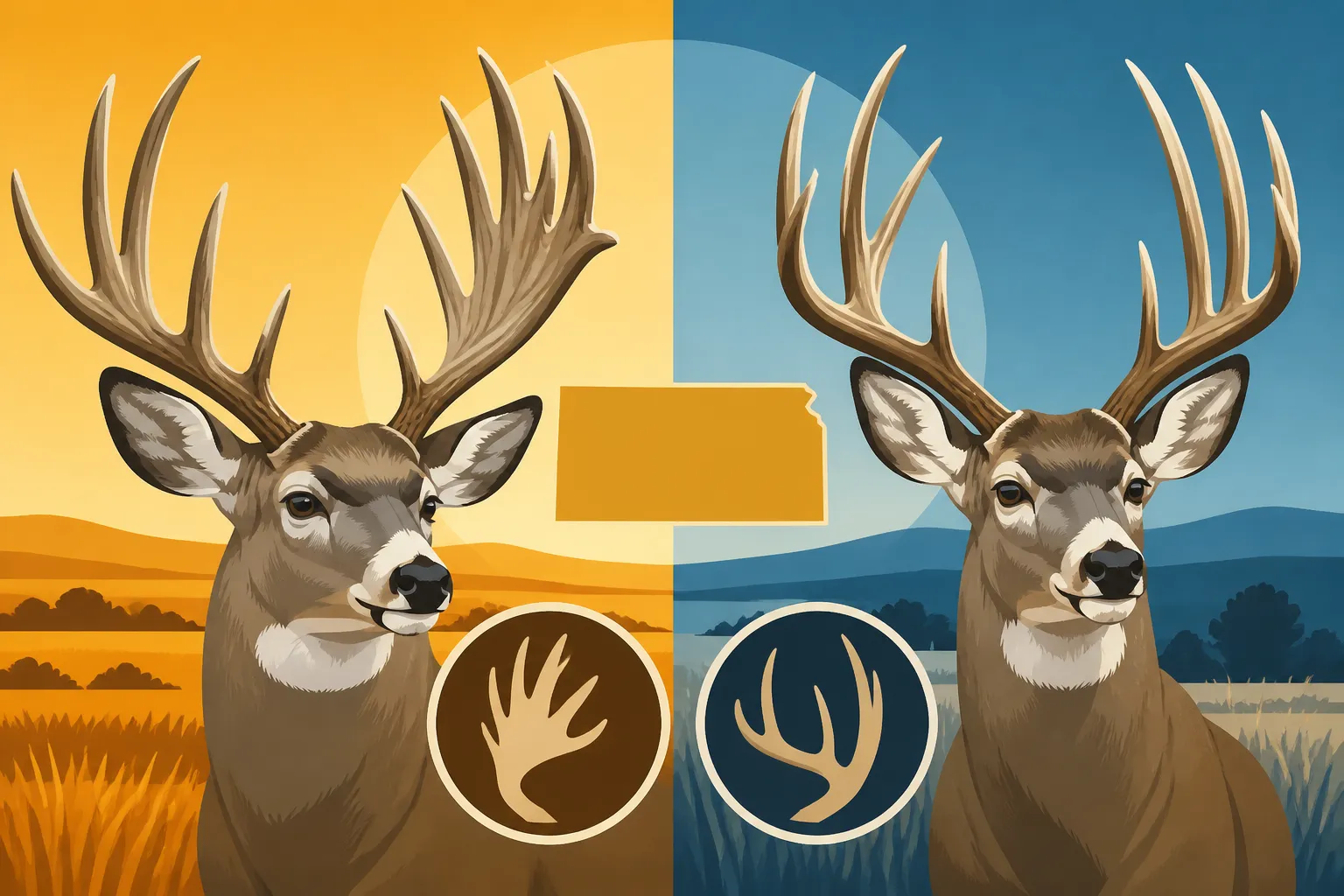
When you look at a whitetail buck's antlers, you'll generally observe a main beam that curves forward and outward, with individual tines — or points — sprouting upwards from that main beam. Think of it like a hand reaching out: the main beam is the wrist and palm, and the tines are the fingers. Each "finger" (G1, G2, G3, etc.) typically grows independently from the main beam without further branching. You might see a small, short brow tine (G1) close to the pedicle, and then a series of increasingly longer points further along the beam. Occasionally, a whitetail might develop a "fork" on one of its tines, especially on a G2 (the second point back from the brow tine), which can sometimes confuse new hunters. However, this is usually an isolated fork on a single tine, not a consistent, repeated bifurcation across the entire antler. The overall appearance is a smooth main beam with distinct, separate points rising from it.
Mule Deer Antler Growth Patterns
Mule deer antlers, by contrast, are renowned for their "forked" or "bifurcated" growth. Instead of a single main beam with tines branching off, a mule deer's antler typically forks into two main beams, and then each of those forks again. Imagine the main beam coming off the head, then splitting into two, and each of those splits into two more. This creates a distinctive "double-forked" or "dichotomous" pattern. It's less about individual tines growing off a main stem and more about a continuous branching. While whitetails generally have prominent brow tines, mule deer often have very small, vestigial brow tines, or sometimes none at all. This lack of a strong brow tine, coupled with the consistent forking, is a tell-tale sign. Understanding this fundamental difference is crucial, especially when you are trying to make a quick identification in the field, perhaps using mapping tools like GoHunt to scout potential mixed-species areas.
Understanding Typical vs. Non-typical Antler Growth
It's important to differentiate between typical and non-typical antler growth, as both whitetails and mule deer can produce non-typical racks that might throw off your initial identification based solely on the classic branching patterns. A "typical" rack adheres to the species' characteristic growth—clean, symmetrical points on a whitetail, and the distinctive forking on a mule deer. However, non-typical antlers have abnormal points, often called "kickers," "stickers," or "drop tines," that deviate from the normal growth pattern.
For a whitetail, a non-typical antler might have additional points growing off the main beam in unusual places, or even drop tines hanging down. While still starting with a main beam, these extra points can sometimes create a more "busy" or confusing appearance that isn't strictly the clean, upright tines you expect. Similarly, a mule deer might have non-typical points that add to its character. A non-typical mule deer might have a main beam that doesn't fork perfectly, or has extra points growing in odd directions. The key here is to look beyond just the presence of a few extra points and try to discern the underlying growth pattern. Does it primarily stem from a main beam with individual tines, even with some abnormalities? Or does it fundamentally exhibit the repeated forking structure? This helps confirm the species even when dealing with unique or trophy-class racks that break the mold. Knowing the specific characteristics, like those detailed in Mule Deer Antler Shape Differences, can be a game-changer.
Beyond the Forks: Mass and Overall Configuration
While the branching pattern is paramount, mule deer and whitetail antlers also often differ in their overall mass, spread, and the way they are carried on the deer's head. These subtler cues can confirm your initial assessment or help you make a call when the branching pattern isn't perfectly clear.
Comparing Whitetail and Mule Deer Antler Mass
Generally, mule deer antlers tend to have more mass, especially at the bases and throughout the beams, compared to whitetails of similar age and score. A mature whitetail buck can certainly carry an impressive, heavy rack, but often the individual tines are longer and more slender. Mule deer, on the other hand, frequently display a thicker, heavier circumference to their beams, even if the individual points themselves aren't as long as a big whitetail's. This "heft" can be noticeable even from a distance, contributing to a more robust, sometimes almost 'club-like' appearance at the base before the significant forking begins. This difference in mass is a general rule, and there are always exceptions, but it's a good secondary characteristic to consider.
The Influence of Nutrition and Genetics
It's absolutely critical to remember that nutrition, age, and genetics play enormous roles in antler development for both species. A young, healthy whitetail in prime Kansas agricultural country might have a very impressive, heavy rack, potentially blurring the mass distinction with a younger or less well-nourished mule deer. Conversely, a mule deer from a more arid, less nutrient-rich environment might have a lighter rack than you'd expect. Kansas has some incredible soil fertility, particularly in its agricultural regions, which can lead to exceptional antler growth in both whitetails and mule deer. Don't let an exceptionally large or unusually shaped rack immediately override all other identification cues. Always consider the overall context of the deer's body and its habitat. You can find more detail on this in Why Kansas Grows Trophy Whitetails.
Spread and Beam Length Considerations
Another subtle difference can be seen in the overall spread and beam length. Whitetail bucks often have main beams that sweep widely outward and forward, giving them a broad appearance from the front or side. The beams themselves can be quite long. Mule deer antlers, while certainly capable of impressive width, tend to grow more upright before they begin their characteristic forking. The overall impression can sometimes be that mule deer antlers appear taller and more compact, even when they have a good spread. Their main beams might not appear as long as a whitetail's before the major branching occurs. Of course, individual deer vary greatly, and a huge mule deer will have a significant spread, but observing the direction and initial sweep of the main beam before branching can offer another clue. This also ties into how different antler structures might appear when looking at Boone and Crockett Minimums for Whitetail versus other scoring systems for mule deer.
Field Identification and Overlap Zones
Making a confident identification in the field, especially in the fleeting moments a deer might present itself, requires combining all these observations. The challenge is amplified in the western regions of Kansas where mule deer are present and their range overlaps with whitetails.
Distinguishing in Mixed Habitats
In western Kansas, particularly in units like 1 and 2, you're truly in a transition zone where both whitetail and mule deer call home. This is where the difficulty really ramps up. You might be hunting a creek bottom with some timber, classic whitetail habitat, but a mule deer might be using it as a travel corridor between CRP fields or breaks. Conversely, a whitetail might venture out into open prairie more typical of mule deer. When a deer steps out, your first instinct will be to look at the antlers. If you see immediate, repeated forking, you're likely looking at a mule deer. If you see a strong main beam with individual points, it's probably a whitetail. But don't stop there. This is why tools like GoHunt are so valuable, as they can provide data on reported sightings and harvest numbers within specific units, giving you a better understanding of what species are commonly found where you're hunting. For more information on where these species thrive, check out Mule Deer Range in Western Kansas.
Combining Antler Cues with Body Characteristics
Antlers are fantastic, but they are only one part of the puzzle. When trying to make a definitive identification, especially if the antlers are atypical or unclear, always look at the other distinguishing characteristics of the animal.
- Ears: Mule deer famously have much larger ears, often described as "mule-like," which are almost comically oversized compared to their head. Whitetail ears are smaller and more proportional.
- Tail: This is often the easiest and most definitive visual cue. Whitetails have a broad, flag-like tail that is brown on top and pure white underneath. When alarmed, they will raise it high, hence "whitetail." Mule deer have a narrower, rope-like tail that is usually white with a black tip. They don't typically "flag" it like a whitetail.
- Body Shape and Color: Mule deer tend to have stockier bodies, and their coloring can appear more uniform brownish-gray, especially in winter. Whitetails often appear leaner and can have a more reddish-brown coat.
- Gait: Perhaps the most unique mule deer characteristic is their "stotting" or "pronking" gait. When alarmed, they often bounce away with all four feet hitting the ground at once, like a pogo stick. Whitetails run with a more traditional bounding gait.
By combining antler observations with these body cues, you can significantly increase your confidence in making a correct identification. Many hunters struggle with Telling a Mule Deer From a Whitetail in the moment, but a holistic approach helps.
When Antler Differences Are Not Clear-Cut
Let's be realistic: sometimes, the antlers just aren't perfectly textbook. A whitetail might have unusually forked G2s, or a younger mule deer might not have developed its full dichotomous branching yet, making it look more like a whitetail. What do you do in these situations?
First, fall back on the body characteristics, especially the ears and tail. These are usually much more consistent. Second, consider the habitat you're in. While both can overlap, a deep timber patch is more likely to hold a whitetail, while wide-open, broken country is more indicative of a mule deer. Third, and most importantly, if you are unsure, pass on the animal. Kansas has specific regulations regarding mule deer harvest, often requiring a special Kansas Mule Deer Stamp Draw in addition to your regular whitetail permit, and these can be unit-specific. It's simply not worth the risk of a violation if you're not 100% certain of the species. When using your mapping app like GoHunt, make notes of any ambiguous sightings – this can help you learn and refine your identification skills over time. Making the right call is part of responsible hunting, and sometimes that means waiting for an animal you can definitively identify.
The Impact of Hybridization and Regional Blurring
The fascinating, and sometimes frustrating, aspect of deer identification in Kansas is the potential for hybridization, particularly in the western fringes of the state. This natural phenomenon adds another layer of complexity to antler identification.
Where Ranges Overlap in Kansas
The primary range for mule deer in Kansas is concentrated in the western counties, roughly west of Highway 281. This is where you'll find the rolling prairies, canyons, and more arid landscapes that mule deer prefer. However, whitetails are incredibly adaptable and have expanded their range across nearly all of Kansas, including these western areas. This means that in these overlap zones, you're likely to encounter both species. Rivers and creek bottoms in western Kansas, while still favored by whitetails, can also serve as travel corridors for mule deer moving between larger tracts of cover. This creates a scenario where a hunter could genuinely see either species in similar habitat, making the need for careful identification even greater. Knowing the specific distribution, like that covered in Mule Deer Numbers in Western Kansas, is incredibly helpful.
Hybrid Antler Characteristics
When mule deer and whitetail deer interbreed, their offspring, known as "hybrids" or "mule-tails" (though this term isn't scientific), can exhibit a perplexing mix of characteristics from both parent species. This includes their antlers. A hybrid might have antlers that are primarily whitetail-like with a main beam and some individual tines, but then one or more of those tines might have a distinct, mule-deer-like fork. Or, conversely, the antler might start with a mule deer's dichotomous branching but then have some tines that grow more like a whitetail. This can be truly challenging for even experienced hunters to discern. It's a prime example of why relying on multiple identification cues—not just antlers—is so vital. If you encounter a deer with truly ambiguous antlers, coupled with mixed body characteristics (e.g., mule deer ears but a whitetail-like tail), you might be looking at a hybrid.
When in Doubt, Prioritize Legal Harvest and Conservation
Given the potential for hybrids and the often-subtle distinctions in antler growth, the overarching advice in a mixed-species zone remains: if you are not 100% certain of the species, do not shoot. Kansas regulations are clear, and while some permits might allow either species, many are specific. Misidentifying a deer could lead to a violation, and more importantly, it runs counter to ethical hunting practices. When a deer presents itself, take a moment, use your binoculars or spotting scope, and evaluate every possible characteristic—ears, tail, body, and, of course, the antler growth pattern. If you're hunting in a mule deer management unit with a specific tag, you absolutely need to be sure. Prioritizing conservation and legal harvest means making informed, confident decisions in the field. This also ties into broader concerns like Mule Deer Decline in Kansas and the careful management of populations.
| Antler Characteristic | Whitetail Deer | Mule Deer |
|---|---|---|
| Growth Pattern | Main beam with individual tines (points) growing off it. Tines typically do not fork. | Main beam forks, and each fork typically branches again (dichotomous or double-forked). |
| Brow Tines (G1) | Usually prominent, strong brow tines. | Often small or absent. |
| Antler Mass | Generally good mass, but beams can be more slender with longer, individual tines. | Often thicker bases and heavier mass throughout the beams, with shorter, robust points. |
| Overall Shape | Main beams typically sweep forward and outward. | Main beams tend to grow more upright before branching, giving a taller, sometimes more compact appearance. |
| Appearance | Smooth main beam with separate points. | Distinctive forking throughout. |
Disclaimer
This article is for general informational purposes only and does not constitute professional advice. Laws, prices and regulations vary by location and change over time. Consult a qualified professional for guidance on your specific situation.