Telling Mule Deer From Whitetails at Distance
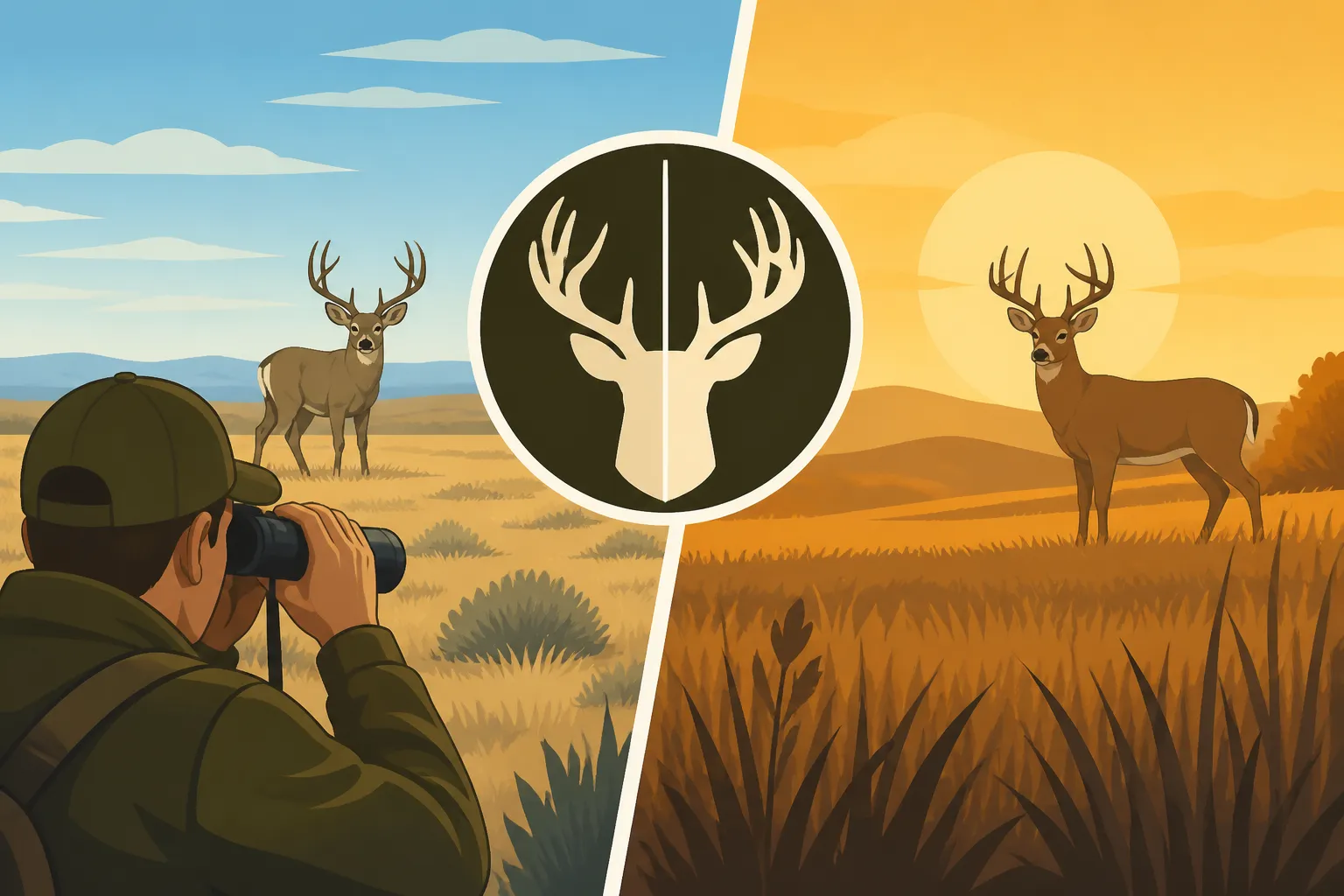
It's incredibly frustrating when you're glassing a distant ridge or a far-off field edge in western Kansas, and you spot a deer, but you just can't quite tell if it's a mule deer or a whitetail. This uncertainty can lead to missed opportunities or, worse, misidentification that impacts your hunting plans. This guide will help you understand the key visual differences, behavioral cues, and habitat indicators that can help you distinguish between these two magnificent deer species, even when they're a long way off.
The Tail: Your First and Often Best Clue
When trying to identify deer from afar in Kansas, especially where whitetails and mule deer share habitat, the tail is almost always your first and most reliable indicator. It might sound simple, but the differences are stark once you know what to look for.
Whitetail Tail Characteristics
Think of a whitetail's tail as a signal flag. When a whitetail is alarmed or running, that tail goes straight up, flashing pure white underneath. It's an unmistakable, broad, bushy white flag with a brown fringe on top. This is nature's warning system for the rest of the herd. They raise it high, often waving it back and forth as they bound away. Even when they're relaxed and feeding, you'll often see them twitching or flicking their tail, and it will be mostly brown on top with white underneath, but it still has that distinct, wide shape. In Kansas, where whitetails are king, seeing that white flag disappear into a creek bottom is a common sight.
Mule Deer Tail Characteristics
Mule deer, on the other hand, have a much more subtle tail. It's typically smaller, rope-like, and either all white with a black tip or a brownish-gray with a black tip. It doesn't "flag" in the same dramatic way a whitetail's does. When a mule deer is alarmed, its tail might perk up, but it usually stays relatively flat or droops slightly, never going straight up like a whitetail's. Imagine a short, narrow rope, often with a distinct black paint-dipped tip. This difference is so pronounced that even a quick glance through binoculars can often confirm the species if you get a clear view of the tail. When you're trying to figure out if you're looking at a whitetail or a mule deer in the wide-open expanse of Western Kansas Plains Hunting Country, this tail detail is paramount.
Body Shape and Size: Subtle but Telling
Beyond the tail, the overall body shape and size can offer additional clues, though these can be harder to discern at extreme distances or in varied terrain.
Whitetail Body Structure
Whitetails tend to have a more compact, sleek, and almost athletic build. Their necks often appear longer and more graceful. Their ears are generally proportionate to their head size, not overly large. While a big Kansas whitetail buck can be a formidable animal, their body mass is usually distributed in a way that makes them look lean and fast. They also have a more reddish-brown coat in warmer months, fading to a grayer brown in winter. The way they carry themselves, with their head usually lower to the ground while feeding or moving stealthily through cover, also contributes to their overall appearance. Knowing what makes these animals so robust in the state is key to understanding Why Kansas Grows Trophy Whitetails.
Mule Deer Body Structure
Mule deer often appear stockier and heavier-bodied than whitetails, especially in the hindquarters. Their most striking feature, apart from the tail, is their ears, which are noticeably larger, almost comically so, giving them their "mule" moniker. These large ears are constantly swiveling, picking up sounds across vast distances. Their coat tends to be a more consistent grayish-brown year-round, which helps them blend into the arid, rocky terrain of their preferred habitat. When you're trying to distinguish them from a distance, look for that more robust, almost blocky build and those prominent ears. If you're hunting in the specific units where you might find these animals, understanding Kansas Deer Units and What Each Holds can further aid your identification.
Antlers and Gait: Key Identifiers in Action
While not always visible or easily discernible, the way a deer's antlers grow and how it moves are critical differentiators, especially when you catch them on the move.
Whitetail Antler Configuration
Whitetail antlers typically grow from a single main beam that extends forward and then sweeps back. All the individual tines, or points, then grow upwards from this main beam. Imagine a long arc with points shooting off it like fingers. There might be small brow tines, but generally, all the major points come off that central beam. This characteristic growth pattern is what gives them their classic appearance. It's rare to see a true fork in the main beam itself. For hunters specifically targeting whitetails, understanding Kansas Whitetail Hunting Tactics Through the Rut often involves identifying these antler characteristics quickly.
Mule Deer Antler Configuration
Mule deer antlers are known for their distinctive bifurcated (forked) growth pattern. The main beams fork, and then those forks typically fork again. This creates a "double-forked" or "split" appearance, which is quite different from the whitetail's single-beam growth. While variations exist, this general pattern holds true for most mule deer. Even from a distance, if you can make out the general structure of the antlers, seeing that characteristic splitting rather than points coming off a single main beam can be a dead giveaway. You can delve deeper into this topic by reading about Mule Deer Antler Shape Differences.
Whitetail Gait
When a whitetail feels threatened and needs to cover ground quickly, it typically runs. This is a fluid, powerful run with an alternating leg motion, very much like a racehorse. They are incredibly agile, capable of weaving through thick timber or jumping over obstacles with ease. You'll see that characteristic white flag held high as they burst away. Their escape strategy often involves using cover to disappear.
Mule Deer Gait
Mule deer have a truly unique and unmistakable gait when alarmed: the "stot" or "pronk." Instead of running, they bounce. All four feet leave and hit the ground simultaneously, in a stiff-legged, bounding motion. This looks almost bouncy, like they're on springs. They can cover surprising amounts of ground this way and often use it to gain elevation or clear open spaces while keeping an eye on the threat. If you see a deer bouncing away across a prairie field with all four feet hitting at once, it's almost certainly a mule deer. This specific movement is one of the most reliable long-distance identifiers.
Habitat and Range Overlap: Where to Expect Each Species
Understanding the typical habitat preferences and geographical ranges of both species in Kansas can provide a strong initial clue, even before you spot an animal. While there are areas of overlap, knowing the general tendencies helps narrow down possibilities.
Whitetail Strongholds in Kansas
Whitetail deer are incredibly adaptable and can be found across all of Kansas, from the dense river bottoms and timbered draws of the east to the more scattered cover of the west. They thrive in areas with a mix of agricultural fields, brushy creek beds, and woodlots. In the western parts of the state, they often stick closely to riparian corridors – the trees and brush along rivers and creeks – where they find abundant food, water, and cover. If you're hunting near a substantial timber block or a winding river, odds are good you're primarily in whitetail country. This habitat preference means you'll often find them utilizing specific features like CRP Grass and Where Bucks Bed or even in thickets on private property.
Mule Deer Territory in Kansas
Mule deer are much more restricted in their range within Kansas, primarily found in the western third of the state. They prefer the more open, arid, and broken country – think rolling prairies, canyons, and scattered junipers. They are built for wide-open spaces and are often seen feeding in sparse grasslands or on the edges of agricultural fields that are adjacent to more rugged terrain. While you might occasionally find them utilizing small pockets of timber in western river systems, they generally avoid dense woods. Knowing the specific Mule Deer Range in Western Kansas is crucial for even having a chance to distinguish them.
Areas of Overlap
The key challenge in identification often arises in the western counties of Kansas, where the ranges of whitetails and mule deer overlap. Here, you might find both species using the same general landscape, though often with slight preferences for different microhabitats. For example, a mule deer might be out feeding in a wide-open wheat stubble field, while a whitetail might be clinging to the brushy ditch line running through it. This overlap can be a real head-scratcher. It's why relying on multiple cues – tail, body, gait, and antlers – becomes so important. Tools like a sophisticated mapping app, such as one from GoHunt, can provide detailed satellite imagery to help you identify potential Mule Deer and Whitetail Overlap areas even before you step foot in the field. This can help you anticipate which species you're more likely to encounter in certain parts of a property.
Combining Observations for Positive Identification
Making a positive identification from a distance isn't about relying on just one characteristic. It's about combining all the visual and behavioral clues you can gather. Think of yourself as a detective, piecing together evidence.
Step-by-Step Observation Strategy
- Initial Glimpse (Tail First): As soon as you spot a deer, try to locate its tail. Is it a wide, bushy flag? Or a narrow, rope-like tail with a black tip? Even if it's not flagging, the shape and color are often immediately noticeable.
- Body Scan (Ears and Build): If the tail isn't definitive, move your optics to the head and body. How large are the ears in proportion to the head? Does the deer appear sleek and compact, or stocky and heavy-hipped?
- Antler Assessment (If a Buck): If it's a buck, pay close attention to the antler growth. Do the points come off a single main beam, or does the main beam fork and then fork again? This takes a clear view, but it's often definitive.
- Behavioral Cues (Gait and Movement): Watch how the deer moves, especially if it's startled or walking away. Does it run with a fluid stride, or does it "pronk" with a stiff-legged bounce? How does it react to perceived threats? A mule deer might pause on a distant rise to assess, while a whitetail might quickly seek cover.
- Habitat Context: Consider the immediate surroundings. Is it dense timber and creek bottoms, or open prairie with scattered draws? While not foolproof in overlap zones, it adds to the overall picture. Before your hunt, take some time to do some E-Scouting Kansas Farm Country From Home using satellite maps, paying attention to features like Hunting Terrain Funnels in Flat Country which might favor one species over another.
A Comparative Look
Here's a quick comparison table to help solidify these distinctions:
| Feature | Whitetail Deer | Mule Deer |
|---|---|---|
| Tail | Wide, bushy, brown on top, white underside. Flags high. | Narrow, rope-like, all white or brownish-gray with black tip. Doesn't "flag." |
| Ears | Proportionate to head size, smaller | Very large, "mule-like" |
| Body Build | Sleek, compact, athletic. Neck often appears longer. | Stockier, heavier-bodied, especially hindquarters. |
| Antlers | Points branch off a single main beam. | Typically bifurcated (forked), main beams fork, then fork again. |
| Gait (Alarmed) | Runs with fluid, alternating leg motion, flags tail. | "Stots" or "pronks" – all four feet hit the ground simultaneously. |
| Coat Color | Reddish-brown (summer), grayish-brown (winter) | More consistent grayish-brown year-round |
| Habitat | Rivers, creeks, timber, brush, ag fields (statewide) | Open plains, canyons, broken country (western Kansas) |
Even with tools like a spotting scope, making a solid judgment at hundreds of yards takes practice. The more time you spend observing deer, the better you'll become at picking up on these nuanced differences. When you're spending hours glassing, perhaps trying to pinpoint a specific deer you've been monitoring using your GoHunt intel, it's these minute details that can confirm what you're looking at. Don't be afraid to take your time and observe, using all the clues available to you.
Disclaimer
This article is for general informational purposes only and does not constitute professional advice. Laws, prices and regulations vary by location and change over time. Consult a qualified professional for guidance on your specific situation.