Reading a Kansas Wind for Waterfowl
Hunting waterfowl in Kansas can be one of the most exhilarating experiences, but it's also incredibly humbling when you watch a perfect flock of mallards or a string of geese commit to your spread, only to flare at the last second. Often, the culprit isn't your calling or your decoys, but a misjudgment of the wind. Understanding how wind dictates bird movement is absolutely critical to success, and this guide is here to help you master reading the Kansas wind for your next waterfowl hunt.
The Unseen Hand: How Wind Shapes Waterfowl Movement
The wind is far more than just a nuisance on a cold morning; it's a fundamental force that dictates almost every aspect of a waterfowl's existence, from how they fly to where they choose to feed and rest. Ignoring its impact is a surefire way to send ducks and geese flaring out of range.
Flight Patterns and Landing Zones
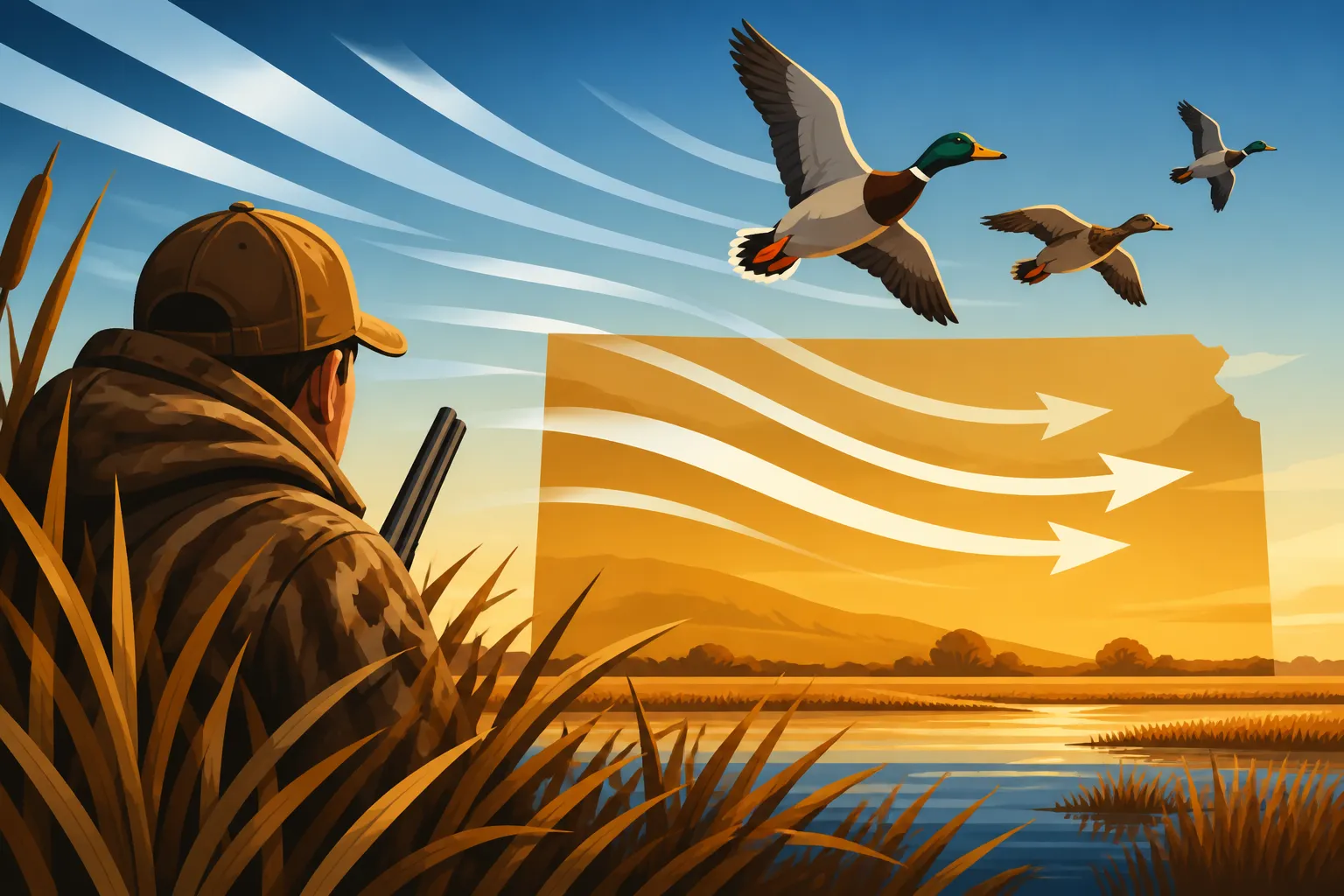
Waterfowl are master aviators, and they use the wind to their absolute advantage. Think of a commercial airliner needing to land or take off into the wind for optimal lift and control. Ducks and geese operate on the same principle. They prefer to land directly into the wind, using it as a natural brake to slow their descent and maintain stability. This is why you'll rarely see a bird land with a tailwind; it's dangerous and clumsy for them.
When birds are approaching your spread, they're looking for a clear, safe landing zone, and that zone will almost always be directly into the wind. If your decoy spread isn't set up to provide a natural, wind-aligned landing strip, or if your blind is positioned where the wind is blowing your scent directly at their approach path, you're stacking the odds against yourself. They'll circle, they'll look, and if something feels off, they'll be gone. This behavior is critical whether you're working a small playa lake after rain or setting up for Decoying Ducks on a Kansas Reservoir. Every bird, from a pintail to a gadwall, is hardwired to use the wind in this predictable way.
Feeding and Roosting Influences
Beyond just flying, wind heavily influences where ducks and geese decide to feed and roost. In strong, blustery conditions, birds often seek out sheltered areas to conserve energy and avoid being tossed around. This could mean a protected side of a large reservoir, a deep-cut creek bottom, or the lee side of a timbered shelterbelt in farm country. High winds can make open fields feel less secure for feeding geese, pushing them into more protected stubble fields or even forcing them to stay on the water.
Conversely, a light breeze can be beneficial, creating natural ripples on the water that make decoys appear more lifelike. It also helps disperse scent, which can be a double-edged sword: it carries your scent further but can also make it harder for birds to pinpoint a threat if you're well-hidden. When thinking about Field Hunting Geese in Stubble, understanding how wind dictates where geese feel safe to feed is paramount. They'll often try to feed with the wind at their backs, allowing them to see potential predators approaching from upwind, giving them time to react and take flight into the wind.
Thermal Dynamics and Migration
While local wind patterns are crucial for daily hunting, understanding broader thermal dynamics and migratory winds can help you predict larger movements. Cold fronts often bring strong north winds, which are a major trigger for ducks and geese to push south. When a strong northern high-pressure system settles in over the Central Flyway, those birds will be on the move, and knowing their Duck and Goose Migration Timing can help you plan your hunts.
These larger wind patterns aren't just about direction; they're about temperature changes, barometric pressure, and cloud cover, all of which influence a bird's decision to travel. A warm front might slow migration, but a strong south wind behind it could bring local birds back north for a short period. Staying attuned to these larger weather systems, and how they translate into local wind conditions, gives you a significant edge in predicting when new birds might arrive or when current birds might shift their patterns.
Decoding the Forecast: Reading and Predicting Kansas Winds
Successfully hunting waterfowl in Kansas often boils down to accurately reading the wind, not just in the morning of the hunt, but days in advance. It's a blend of high-tech forecasting and old-school field observation.
Local Weather Reports
In today's world, we have an incredible array of tools at our fingertips to predict weather, including wind. Standard weather apps on your phone are a start, but for waterfowl hunting, you need more granular data. Apps like GoHunt, which often cater to big game hunters but have excellent weather overlays, can provide detailed wind direction and speed forecasts, sometimes hourly, and even account for geographical features. These tools are far more precise than a general forecast.
When checking reports, pay close attention to wind gusts, not just sustained winds. A sustained 10 mph wind is manageable, but gusts up to 25 mph can make birds skittish and unpredictable. Also, look for shifts in wind direction throughout the day. A seemingly perfect north wind at dawn might swing to the west by mid-morning, completely changing your ideal setup. This is particularly important on Kansas Walk-In Hunting Access Explained properties where you might have limited setup options and need to be mobile. A good forecast helps you plan your access route and Layout Blinds in Cut Fields or a boat blind position.
Visual Cues on the Landscape
No matter how good your weather app is, nothing beats confirming wind conditions on site. As you approach your hunting spot, observe visual cues:
- Flags and Banners: Look at local flagpoles, banners, or even clotheslines at distant farmhouses. These give you a macro indication.
- Trees and Vegetation: The way tree branches sway, or tall grass bends, can tell you a lot about wind direction and strength. Even subtle rustling in corn stubble or CRP grass can provide clues.
- Water Ripples: On open water, ripples and whitecaps clearly show wind direction. The choppier the water, the stronger the wind.
- Smoke and Dust: If there's any smoke from a distant bonfire or dust being kicked up by a vehicle, watch its direction.
- Milkweed or String: Many hunters carry a small bag of milkweed fluff or a spool of lightweight thread. Toss a bit into the air, and it will drift with even the slightest breeze, giving you a very accurate, localized wind direction at your exact position. This is invaluable when making final adjustments to Decoy Placement and Wind Direction.
The Importance of Wind Direction Consistency
A steady, consistent wind is a waterfowl hunter's best friend. It allows birds to approach predictably, giving you clear shooting lanes. However, Kansas terrain isn't always flat and open. River bottoms, timbered draws, and even large shelterbelts can create swirling winds or micro-eddies that can fool both you and the birds.
In areas with varied topography, like Reading a Kansas Creek Bottom for Deer Sign (which also applies to waterfowl near water sources), the wind on the ground might be completely different from the wind 50 feet up. Birds will often react to the wind at their flight level, which might be different from what you feel in your blind. Pay attention to how the birds are actually flying and adjusting their wings, even if it contradicts your ground-level wind checker. If you notice birds struggling to commit or consistently flaring from a certain direction, it might be a subtle wind shift or swirl you haven't accounted for.
Strategizing Your Setup: Adapting to Wind for Success
Once you understand how wind works and how to read it, the real art is in adapting your setup to maximize your chances. Every aspect of your spread, from decoy placement to blind positioning, must be wind-conscious.
Decoy Spreads and Wind
The cardinal rule for decoy spreads is that the birds will land into the wind. Therefore, your "kill hole" – the open area where you want birds to land – must be situated directly upwind from your blind.
- Open Water (Ducks): On a Kansas Reservoir Hunting Access spot, set your decoys so that they naturally drift and face into the wind. Create a U, J, or V-shaped spread with the opening facing directly into the wind, towards where you expect the birds to approach. Your blind should be downwind of this opening. The birds will fly over your blind, see the decoys, swing out, turn into the wind, and pitch into your kill hole, offering broadside shots.
- Field Spreads (Geese): When Field Hunting Geese in Stubble, the concept is similar. Place your Decoying a Kansas Whitetail Buck (but in this case, a goose decoy spread) with a landing zone upwind of your layout blinds. Geese are often more sensitive to blind placement. You want them focused on the landing strip, not on a line of unnatural bumps in the field. The wind will also create natural motion in full-body decoys, which is a huge advantage. Ensure your decoys are spaced appropriately for the wind conditions – tighter in light winds, a bit more spread out in heavy winds to avoid tangles and create a more natural look.
The wind also gives your decoys life. Ripples on the water add movement to floating decoys, and a slight breeze can make full-body field decoys sway, mimicking feeding birds. Incorporate motion decoys, like a Mojo duck, upwind from your blind to attract attention and give the impression of active birds struggling against the breeze.
Blind Placement and Wind
Your blind placement is intrinsically linked to the wind and your decoy spread. The primary goals are concealment and scent control.
- Concealment: Always try to position your Ground Blinds in Open Country or layout blinds so that the sun is at your back, if possible, especially during morning hunts. More importantly, your blind needs to blend seamlessly with the surroundings, regardless of wind. If the wind is blowing directly at your blind from the primary approach direction, birds might pick you out more easily, or your scent will carry straight to them.
- Scent Control: While scent might be less of a concern for waterfowl than for deer, it's still a factor, especially for wary geese. Ideally, your blind should be downwind of your kill hole, so any scent you generate is carried away from the birds as they approach. If the wind is swirling or unpredictable, choose a blind location that offers maximum concealment and minimizes the chance of your scent blowing into the flight path. Think about natural cover like cattails, brush, or standing crops that can help break up your outline and hide your Layout Blinds in Cut Fields.
Consider specific scenarios. If you're Hunting Kansas Reservoirs and Playas, a boat blind might need to be anchored to account for wind, ensuring it doesn't swing and expose you. On open Cimarron National Grassland Hunting areas, lay-down blinds are often brushed in meticulously, with the wind dictating the angle of approach into the setup.
Access Routes and Wind
This is an often-overlooked aspect of wind strategy. Bumping birds on your way into a spot can ruin a hunt before it even begins. Your access route needs to take the wind into account to avoid sending birds airborne downwind of your desired setup.
- Upwind Approach: Whenever possible, approach your hunting location from downwind. This means the wind will be blowing from the birds towards you as you walk in. If you accidentally spook any birds, they'll typically fly into the wind to gain altitude and speed, carrying them away from your hunting area and not directly over your decoys or towards your planned blind location.
- Minimizing Disturbance: On
Kansas Public Land Deer Huntingtracts that also hold waterfowl, being mindful of your approach is doubly important. Use terrain features like creek banks, tall grass, or timbered edges to hide your approach. CheckGoHuntor other mapping apps that show terrain elevation to plan the quietest, most concealed route. This is especially vital on Hunting Pressure Patterns on Kansas Public Land, where birds are already skittish and any disturbance will send them packing. Walking in before legal light also helps, using the darkness to mask your approach before the wind really starts to play a factor in their awareness.
Advanced Wind Tools and Real-Time Adjustments
Even with the best planning, the wind in Kansas can be notoriously fickle. Having advanced tools and the ability to make real-time adjustments is what separates consistently successful hunters from those who just get lucky.
Digital Mapping and Wind Layers
Modern digital mapping applications have revolutionized how hunters prepare for a hunt. Services like GoHunt aren't just for big game anymore; their ability to overlay detailed weather data, including current and forecast wind direction and speed, onto high-resolution satellite imagery is invaluable for waterfowl hunters.
You can virtually scout a Kansas State Wildlife Areas tract or a remote Playa Lake Hunting After Rain spot from home, seeing how the wind will interact with the topography. You can identify potential wind breaks, ideal approach routes, and optimal blind locations long before you ever step foot in the field. This capability allows you to consider multiple wind scenarios for a single location, giving you a Plan A, B, and C for different conditions. For instance, if you're eyeing a specific River Oxbows and Deer Movement that holds ducks, you can see how a north wind versus a south wind would change their approach and your setup. This kind of detailed planning is a game-changer for nonresident hunters or those exploring Hunting Kansas Walk-In Land Without Burning It Out.
On-Site Wind Checks
No matter how much you pre-scout or how good your app is, always perform on-site wind checks. Things change. A small pocket of timber or a change in crop height can create microclimates and localized wind patterns not reflected in a general forecast.
Carry a small, lightweight wind checker. This could be a squeeze bottle of unscented powder, a piece of yarn, or a small bag of milkweed. Use it constantly as you set up. If you're building a makeshift blind, check the wind after every major change. If you're repositioning decoys, re-check. Even subtle shifts can alter how birds commit. Remember, birds are operating on instinct, and even a slight quartering wind that feels insignificant to you can be enough for them to adjust their approach, potentially putting them out of your ideal shot zone. Making these real-time adjustments is part of Decoying a Kansas Whitetail Buck (substitute 'duck' or 'goose') success.
Learning from Experience
Ultimately, the best wind reader isn't the one with the fanciest gadget, but the one who spends the most time in the field, observing and learning. Every hunt is a lesson. Pay attention to:
- How birds react: When a flock flares, try to identify why. Was it a wind swirl? Your exposed face? An un-brushed blind?
- Successful setups: When you have a banner day, analyze what went right. Was the wind consistent? Did the birds approach exactly where you expected?
- Varying conditions: Hunt in different wind speeds and directions. A light breeze requires a different setup than a howling gale.
- Species-specific behavior: Geese often react differently to wind than mallards. Learn these nuances.
There's no substitute for hundreds of hours spent out in the Kansas elements, watching how the natural world interacts with the wind and how the birds respond. This accumulated wisdom, combined with modern tools, is your most powerful asset for Waterfowl Hunting Kansas Reservoirs and Playas or any other waterfowl pursuit.
| Wind Direction (Relative to Blind) | Decoy Spread Type | Blind Placement Strategy | Bird Approach Pattern |
|---|---|---|---|
| Directly Behind Blind | J or U-Hook | Downwind of Kill Hole, maximum concealment | Birds swing wide, turn into wind, land directly in front of blind |
| Quartering from Left/Right | J or U-Hook | Downwind, angled slightly to obscure approach path | Birds approach from a slight angle, land into the wind slightly off-center |
| Directly in Front of Blind | Straight Line | Directly into wind, highly challenging to conceal | Birds fly over decoys, turn around to face blind; high risk of flaring |
| Crosswind (Parallel to Blind) | Diagonal Line | On downwind side of decoys, using natural cover for break-up | Birds approach along wind line, turn sharply into wind for landing |
| Swirling/Variable | Clustered | Adaptable, mobile blind; focus on natural cover and quick shifts | Unpredictable; birds may try multiple approaches, high chance of flaring |
Disclaimer
Hunting is an inherently dangerous activity. Always prioritize safety, adhere to all Kansas hunting regulations, and be aware of your surroundings. The information provided here is for educational purposes only and should not replace professional guidance or personal judgment.