Decoying a Kansas Whitetail Buck
There’s nothing quite like the sight of a mature Kansas whitetail buck, with his neck swollen and his guard down, marching straight into your setup. But anyone who’s spent time in a treestand or ground blind knows the frustration when a buck hangs up, skirts your position, or simply spooks. Decoying can be a game-changer, drawing in wary deer that would otherwise give you the slip. This guide will dive deep into the art and science of successfully decoying a Kansas whitetail buck, helping you understand their behavior, choose the right setup, and execute your plan flawlessly for those close-range encounters.
Understanding the Whitetail's Response to Decoys
Before you even think about unpacking that plastic deer, it’s crucial to wrap your head around why a whitetail buck reacts to a decoy and what factors influence his approach. It's not just about putting a fake deer out there; it's about understanding the subtle cues and instincts you're trying to exploit.
Why Decoys Work and Why They Don't
Decoys work because they tap into a deer's primal instincts: curiosity, dominance, and the drive to breed. During the rut, a buck is constantly looking for does to breed and other bucks to challenge or avoid. A well-placed decoy can simulate either scenario, triggering an immediate, often aggressive, response. The sight of another deer in their territory, especially a potential rival or a receptive doe, can override a buck's natural caution. This is particularly true during the peak of the rut in Kansas, when bucks are more susceptible to visual stimuli.
However, decoys don't always work, and sometimes they can even deter deer. The main reasons for failure usually revolve around realism and wind. If a decoy looks unnatural, is positioned incorrectly, or if a deer smells human scent in the area, it will likely be ignored or cause the deer to spook. Bucks are smart, and while rut-crazed, they're not dumb. They'll circle downwind almost every time to scent-check the "intruder," and if they catch your human odor, the game is over. Also, if deer in your specific hunting area have been pressured or have seen a lot of decoys, they might become "decoy-shy," making them much harder to fool.
Reading Deer Body Language to a Decoy
Observing a buck's body language as he approaches a decoy is critical for knowing when to shoot, when to call, or when to hold tight. The initial reaction will tell you a lot. A buck might pause, stare intently, and then slowly start to approach, often stiff-legged with his hackles raised, indicating aggression. He might circle widely downwind, cautiously trying to catch a scent before committing. This is where a detailed mapping tool like GoHunt can be invaluable for pre-scouting wind currents and potential approach routes, helping you anticipate where a buck might try to circle.
If he drops his head, lays his ears back, and walks directly at the decoy, he’s likely challenging it. This is often the ideal scenario, as he's committed and presenting a good shot. Sometimes, a buck might exhibit a "stomp and blow" reaction, signifying alarm and curiosity mixed with suspicion. This often means he's seen something he doesn't like or has caught a whiff of something off. If he turns and walks away without looking back, you've likely spooked him, either by scent, movement, or an unnatural setup. Understanding these cues in real-time allows you to make quick decisions, maximizing your chances of success. You'll often see these behaviors during the period described in When the Kansas Rut Peaks.
Types of Decoys and When to Use Them
Not all decoys are created equal, and choosing the right one for your specific situation in Kansas can make all the difference between an exciting encounter and an empty sit. Each type of decoy elicits a different response, and knowing when to deploy each is key.
Buck Decoys for Aggression and Dominance
Buck decoys are probably the most commonly used, and for good reason: they directly challenge a dominant buck's territorial nature. A life-sized buck decoy, especially one with a decent rack, can be incredibly effective during the pre-rut and early to mid-rut when bucks are establishing dominance and actively seeking out rivals. The goal here is to make a real buck believe there's an intruder in his area, infringing on his breeding rights.
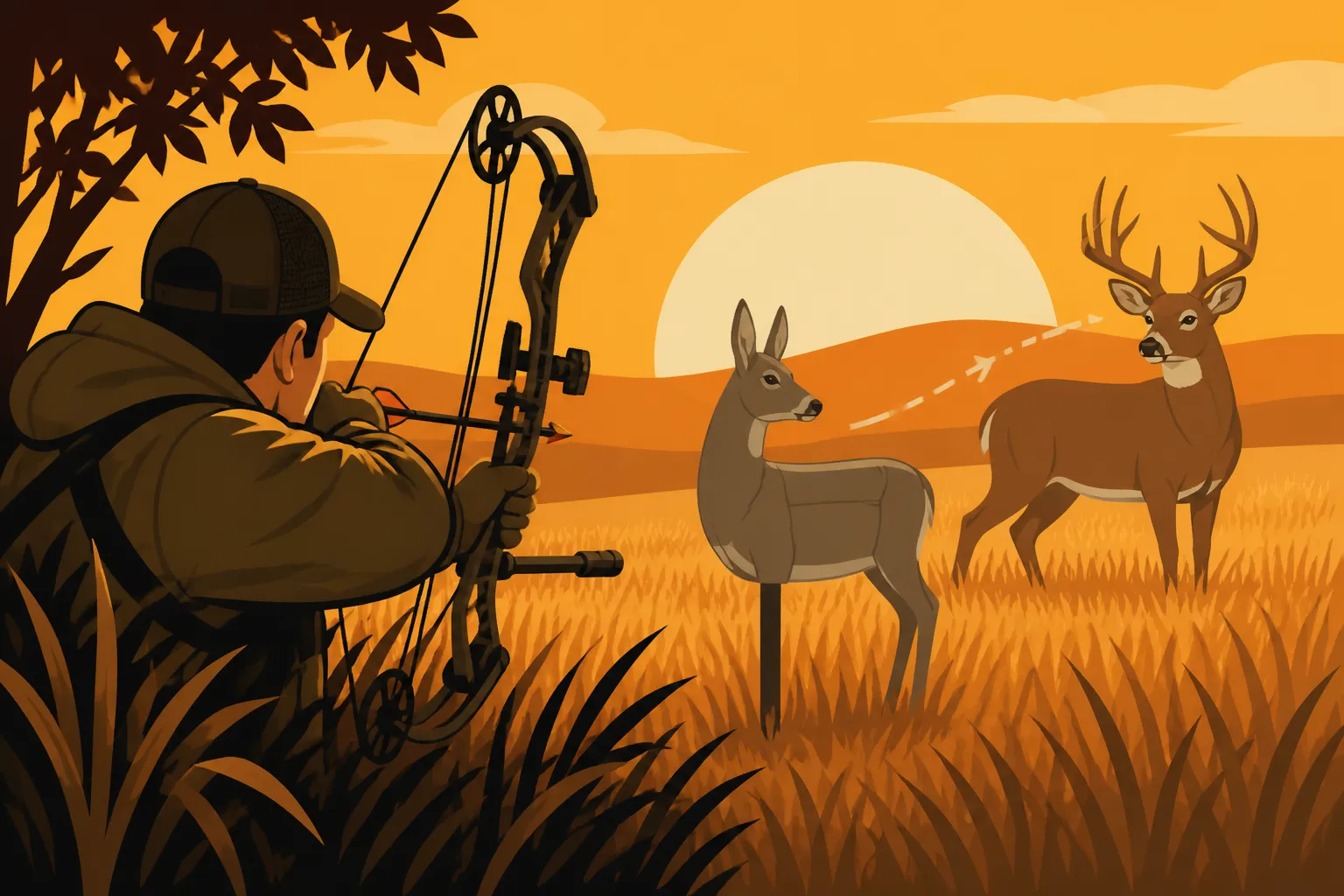
When using a buck decoy, consider portraying a younger, subordinate buck. A mature Kansas buck is less likely to shy away from a smaller challenger. If you put out a massive, intimidating decoy, a wary old monarch might just skirt it or keep his distance, waiting for the "intruder" to leave. However, if he sees a smaller buck, his instinct to dominate and chase off the competition takes over. Position your buck decoy facing away or slightly quartering away from your stand, as if it's either leaving or unaware of the approaching buck. This often encourages the real buck to come in head-on or broadside to confront it, presenting a perfect shot opportunity. We cover similar strategies in Rattling and Grunting During the Kansas Rut.
Doe Decoys for Curiosity and Breeding
Doe decoys, on the other hand, appeal to a buck's desire to breed. They are incredibly effective when bucks are actively seeking receptive does, which can be throughout the entire rut cycle, but especially when does are coming into estrus. A doe decoy signals an opportunity for a buck to breed, drawing him in with less aggression and more curiosity.
The beauty of a doe decoy is that it can work on bucks of all sizes, from young spikes to seasoned giants. They don't typically trigger the same aggressive, hackle-raising challenge that a buck decoy does, often resulting in a more relaxed, but still committed, approach. Position your doe decoy in a feeding or breeding stance, facing towards your stand or slightly angled away. A receptive doe decoy, often with its tail raised, can be a potent attractant. Many hunters have found success in Kansas by pairing a doe decoy with calling sequences, making it appear as if a doe is actively seeking a mate. You might find more detail on choosing between these options in Doe Decoys Versus Buck Decoys.
Fawn Decoys and Mixed Setups
Fawn decoys are a less common but sometimes highly effective option, especially when used in conjunction with a doe decoy. The presence of a fawn can signal a relaxed, comfortable environment, drawing in does and, by extension, the bucks that are trailing them. A doe with a fawn is often viewed as approachable and non-threatening. When you combine a fawn decoy with a doe, it paints a picture of a family group, which can calm nervous deer and encourage them to investigate more closely.
A powerful mixed setup for a mature Kansas buck during the rut involves a doe decoy, potentially with a fawn, and a smaller, subordinate buck decoy positioned a short distance away. This setup tells a story: a smaller buck is attempting to breed a doe, and a dominant buck will often feel compelled to interrupt this. He sees a breeding opportunity and a rival to chase off. The key here is the spacing; place the buck decoy a little further from the doe than you might think, allowing the approaching dominant buck to target the subordinate buck without immediately perceiving your stand location. Using mapping software like GoHunt can help visualize these distances and angles before you even step foot in the field.
| Decoy Type | Primary Appeal | Best Season/Timing | Typical Reaction Elicited | Ideal Positioning |
|---|---|---|---|---|
| Buck Decoy | Dominance, Rivalry | Pre-Rut, Early/Mid-Rut | Aggression, Challenge | Quartering away, subordinate stance |
| Doe Decoy | Breeding, Curiosity | Full Rut, Late Pre-Rut | Curiosity, Investigation | Feeding, receptive stance |
| Fawn Decoy | Safety, Curiosity | Early Season, with doe | Relaxation, Investigation | Near a doe decoy |
| Mixed (Doe/Buck) | Dominance, Breeding | Peak Rut | Aggression, Breeding | Subordinate buck near receptive doe |
Strategic Decoy Placement for Kansas Conditions
The success of your decoy setup hinges almost entirely on its placement. In the often-open and flat landscapes of Kansas, where deer can see for long distances, every detail matters. Ignoring basic principles of wind, visibility, and shot angles will lead to frustration more often than success.
Wind Direction and Scent Control
This is arguably the most critical factor in decoying any whitetail, and especially in open Kansas country. Bucks will almost always try to approach a decoy from downwind to scent-check it. Your job is to predict this approach and set up your decoy and stand accordingly. This means ensuring that the prevailing wind carries your scent away from where you expect the buck to approach and also prevents him from getting directly downwind of the decoy itself if you've handled it excessively.
Always place your decoy so that an approaching buck, circling downwind, will pass within bow or gun range of your stand before he hits your scent cone. If you're using a buck decoy, position it so the real buck will present a broadside or quartering-away shot as he challenges the fake. If it's a doe, aim for a broadside shot as he approaches to investigate. This careful planning around wind and expected deer movement is paramount. Without it, you’re just setting up for failure. Tools like GoHunt's wind forecasting layers are incredibly useful for planning your approach and setup for specific wind directions. Check out Decoy Placement and Wind Direction for more in-depth strategies.
Open Fields and Edge Cover Considerations
Kansas is known for its expansive crop fields and vast grasslands. This presents unique challenges and opportunities for decoying. In large, open fields, deer can spot a decoy from hundreds of yards away. This can be a huge advantage, as it draws them in from a distance. However, it also means your setup needs to be highly realistic, and your movements to and from the stand must be absolutely minimal. Don't underestimate a deer's eyesight in open country.
When setting up in an open field, place your decoy within comfortable shooting range, ideally 20-30 yards for bowhunting, and 50-100 yards for firearms. Consider placing it near a natural travel corridor, such as a field edge, a fence line crossing, or a finger of timber extending into the field. These are the routes bucks often use, and a decoy placed along one of these pathways makes it seem even more natural. If possible, use edge cover to break up your silhouette and provide a natural backdrop for your stand. Sometimes, a well-brushed ground blind can be more effective than a treestand in these open environments to minimize detection. For more on maximizing opportunities in these terrains, consider reading Hunting Terrain Funnels in Flat Country.
Decoy Angles and Shot Opportunity
The angle of your decoy relative to your stand is crucial for presenting the best shot opportunity. As mentioned, bucks often approach a buck decoy head-on or quartering to challenge it. If your decoy is facing directly at your stand, the approaching buck will likely be facing you, offering a less-than-ideal frontal shot. Instead, position your buck decoy quartering away slightly, or even completely away from your stand. This encourages the real buck to circle, present a broadside, or quartering-away shot as he confronts the decoy.
For a doe decoy, you want to present a welcoming, available posture. A doe decoy standing broadside or slightly quartering toward your stand can encourage a buck to walk right into a perfect broadside shot as he approaches her. Avoid having the decoy directly facing your stand, as this can make an approaching buck focus on the decoy's face and potentially notice your stand or movement. Think about the "story" your decoy is telling and how the real buck will want to insert himself into that narrative to give you the best ethical shot.
Timing Your Decoy Setups for Peak Effectiveness
Just as important as how you place your decoy is when you decide to use it. Whitetail behavior changes dramatically throughout the hunting seasons, especially in Kansas, and your decoying strategy needs to adapt accordingly. Deploying a decoy at the wrong time can be as ineffective as leaving it in the truck.
The Pre-Rut and Early Rut Window
The pre-rut, typically in late October in Kansas, is a fantastic time to start experimenting with decoys. Bucks are becoming more active, scrapes and rubs are popping up everywhere, and they're starting to feel the urge to breed. They're still somewhat cautious but are highly responsive to visual cues of other deer. During this period, a buck decoy can work well, triggering early dominance displays. Bucks are establishing their pecking order and are more likely to confront a perceived rival.
A doe decoy can also be effective during the early rut as the first does start coming into estrus. Bucks are cruising, scent-checking, and actively looking for hot does. A doe decoy, especially one paired with some quiet estrus bleats or grunts, can be irresistible. This early window is often characterized by bucks covering a lot of ground, and a visible decoy can stop them in their tracks and pull them in. For more on this critical period, consider our guide on Hunting the Kansas Pre-Rut in Late October.
Peak Rut Aggression and Timing
When the Kansas rut truly peaks, usually around early to mid-November, buck behavior shifts into overdrive. This is arguably the absolute best time for decoying. Bucks are at their most aggressive, territorial, and single-minded about breeding. They are covering vast distances, often with their noses to the ground, and their caution can be significantly reduced, especially if a receptive doe is involved.
During the peak rut, both buck and doe decoys can be incredibly potent. A buck decoy can draw in a rival that might otherwise ignore calls. A doe decoy can pull a cruising buck off a trail from a long distance. Mixed setups, where a subordinate buck is "harassing" a doe, can incite a dominant buck into a furious charge. This is the window when bucks are most likely to drop their guard and commit fully to a decoy. Remember, however, that while their aggression is high, their sense of smell is still 100%. Always prioritize scent control. If you're looking for more general strategies during this time, check out Kansas Whitetail Hunting Tactics Through the Rut.
Late Season Scenarios
As the rut winds down in late November and into December, deer behavior changes again. Bucks are often worn out, have likely bred several does, and their aggression levels drop significantly. They become more focused on recovering lost weight and finding reliable food sources. Decoying during the late season can be much tougher, but it's not entirely out of the question, especially if there are still some unbred does or a secondary rut occurring.
During the late season, a doe decoy is generally more effective than a buck decoy. A tired buck might still respond to the visual of a lone doe, especially if she appears to be receptive. However, his approach will likely be much more cautious and slow. You'll need to be extremely patient and mindful of cold weather, which can make decoys appear stiff or unnatural if not handled properly. Focus on setting up near known late-season food sources, like standing corn or milo fields, where deer are actively feeding. Often, a decoy at this time is more about piquing curiosity than triggering aggression. A related resource would be Late-Season Food Source Hunting.
Enhancing Your Decoy Setup with Scents and Calls
A visual decoy is a powerful tool, but it becomes exponentially more effective when you engage a deer's other senses. Adding scents and calls to your decoy setup creates a multi-sensory illusion that can be incredibly convincing, drawing in even the wariest of Kansas whitetails.
Complementary Scents and Lures
Scent is a deer's primary defense mechanism, and it's also a powerful communication tool. Using appropriate deer scents around your decoy can dramatically boost its realism. For a doe decoy, a quality estrus doe urine can make the fake appear irresistible to a cruising buck. Apply it to the decoy itself, especially around the tail area, and also to nearby scrapes or scent wicks placed downwind of the decoy. This creates a scent trail that a buck can follow directly to the visual of the decoy.
When using a buck decoy, a dominant buck urine or mock scrape scent can signal that a rival buck has been in the area. This can infuriate a dominant buck and pull him in for a confrontation. Be strategic with your scent application; a little goes a long way. Too much can be overpowering and unnatural, potentially making deer suspicious. Always handle scents with gloves to avoid contaminating them with human odor. Also, be aware of Kansas regulations regarding the use of natural urines and ensure any products you use are CWD-safe or synthetic.
Grunts and Rattling to Draw Attention
Calls are the final piece of the puzzle, bringing sound into the visual and olfactory illusion. Grunt tubes and rattling antlers can be used to grab a buck's attention from a distance and make him investigate the decoy. If you spot a buck cruising far off, a series of grunts can make him pause and look your way. Once he sees the decoy, he might commit.
For a buck decoy, aggressive rattling sequences can simulate a fight, drawing in curious or dominant bucks eager to see who's sparring. Follow up rattling with grunts or snort-wheezes to make the scene even more realistic. For a doe decoy, soft estrus bleats or tending grunts can make her seem receptive and actively calling for a mate. Remember to call sparingly and realistically. Overcalling can spook deer, especially if they don't see the source of the sound. The combination of sight, smell, and sound creates an irresistible scenario that can pull a big Kansas buck right into your lap. For more on calling strategies, refer to Grunt Calls That Work in the Pre-Rut and Snort-Wheeze on a Cruising Buck.
Common Decoy Mistakes and How to Avoid Them
Decoying can be incredibly effective, but it's also fraught with potential pitfalls. Many hunters get excited and rush into a setup, only to wonder why it failed. Avoiding these common mistakes can significantly increase your odds of success in Kansas.
Forgetting the Wind
This cannot be stressed enough: wind is king. The single biggest reason decoy setups fail is because the hunter forgets or misjudges the wind. A buck will almost always try to circle downwind to scent-check anything new in his territory, whether it's a real deer, a rival, or a decoy. If he catches your human scent during this maneuver, he's gone, often for good.
To avoid this, use a reliable mapping application like GoHunt's wind prediction feature to plan your approach and stand location. Always set up so that the buck must pass within shooting range before getting directly downwind of your stand. This means positioning your decoy upwind of your stand. For instance, if the wind is blowing from the north, your stand should be to the north, your decoy to the south, allowing a buck circling downwind (to the south) to come into range before hitting your scent. Pay attention to thermals, especially in the mornings and evenings, which can cause unpredictable shifts in wind direction.
Overusing or Misusing Decoys
There's a time and a place for decoys, and overusing them or using them inappropriately can educate deer and make them wary. Deploying a decoy every single hunt, regardless of conditions or time of season, can lead to diminishing returns. If deer in your area constantly see stationary, unresponsive decoys, they may eventually learn to ignore them or become suspicious.
Misusing decoys includes using the wrong type for the season (e.g., a dominant buck decoy in the late season when bucks are focused on food), or placing it in an unnatural setting (e.g., a buck decoy in the middle of a wide-open field with no cover, looking out of place). Always strive for realism. Ensure your decoy is clean, doesn't smell of plastic, and is posed naturally. If a decoy is swaying wildly in high winds or is covered in spiderwebs, it looks fake. Periodically check its appearance and adjust as needed. Consider reading about Using a Decoy in Open Fields for specific advice.
Poor Access and Exit
One of the most overlooked aspects of decoying, especially in open country like much of Kansas, is your access and exit routes to and from your stand. If you spook deer on your way in or out, even the most perfect decoy setup won't matter. Deer will associate that area with danger. Plan your routes carefully to minimize noise and scent disturbance.
Use natural cover, like creek bottoms, hedgerows, or timber strips, to conceal your approach. Avoid walking directly through known bedding areas or major travel corridors. If you must cross an open field, do so under the cover of darkness or during a heavy rain when visibility and scent are minimized. With tools like GoHunt, you can map out low-impact access routes that keep you hidden and your scent away from where you expect deer to be. This is particularly important on public lands where other hunters' movements can also impact deer behavior, which is detailed in Hunting Pressure Patterns on Kansas Public Land. A stealthy entrance and exit ensures that the deer you're trying to fool will actually stick around long enough to see your decoy.
Disclaimer
Hunting is an inherently dangerous activity. The information provided in this guide is for informational purposes only and is not a substitute for professional advice, proper training, or adherence to all local, state, and federal hunting laws and regulations. Always prioritize safety, respect wildlife, and obtain all necessary licenses and permits before hunting.