Coyote Calling in Open Kansas Country
There’s nothing quite like the piercing howl of a coyote cutting through the crisp Kansas air, and while that sound can send shivers down your spine, it also signals an opportunity for a challenging and rewarding hunt. Calling coyotes in the vast, open expanses of Kansas can feel like an impossible task, with seemingly nowhere to hide and coyotes that appear out of thin air. This guide will walk you through the nuances of successful coyote calling in these expansive landscapes, helping you understand their behavior, choose the right gear, master effective calling techniques, and ultimately, bring those wily song dogs into range.
Understanding Coyote Behavior in Wide-Open Kansas Spaces
Hunting coyotes in Kansas is a different ballgame than in brushy timber or thick mountains. The open landscape shapes their every move, from how they hunt to how they react to perceived threats. To consistently call them in, you first need to get inside their heads and understand their world.
The Impact of Flat Terrain on Coyote Movement
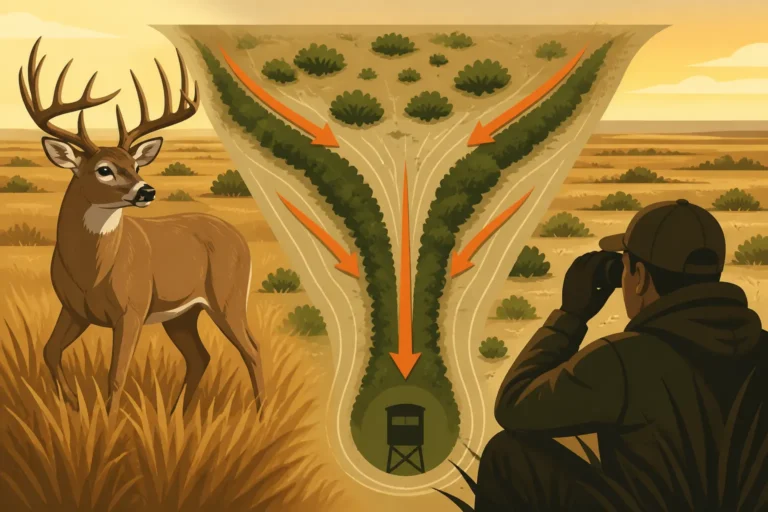
Imagine being a coyote in a sprawling Kansas wheat field or a sea of CRP grass. You can see for miles, but so can everything else. This lack of significant cover means coyotes become incredibly adept at using even the most subtle changes in elevation, like a small ditch, a terrace, or a slight rise, to their advantage. They’ll often travel along these features, staying just out of sight until they need to expose themselves. When approaching a call, a coyote rarely runs straight in. Instead, they’ll almost always circle downwind, using their incredible sense of smell to verify what they’re seeing and hearing. This circling behavior is a critical factor you must account for in your setup. If you don't anticipate their downwind approach, you'll be busted more often than not. They also tend to move in ways that keep them out of direct line of sight until they are ready to commit, often using the background of the horizon or distant tree lines to mask their outline.
Furthermore, the sheer visual range in open country means coyotes often spot you long before you spot them, even if you think you're well hidden. Their eyesight is phenomenal, and they are constantly scanning. This makes your approach to a stand location, and your concealment once there, paramount. You can't just walk into a field and expect to call one in; every step, every ridge, every fence line needs to be considered for its visibility. It’s a constant chess match where they have the advantage of terrain knowledge and an innate distrust of anything out of place. This is where good scouting, even just a quick look at aerial imagery on an app like GoHunt, can reveal those subtle terrain breaks that a coyote will instinctively use.
Seasonal Changes and Coyote Vocalizations
Just like any other wild animal, coyote behavior and vocalizations shift throughout the year, driven by their biological needs and social structure. Understanding these patterns allows you to select the most effective calls for the time you're hunting.
During the late fall and early winter, often from November through December, coyotes are actively dispersing, and the younger coyotes are establishing new territories. This is a great time for distress calls – rabbit, fawn, or bird distress – as coyotes are hungry and opportunistic. They're also often more vulnerable to curiosity as they range widely. As you move into late winter, typically January and February, the mating season kicks into high gear. This is when howling becomes incredibly effective. You'll hear dominant male howls, female invitation howls, and even challenge howls. Using these vocalizations can trigger a response from territorial coyotes looking for a mate or defending their turf. Understanding these distinct vocalizations and being able to mimic them accurately can be the difference between a successful setup and a silent one. During this period, you might find that lone howls or even a challenge howl followed by a female invitation call can bring a wary male rushing in.
Once spring arrives and pups are on the ground, usually from March through May, pup distress calls can be lethal. An adult coyote, particularly a female, is highly protective of her young, and the sound of a pup in distress can bring her in fiercely and without much hesitation. However, late spring and summer can be challenging as cover is thick, and coyotes are more focused on hunting for their pups and avoiding humans. You might still find success with distress calls, but the response might be slower or more cautious. The key is to match your call to the season and the coyote's primary motivations, whether it's hunger, territorial defense, or parental instinct. Observing "Coyote Behaviour in Farm Country" through the seasons can give you valuable insights.
Essential Gear for Calling Coyotes in Open Country
When you're out in the vastness of Kansas, your gear selection isn't just about comfort; it's about giving you the edge you need against a predator with incredible senses. Every piece of equipment, from your optics to your camouflage, plays a crucial role in your success.
Optics: Your Best Friend for Long Distances
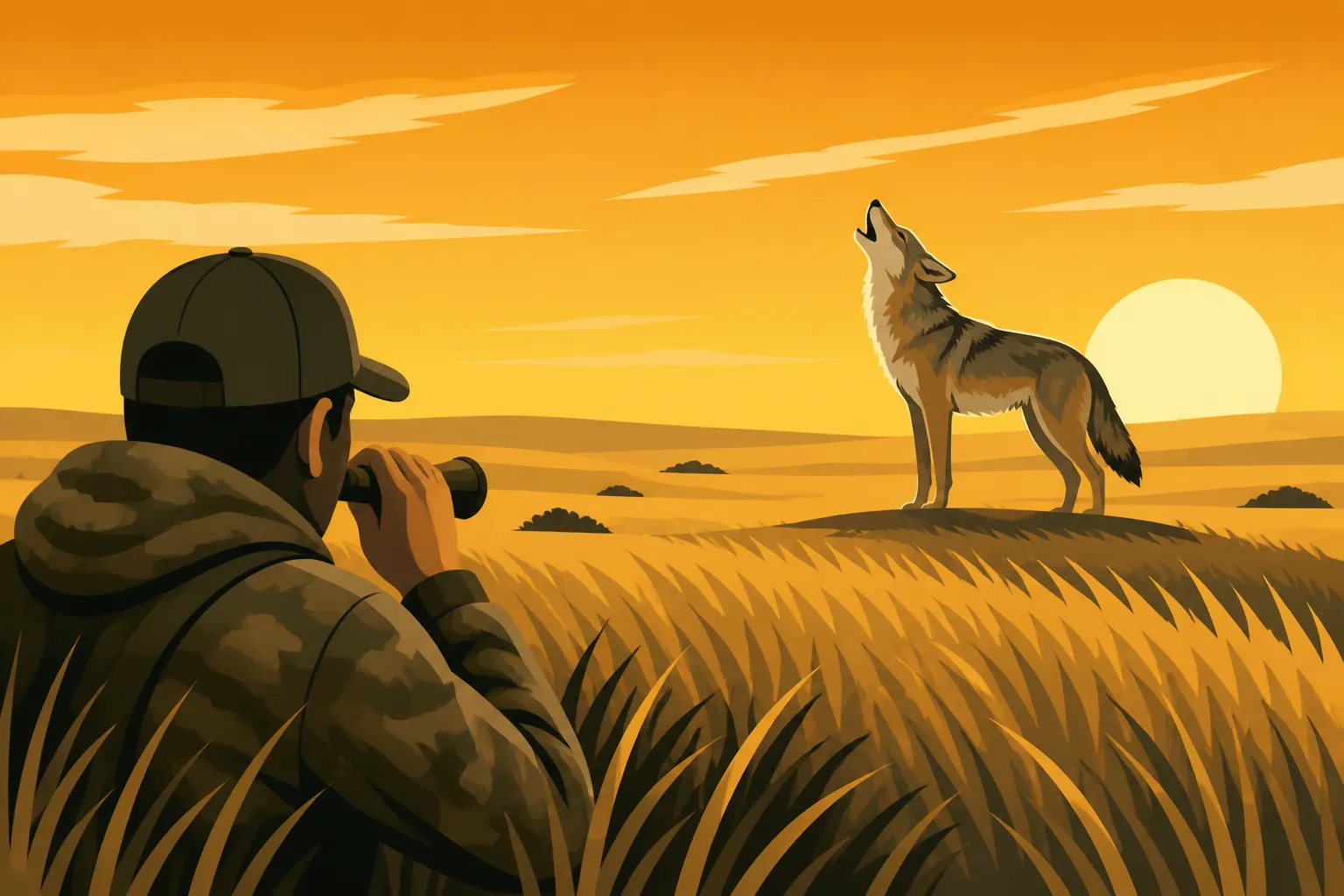
In open country, the ability to see things far away and quickly identify them is non-negotiable. Coyotes often hang up at extreme distances, circling or pausing to assess the situation before committing. High-quality binoculars are your first line of defense. A good pair of 10×42 or even 12×50 binoculars will allow you to scan the horizon, pick out subtle movements, and identify coyotes approaching from hundreds of yards away. You’ll be able to spot that faint glint of a coyote's eye or the flick of an ear long before it’s visible to the naked eye, giving you precious time to prepare for the shot. Don't skimp on glass here; clarity and light gathering are paramount, especially during those low-light dawn and dusk hours when coyotes are most active.
Beyond binoculars, a spotting scope can be incredibly valuable if you're hunting larger tracts or engaging in longer-range setups, allowing you to confirm a coyote's identity or assess its exact trajectory without moving. And, of course, a reliable rangefinder is absolutely essential. In flat terrain, distances can be incredibly deceptive, and misjudging a shot by even 50 yards can lead to a missed opportunity or, worse, a wounded animal. Before every shot, especially in open country, you must know your exact distance. Take the time to range various landmarks around your setup so you have known reference points. This practice is just as important as ensuring your rifle is properly zeroed, a skill similar to "Sighting In Before Firearm Season".
Electronic Callers vs. Hand Calls: Pros and Cons
Both electronic callers and hand calls have their place in a coyote hunter's arsenal, but each shines in different scenarios, especially in open Kansas country.
Electronic callers offer unmatched versatility and volume. You can broadcast a wide range of realistic sounds – from rabbit distress to various howls and pup distress – at volumes that carry across vast fields. Many modern e-callers come with remote controls, allowing you to place the caller a significant distance from your position. This is a huge advantage in open country because it draws the coyote's attention away from your actual location, giving you a better chance to go undetected as the coyote focuses on the sound source. Top brands like Foxpro and Primos offer fantastic options with extensive sound libraries and reliable remotes. The ability to switch calls with a button press, without any movement, is a game-changer when you're trying to coax in a wary coyote. The volume control is also crucial; you can start with soft, inquisitive sounds and gradually increase the intensity to grab attention from afar, then reduce it as the coyote closes in.
Hand calls, on the other hand, require more skill and practice, but they offer an intimacy and nuance that can be incredibly effective, especially on pressured coyotes. The subtle inflections you can achieve with a hand call can sometimes sound more natural to a coyote than a perfectly reproduced electronic sound. They are also lightweight, battery-independent, and incredibly reliable. For situations where a coyote hangs up or seems to be analyzing the sound, a well-executed series of barks or whimpers with a hand call can be the final trigger. Many experienced callers carry both, using an e-caller for initial long-range attention and then switching to a hand call for close-in finesse. However, in Kansas's wide-open spaces, the sheer reach and decoy effect of a remote e-caller often make it the primary choice for many hunters.
Here's a quick comparison of the two:
| Feature | Electronic Callers | Hand Calls |
|---|---|---|
| Sound Variety | Vast library of realistic sounds | Limited to caller's skill and call type |
| Volume | High, adjustable, carries long distances | Limited by lung capacity, harder to project far |
| Remote Control | Often included, allows placement away from hunter | Requires hunter to be near call, more movement |
| Stealth | Less movement by hunter, coyote focuses on caller | More hunter movement and exposure |
| Skill Level | Easier to use, focus on timing and setup | Requires significant practice and mastery |
| Power Source | Batteries, can run out | Hunter's breath, no power needed |
| Cost | Generally higher initial investment | Lower initial cost, can be very affordable |
| Effectiveness | Excellent for long-range attraction, drawing attention | Great for subtle nuances, wary coyotes, close-in work |
Camouflage and Concealment Strategies
Concealment is critical when hunting coyotes in open Kansas country, possibly even more so than for deer. Coyotes have exceptional eyesight and are constantly scanning their surroundings. Your goal isn't just to be hidden, but to break up your human outline completely.
Full camouflage from head to toe is essential. Choose patterns that match the local terrain and season—tans and browns for dry CRP grass or wheat stubble, greens for lusher periods, and broken patterns to disrupt your shape. Don't forget a face mask and gloves; exposed skin will stick out like a sore thumb. More importantly than the pattern itself is how you use the cover available. In Kansas, "cover" might mean a lone cedar tree, a small cluster of brush in a fence line, or even just the shadows cast by a small rise. You need to position yourself where you can blend into the background, ideally with something behind you to break up your silhouette, and be able to see a wide field of view.
Often, natural cover is scarce, so portable ground blinds or even simple camo netting can be invaluable. A small pop-up blind that you can quickly deploy offers full concealment and allows for some movement without being detected. If using natural cover, ensure you're not silhouetted against the skyline. Instead, try to position yourself slightly below a ridge or against the darkest part of a distant treeline. Even a subtle change in elevation can be enough to hide your lower body. Always approach your setup spot carefully, keeping low and out of sight. Remember that coyotes will usually try to circle downwind of your position, so choose a setup that allows you a clear shot in that likely approach lane while keeping yourself concealed from their initial visual scan. This means paying attention to "Wind and Thermals on a River Bank" principles, even when hunting the plains, to understand how your scent will travel.
Mastering Coyote Calling Techniques for Kansas Plains
Calling a coyote is an art form, not just pressing a button or blowing a call. It requires patience, keen observation, and the ability to adapt. In Kansas's open country, these skills are amplified.
Setting Up for Success: Wind, Sun, and Entry/Exit Routes
Your setup is arguably the most critical component of successful coyote calling in open country. Forget about just finding a spot to sit; you need a strategic advantage. First and foremost, always consider the wind. Coyotes will almost always circle downwind to get your scent. This means you need to set up so your scent blows away from where you expect the coyote to approach, and ideally, you have a clear shooting lane downwind. You might position your caller upwind of your position, enticing the coyote to come to the sound and then circle downwind, bringing it broadside to your shooting lane. Use the prevailing winds to your advantage, and remember that thermals can play a role, especially around draws or water features.
Secondly, the sun's position matters. Try to set up with the sun at your back, shining directly into the coyote's eyes as it approaches. This makes it harder for them to see you clearly and reduces glare for your optics. Early morning or late afternoon hunts often offer the best sun angles. Finally, plan your entry and exit routes meticulously. This is where applications like GoHunt come in handy, allowing you to scout from home and identify discrete paths. You need to get to your setup location without being seen or heard by any coyotes in the area, and likewise, you need a way to leave without disturbing potential game or leaving a trace. Think about "Access Routes That Do Not Bump Deer" – the same principles apply for wary coyotes. Walk low, stick to ditches or tree lines, and avoid silhouetting yourself on ridges. A poor entry can ruin a stand before you even sit down.
Call Sequences and Volume Adjustments for Open Fields
The vastness of Kansas means your calls need to carry. Start with a medium volume, especially if you're uncertain about how far away coyotes might be. The goal is to grab attention without startling anything close. After an initial series (say, 30-60 seconds of distress or a series of howls), go silent for several minutes—three to five minutes is a good starting point. This gives coyotes time to respond and start moving. Then, repeat your calling sequence, perhaps increasing the volume slightly. The silence in between calls can be just as important as the calls themselves, allowing coyotes to gain confidence and move in.
Vary your calls. While a simple rabbit distress often works, having a repertoire of sounds is beneficial. If a coyote hangs up, try switching to another distress call, or perhaps a series of coyote vocalizations like a challenge howl or pup distress. Sometimes, an aggressive howl followed by a more submissive whimpering can trigger a territorial response. The key is to project sound across the wide-open landscape, but also be ready to reduce volume significantly as a coyote closes in. You don't want to blast a call at max volume when a coyote is 100 yards out; it can spook them. Adapt your volume and call type based on the response you get, or lack thereof. Sometimes, a long, drawn-out pause after a series of howls can make a coyote desperate to find the source. This is especially true during the rut, when they're actively searching for mates.
Reading Coyote Reactions and Adapting Your Approach
Coyotes communicate constantly through body language, and learning to interpret these subtle cues is paramount to successful calling. When a coyote first hears your call, it might stop dead in its tracks, ears swiveling, trying to pinpoint the source. This is a moment to observe, not to call more. If it starts trotting in, often with a curious, hesitant gate, maintain your current call sequence and volume. It’s coming, but it’s still assessing.
The real test comes when a coyote "hangs up"—stops at a distance (often 150-300 yards in open country) and looks intently, but doesn't commit. This is the moment to adapt. If it's circling downwind, it's trying to get your scent. Be ready for a shot. If it's just standing there, consider a change in call. A subtle, soft pup distress can sometimes seal the deal, tugging at their parental instincts. Or, a quick, sharp bark with a hand call can break its hesitation. If it starts to trot away, don't give up immediately; a series of frantic, high-pitched distress calls might just pique its curiosity enough to turn it back around. Never assume a coyote is gone until it's truly out of sight. Always be ready for a shot, as they can appear or disappear in the blink of an eye in these open landscapes. Pay close attention to "Milo and Corn Stubble Deer Patterns" as coyotes often follow similar patterns, using the cover and food sources.
Advanced Tactics and Considerations for Kansas Coyote Hunting
Once you've got the basics down, it's time to fine-tune your approach for those truly wily Kansas coyotes. These advanced tactics can turn a marginal hunt into a memorable one.
The Role of Decoys in Open Country
Decoys are an absolute game-changer for coyote calling, especially in wide-open country where a coyote's eyes are always scanning. A motion decoy, like a simple rabbit or bird fluttering on a stake, provides a visual focal point that draws the coyote's attention away from you. This is invaluable. A coyote will often lock onto the decoy, giving you the opportunity to subtly adjust your shooting position, raise your rifle, or simply remain undetected while it's distracted. Place your decoy about 30-50 yards upwind of your caller, and position your caller a similar distance upwind from your hiding spot. This setup draws the coyote past the caller, past the decoy, and then downwind of your position, giving you clear shot opportunities.
Static decoys, such as a full-body coyote or a coyote silhouette, can also be effective. A lone coyote decoy might attract territorial coyotes, especially during the rut. A pair of coyotes, perhaps one standing and one bedded, can represent a challenge or simply a social gathering, depending on the call. Be mindful of how realistic your decoys look and how they're positioned relative to the wind. Nothing looks more unnatural than a stiff, unmoving decoy when everything else is swaying in the breeze. Decoys add another layer to the deception, playing on a coyote's visual senses in addition to their hearing, making it much harder for them to pinpoint your location. Just as deer can be tricked by "Decoying a Kansas Whitetail Buck", coyotes respond to visual stimuli.
Hunting Pressure and Educated Coyotes
Kansas coyotes, particularly those on public access areas or frequently hunted private lands, can become incredibly "educated" and wary. They've heard it all before, they've been shot at, and they've learned to associate certain sounds or setups with danger. Dealing with these pressured coyotes requires a different strategy than calling in a naive one.
First, vary your calling sequences significantly. Avoid the generic, repetitive distress calls that every other hunter is using. Mix in less common sounds, or combine vocalizations in unique ways. Sometimes, a very subtle series of howls with long pauses can work better than aggressive distress. Second, extend your setup times. While 15-20 minutes might be standard for unpressured coyotes, educated ones might take 30-45 minutes or even longer to commit. They'll circle, pause, and scrutinize everything before taking the final plunge. Patience is paramount. Third, use your optics even more diligently. These coyotes will often hang up further out, making long-range observation crucial. Referencing resources on "Hunting Pressure Patterns on Kansas Public Land" can give you insight into how to approach different areas, as public land coyotes are often under heavier pressure. Finally, consider switching locations frequently. If you hit a spot and get no response, don't dwell there. Move on to a new area that might not have been hit as hard, possibly scouting new Walk-In Hunting Access (WIHA) areas with tools like GoHunt or by physically "Scouting Kansas Walk-In Tracts Before the Opener".
Safety and Ethical Considerations
Coyote hunting, like all hunting, comes with responsibilities. Safety should always be your number one priority. Always identify your target unequivocally before taking a shot. In open country, it can be easy to misidentify a distant animal, so use your binoculars. Be absolutely certain of what you're shooting at and what's beyond it. Know your backstop, especially with high-powered rifles commonly used for coyotes. A bullet can travel for miles across flat Kansas terrain.
Respect for the land and landowners is also crucial. Always have permission to hunt on private property. If hunting public land, be aware of other users, whether they are hikers, bird watchers, or other hunters. Check the Kansas Department of Wildlife, Parks and Tourism (KDWP) regulations for specific rules on coyote hunting, including legal hunting hours and any specific restrictions in certain areas. For example, "Night Hunting Rules for Coyotes in Kansas" are often different from daytime rules and may require specific permits or equipment. Understand the "Kansas Hunting Licence and Permit Costs" and ensure you have all necessary documentation. Ethical hunting also means making clean, humane shots. Practice regularly to ensure you are proficient with your rifle at varying distances, especially those longer shots common in open Kansas country. This ensures a quick and ethical harvest.
Disclaimer
Hunting is an inherently risky activity. Always prioritize safety, understand and follow all local, state, and federal regulations, and obtain proper landowner permission. The information provided in this guide is for educational purposes and should not replace professional instruction or official hunting regulations.