Access Routes That Do Not Bump Deer
There’s nothing quite as soul-crushing as that gut-wrenching feeling of blowing out deer on your walk-in, especially when you’ve put in all the hard work to scout and set up. We’ve all been there – hearing that snort-wheeze in the pre-dawn dark or seeing a flash of white tails disappearing over the hill, knowing our hunt is likely over before it even began. This guide is all about tackling that exact frustration head-on, helping you meticulously plan and execute access routes that allow you to slip in and out of your hunting spots undetected, maximizing your chances for a successful hunt in the diverse landscapes of Kansas.
Understanding Deer Movement and Pressure
Whitetail deer, especially mature bucks, are incredibly sensitive to human intrusion. They've learned to associate certain sounds, smells, and visual cues with danger, and even the slightest misstep can send them packing for another county. Understanding how your presence impacts their behavior is the first step in mastering stealthy access.
The Impact of Human Presence on Whitetails
Deer are creatures of habit, but they are also highly adaptive. When they encounter pressure, whether it's from hunting, farming, or recreational activities, they quickly adjust their patterns. What might have been a prime bedding area or a consistent travel corridor can become a ghost town if hunters are routinely blowing them out during their access or exit. It’s not just about the moment you bump them; it's the lasting impact that teaches them to avoid certain areas during hunting hours. This means that a poorly planned access route doesn't just ruin one hunt; it can make an entire section of timber or a prime Kansas Walk-In Hunting Access Explained tract unproductive for weeks, or even the whole season.
Think about it from a deer's perspective: if they consistently smell human scent or hear crunching leaves on a specific trail every morning, they'll simply shift their movement to an adjacent creek bottom or a thicker patch of cover. They’ll adjust their timing, too, often moving strictly at night. This is why minimizing your footprint and staying truly undetected is paramount. The goal isn't just to not see deer on your way in; it's to ensure they don't even know you were there. This requires a level of diligence that goes beyond just walking quietly. It involves understanding their daily routines, identifying their primary escape routes, and planning your approach to completely circumvent those sensitive zones.
Identifying Deer Sanctuaries and Core Areas
Every property, whether it's public land or a private lease, has areas where deer feel safest – their sanctuaries. These are often the thickest, most secluded spots, sometimes surrounded by dense cover like cedar thickets, tall CRP grass, or the deepest parts of river bottoms where human disturbance is minimal. Even on public land with moderate pressure, deer will establish these pockets of refuge. Your primary objective when planning an access route is to avoid these sanctuaries at all costs. Walking through a bedding area, even if you don't see a deer, leaves your scent and sends a clear message that this spot is no longer safe.
Mature bucks, in particular, will often have smaller, tighter "core areas" within these sanctuaries, places where they spend the majority of their daylight hours. These spots are incredibly difficult to pin down without extensive scouting, but their general location can often be inferred from terrain features and pressure patterns. Reading a Kansas Creek Bottom for Deer Sign can help you identify these areas by looking for concentrated tracks, rubs, and beds. Utilizing mapping tools like GoHunt, you can analyze satellite imagery to identify areas of thick cover, water sources, and potential bedding zones that you absolutely need to avoid. Plotting your potential stand locations first, and then working backward to establish an access route that goes around these sanctuaries, not through them, is a foundational strategy.
Scouting for Stealthy Access
Effective scouting is the bedrock of successful, stealthy access. You can't just pick a spot on a map and hope for the best; you need to know the lay of the land, how deer are using it, and where the natural pinch points and cover exist that will allow you to slip in undetected.
E-Scouting for Hidden Entry Points
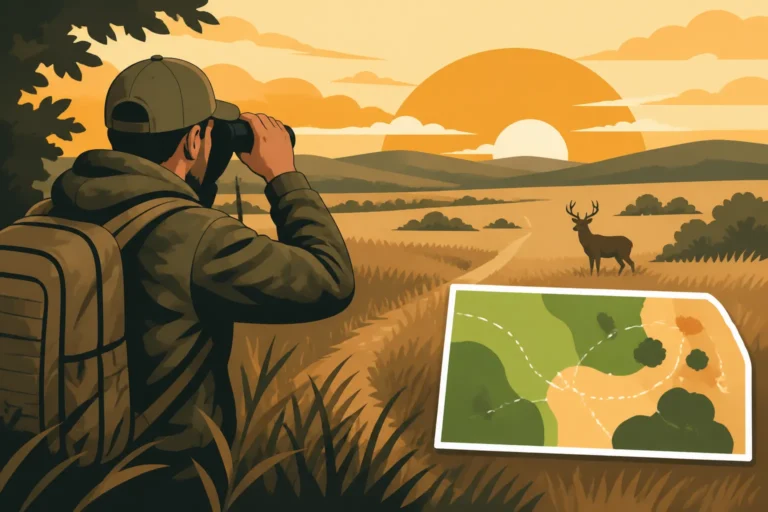
Before you ever set foot in the woods, the most crucial step is to sit down with your mapping tools and really dig into the topography and cover. Tools like GoHunt are invaluable for this, offering detailed satellite imagery, topo maps, and even public land boundaries. Look for terrain features that provide natural cover or act as sound buffers. Are there ditches, creek beds, fence lines with overgrown brush, or lines of timber that you can follow? Think about how these features might hide your movement and muffle your sound. Identifying points where agricultural fields meet timber, or where dense hedgerows break up open country, can reveal hidden entry points.
On flat Kansas farm country, finding these "hidden" routes can be a challenge, but they often exist in subtle forms. A slight rise in elevation, a drainage ditch, or a forgotten strip of tall grass along a property line can offer just enough concealment. Pay close attention to the edges of fields – often, deer will travel these edges, but you need an access route that doesn't follow their primary travel corridors. Instead, look for a parallel route, perhaps a hundred yards or more away, that offers similar cover but is less likely to hold deer actively traveling during hunting hours. The goal here is to identify potential entry points that are not obvious deer trails, but rather human-friendly stealth routes.
On-the-Ground Reconnaissance for Low-Impact Routes
Once you've identified potential access routes through e-scouting, the next step is to hit the ground. This isn't about looking for deer sign; it's about walking your proposed routes, typically outside of hunting season, or during the middle of the day when deer activity is minimal. Pay attention to how your footsteps sound. Are there crunchy leaves, brittle twigs, or noisy corn stubble that will give you away? Identify areas where you can walk softly, perhaps on bare dirt or through damp grass. Look for obstacles that might force you to make noise, like old fence lines or thorny thickets, and try to find ways to go around them.
This reconnaissance should also confirm your e-scouting observations. Does that subtle ditch really offer enough concealment? Is that timber edge as dense as it looked on the map? While walking, envision a deer watching you from its bed. Where would you be exposed? Where could you make too much noise? This is also the time to identify specific landmarks for navigating in the dark, like a uniquely shaped tree, a specific turn in a fence line, or an old piece of farm equipment. Mark these waypoints on your GoHunt app or other mapping device. Remember, the less you have to rely on a flashlight during your approach, the better. This upfront work, done methodically, is critical for successfully Scouting Kansas Walk-In Tracts Before the Opener without disturbing the deer.
Key Principles of Cover and Concealment
When you're trying to sneak into your stand without alerting every deer in the zip code, using available cover is paramount. It's not just about hiding; it's about becoming part of the landscape.
Utilizing Natural Terrain and Vegetation
Kansas might be known for its flat expanses, but even here, natural terrain and vegetation offer incredible opportunities for concealment. Ditches, creek beds, and subtle draws can provide surprisingly effective corridors for quiet movement. Instead of walking across the top of a ridge or field, drop down into a low spot, even if it means a slightly longer walk. These depressions naturally hide your silhouette and often have softer ground for quieter footsteps. Along river bottoms, Wind and Thermals on a River Bank can be tricky, but the dense timber and varied terrain offer excellent visual breaks.
Don't underestimate the power of seemingly sparse vegetation. Even a single line of trees, a thick hedgerow, or a patch of tall grass can be enough to break up your outline and hide your movement, especially in low light conditions. When planning your route, actively look for these features. Can you walk along the backside of a treeline, using the trees themselves as a screen? Can you stay just inside the edge of a standing corn or milo field, using the crop as cover? The more you can blend in and keep your movement from being seen directly by deer, the better your chances of slipping through unnoticed. This approach is fundamental, especially when you're thinking about Hunting Terrain Funnels in Flat Country where deer are already concentrated.
Maximizing Your Approach to Stand Locations
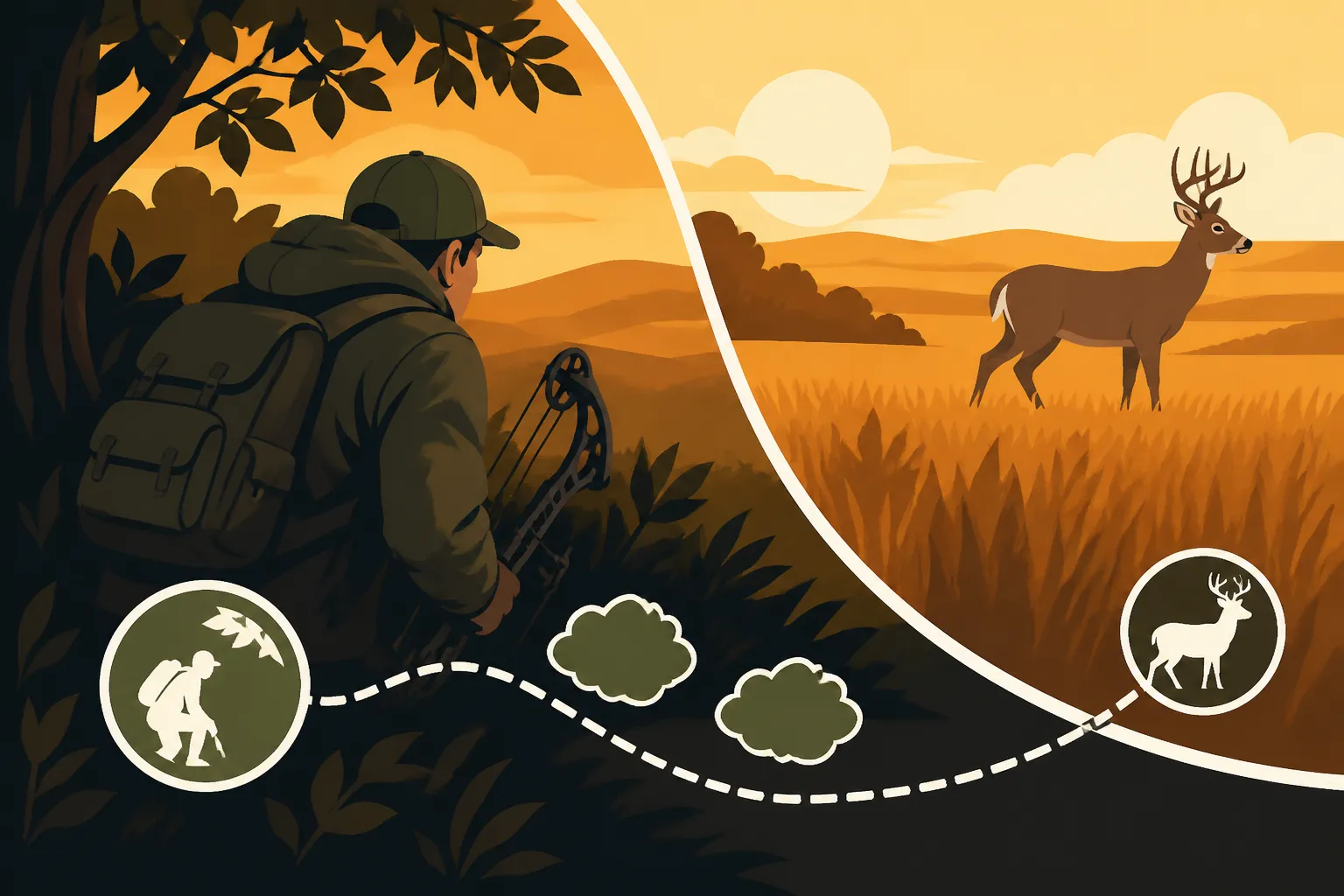
The last 100-200 yards to your stand are arguably the most critical. This is where you’re closest to potential bedding areas or active travel routes, and any mistake will have immediate consequences. This is where meticulous planning for the final approach truly shines. Your access route should deliver you to your stand from a direction that doesn't blow your scent into the area you expect deer to be coming from, and preferably offers the most concealment right up to the base of your tree or blind.
Consider setting up your stand locations with access in mind. Sometimes the "perfect" tree for a shot angle might be completely unapproachable without busting deer. It's often better to choose a slightly less ideal tree that offers a bulletproof access route. When approaching, use every piece of cover available. Crouch low, use slow, deliberate movements. If you’re hunting a Shelterbelt Ends and Buck Travel for example, don't walk directly down the middle of it. Instead, creep along the downwind edge, using the dense growth as a screen. For ground blinds, ensure your Ground Blind Brushing In is thorough enough to allow you to get in and out without being silhouetted against the morning or evening light. Your access route isn’t just about getting there; it’s about getting there without leaving a trace.
Wind, Thermals, and Scent Management
The Kansas wind is a constant factor that demands respect from every hunter. Ignoring it is a surefire way to bump deer, no matter how quiet you are. Incorporating wind and thermal knowledge into your access plan is non-negotiable.
Reading the Wind in Flat Kansas Country
In flat, open country, the wind often blows directly over the landscape, carrying your scent far and wide. This makes planning your access even more critical. Your golden rule should always be: never walk directly upwind to your stand, and ideally, approach with the wind either quartering to your back or directly behind you, blowing your scent away from where you expect deer to be. This might sound counterintuitive for hunting, where you usually want the wind in your face while on stand, but it's crucial for access. You're sacrificing your scent profile on the walk-in to protect the core hunting zone around your stand.
Before leaving your vehicle, confirm the wind direction. A small wind checker or even a quick glance at the direction of smoke from a nearby chimney can give you crucial information. Don't just rely on the forecast; on the ground, micro-currents can shift. If your planned access route puts your scent directly into a bedding area or primary travel corridor, you must have an alternative. This might mean taking a much longer, circuitous route, or even choosing a different stand location for that hunt. Failing to respect the wind on your access route is like ringing a dinner bell for every deer downwind, telling them exactly where you are and sending them into lockdown.
Playing Thermals in River Bottoms and Draws
While open country wind is generally predictable, thermals add another layer of complexity, especially in varied terrain like river bottoms, draws, and creek drainages common throughout Kansas. Thermals are air currents driven by temperature changes. In the morning, as the sun warms the ground, air rises, creating an updraft that carries scent uphill. In the evening, as the air cools, it sinks, creating a downdraft that carries scent downhill.
This means that if you're hunting a stand in a river bottom, your morning access should generally be from above the stand, allowing your scent to be carried upwards and away from the deer still bedded in the cooler lowlands. Conversely, your evening access might be best from below, as your scent will be carried downwards into the draws, away from deer moving towards evening food sources. This is a subtle but powerful aspect of scent control. Combine this with your wind direction. For example, if you're accessing a stand along a creek bottom and the wind is generally blowing north, but the morning thermals are pulling scent uphill, you'll want to access from a high point to the south or east, letting the thermals carry your scent up and the wind push it north, away from the core deer activity. Understanding these dynamics is key to truly stealthy movement, especially when you're looking to ambush deer near a Creek Crossings Worth Hanging a Stand On.
Minimizing Your Footprint and Impact
Even with the perfect route and wind, how you move and when you move can make or break your hunt. Minimizing your physical and sensory footprint is about more than just being quiet; it's about being invisible to the deer's acute senses.
The Importance of Silent Travel
Silence is golden when accessing your stand. This means paying attention to every detail, from your footwear to your clothing, and especially how you walk. Wear soft-soled boots that offer good traction but minimize noise. Avoid clothing that rustles loudly, especially insulated jackets that crinkle with every movement. Layers are great, but choose quiet fabrics like fleece or brushed tricot. Take off your backpack and put it on the ground if you need to adjust anything, rather than fumbling with it while walking.
Beyond gear, focus on your gait. Walk slowly, deliberately, lifting your feet rather than dragging them. Place your weight on your heel first, then roll to your toe, feeling for crunchy leaves or twigs before committing your full weight. Stop frequently, listen, and scan your surroundings. Use the "hunter's pause" to your advantage. It allows you to listen for deer, but also breaks up the monotony of your footsteps, making it harder for deer to pinpoint your location. This is especially vital when you’re executing Walking In Before Legal Light, where every rustle sounds amplified in the pre-dawn quiet. A quiet approach isn't just about avoiding detection at that moment; it reduces the overall "noise footprint" you leave in the woods, making the area feel safer for deer even after you're settled in.
Strategic Timing of Access
When you choose to access your stand can be just as important as how you do it. Most hunters head out in the dark, which is generally a good strategy, but how early you go can make a difference. Arriving too early, long before first light, might mean you're bumping deer that are still feeding or traveling in the area. Often, deer activity peaks right at first light, and if you’re already sitting for an hour, your chances are much better.
For morning hunts, aim to arrive at your stand about 45 minutes to an hour before shooting light. This gives you enough time to get settled, hang your gear, nock an arrow, or load your rifle, and let the woods settle down after your approach. If you’re hunting an area known for active nighttime deer movement, such as near a standing crop of Milo and Corn Stubble Deer Patterns, you might consider waiting a few minutes longer, allowing those deer to clear out before you make your move. For evening hunts, access your stand in the middle of the day, during the least active deer periods, or at least 2-3 hours before you expect deer to start moving into your area. The goal is to be completely settled, still, and scent-free long before the deer are on their feet and moving.
Practical Access Route Examples
Let's get down to some real-world applications. Kansas hunting presents unique challenges, particularly with vast agricultural fields and scattered timber. Here are a couple of common scenarios and how to approach them effectively.
Approaching Creek Crossings and Timber Points
Creek crossings and timber points are classic whitetail hotspots, but they can also be access nightmares. Deer inherently use these as travel corridors, and any misstep can send them fleeing.
Creek Crossings: When you're planning your access route to a stand overlooking a creek crossing, the key is to avoid walking directly down the creek bed itself. While the bed offers concealment, it's often a primary travel route for deer. Instead, aim to approach from higher ground, paralleling the creek a safe distance away, using any available field edges, ditches, or hedgerows. If you must cross the creek, identify a specific crossing point that offers a hard, rocky bottom or a natural bridge where you can cross with minimal noise and avoid leaving strong scent. Often, deer have their own preferred crossing spots; these are the ones you want to avoid during your walk-in.
For example, if you're hunting a bend in a creek that often funnels deer, you wouldn't walk directly along the bank. Instead, you'd scout for a route through an adjacent pasture, a fenceline with brush, or a low swale that keeps you out of sight and sound, approaching your stand from the downwind side of the creek bend. This often means your access route looks like a U-shape on the map, taking you well out of the way before looping back to your stand location, rather than a direct line. Remember, Best Stand Locations in Flat Farm Country are often near these features, so a quiet approach is paramount.
Timber Points: In flat farm country, isolated timber points that jut out into fields or follow a fenceline are magnets for cruising bucks. However, these are often linear features with limited cover, making access tricky. Your best bet is to use the furthest downwind side of the timber for your approach, utilizing the timber itself as a visual and auditory screen.
Imagine a timber point extending south into a cornfield. If the wind is out of the north, you can walk along the western edge of the timber, using the trees to block your scent from blowing into the main body of the timber to your east. Your scent will be blowing into the cornfield, which is generally less likely to hold bedded deer during hunting hours than the timber itself. If the wind is out of the west, you'd walk along the eastern edge. The principle is always the same: keep the most likely deer-holding area directly upwind of your travel, ensuring your scent is blowing away from them. This is especially important for Shelterbelts and Timber Points in Kansas Farm Country, which are often narrow.
Navigating Open Fields and Shelterbelts
Vast open fields are a signature of the Kansas landscape, and they present some of the toughest access challenges. Shelterbelts, while offering cover, can also be high-traffic deer areas.
Open Fields: Walking across an open field in daylight is a death sentence for a deer hunt. Instead, you need to identify features within or around the field that offer concealment. This might include:
- Drainage Ditches: Often, agricultural fields will have drainage ditches, sometimes with overgrown vegetation, that can provide a stealthy pathway.
- Field Edges: Stay tight to the outermost edge of a field, especially if it borders a thicker wood line, a fenceline with tall weeds, or even a standing crop.
- Standing Crops: If permitted and practical, walking just inside the edge of a standing corn or milo field provides incredible visual and sound cover. Be mindful of property lines and regulations.
- Low Swales or Depressions: Even subtle terrain changes can provide a visual break.
Consider parking your vehicle in a spot that allows you to walk around the open field, using a timber edge or a more concealed back road, even if it adds significant distance. Using an app like GoHunt to analyze contour lines and vegetation can help you pinpoint these subtle routes. Your goal is to keep your silhouette below the horizon line as much as possible and use any linear feature to break up your profile.
Shelterbelts: These narrow strips of trees, often planted as windbreaks, are prime bedding and travel corridors for deer. While they offer cover for you, they also hold deer, making direct travel through them risky.
Your access strategy for a shelterbelt should be similar to timber points: utilize the downwind edge, using the trees to block your scent and view. If the shelterbelt is very dense, you might be able to walk just inside it, using the thickest brush as your screen, provided you can do so silently. However, if the shelterbelt is thin or holds many active deer trails, your best bet might be to walk outside it, in a parallel open field, but only if the wind is blowing your scent away from the shelterbelt. Always prioritize scent control over visual concealment when navigating these narrow strips of cover, as deer are almost certainly bedded or traveling within them. This methodical approach ensures you're not just getting to your stand, but you're doing so in a way that truly supports your hunting success and avoids creating negative pressure on the deer.
| Access Challenge | Stealth Strategy | Why it Works |
|---|---|---|
| Open Fields | Utilize ditches, field edges, standing crops. | Breaks up silhouette, offers visual/sound cover, avoids direct exposure. |
| Creek Bottoms | Approach from higher ground, parallel creek. | Avoids primary deer travel routes, leverages thermals, keeps you out of main scent corridors. |
| Timber Points | Walk downwind edge of timber. | Uses timber as a visual/scent screen, pushes your scent into less active areas. |
| Shelterbelts | Walk downwind edge or just inside dense cover. | Conceals movement and scent from deer likely using the shelterbelt as cover. |
| Crunchy Ground | Slow, deliberate steps; soft-soled boots. | Minimizes noise, allows detection of noisy spots before full weight is committed. |
| Pre-Dawn Dark | E-scout waypoints, use minimal light. | Prevents getting lost, reduces visual disturbance, allows eyes to adjust naturally. |
| Scent Dispersion | Always play the wind, understand thermals. | Carries your scent away from deer, preventing their most crucial defense mechanism from alerting them. |
| Bumping Deer on Entry | Avoid known bedding areas, strategic timing. | Prevents educating deer, allows them to establish patterns without disturbance. |
Disclaimer
Hunting is an inherently dangerous activity. Always prioritize safety, follow all local, state, and federal regulations, and obtain appropriate licenses and permits. This guide provides general information and recommendations; individual hunting conditions and experiences may vary. The author and publisher are not responsible for any accidents, injuries, or legal issues that may arise from the use of this information. Always hunt ethically and responsibly.