Wind and Thermals on a River Bank
Hunting Kansas river bottoms can be incredibly rewarding, holding some truly massive deer, but nothing will blow up your hunt faster than swirling, unpredictable winds. If you've ever set up what looked like a perfect stand, only to have a subtle shift in the breeze carry your scent right into a buck's nose, you know the frustration. This guide will meticulously break down the intricate dance of wind and thermals along Kansas river banks, helping you understand, predict, and ultimately adapt to these complex air currents for more successful hunts.
Understanding the Basics of Wind and Thermals in River Bottoms
River bottoms in Kansas are a unique microclimate, a world apart from the open plains or even timbered ridges. The presence of water, varied elevation (even slight changes make a huge difference here), and dense vegetation all conspire to create air currents that can defy conventional wisdom. It’s not enough to just check the Weather Channel app for the prevailing wind direction; you need a much deeper understanding of how that air interacts with the landscape.
The Nature of Air Movement Over Water
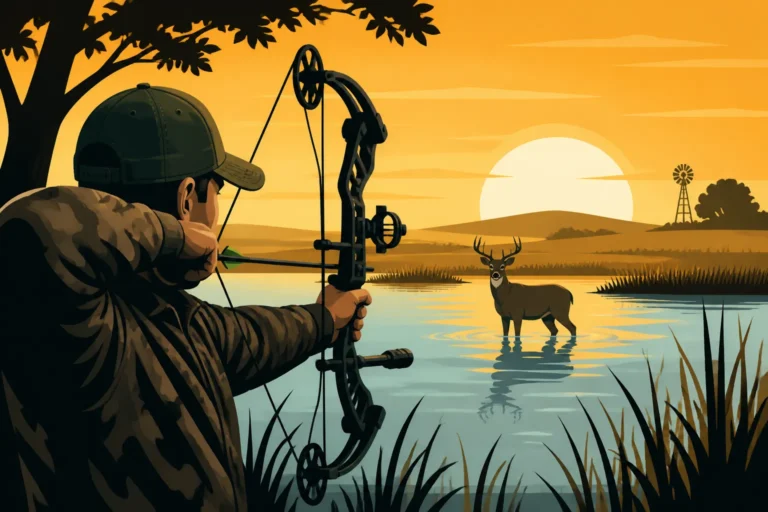
Water is a funny thing when it comes to temperature. It heats up and cools down much slower than land does. Think about those crisp fall mornings: the ground is frosty, but the river might still be giving off a slight mist, feeling comparatively warmer. This difference in temperature between the water and the surrounding land creates its own unique air patterns. As land warms up faster during the day, air over it rises, pulling in cooler, denser air from over the river. Conversely, at night, the land cools quickly, and the warmer air rising from the river can create a localized "thermal bubble" effect, or conversely, pull cooler air down into the lowest points. This constant exchange means that even on a calm day, there's always some subtle air movement influenced by the river itself. This effect is especially pronounced during early season bowhunting over water.
Differences Between Open Country and River Bottom Wind
If you've spent any time hunting the big crop fields or open grasslands of Kansas, you're used to a relatively consistent wind. It might be strong, but it generally blows in one direction, sweeping across the flat terrain. River bottoms, however, are a different beast entirely. The towering cottonwoods, dense cedar thickets along the banks, and the meandering course of the river itself act like a giant baffle. The prevailing wind hits these obstacles, creating eddies, swirls, and pockets of calm air. One minute, your wind indicator might be blowing steadily west; the next, it's swirling directly behind you in a sheltered bend. It’s like trying to predict ripples in a pond after you’ve thrown a handful of rocks in – there are simply too many variables. This complexity is often why hunters get busted in what they thought was a perfect wind.
Impact on Deer Movement and Hunter Scent
Deer, having evolved over millennia, are masters of using these variable air currents to their advantage. They understand the subtle shifts in thermals and wind better than any human hunter. A mature buck will often bed in a spot where he can smell anything coming from downwind, while also using an uphill thermal to catch scent from above him. When traveling, especially during the rut, they might cruise parallel to a river bank, confident that the swirling air will either diffuse an approaching predator's scent or give them an early warning. As hunters, our goal is to exploit these patterns, but our biggest weakness is our scent. A deer's nose is incredibly powerful, and even a faint whiff of human odor, carried by an unexpected eddy, is often enough to send them crashing away. This means that meticulous planning around wind and thermals isn't just a suggestion; it's the absolute foundation of a successful river bottom hunt.
Reading the Wind on a Kansas River Bank
Knowing what the wind should be doing versus what it is doing are two vastly different things, especially in the chaotic environment of a river bottom. Successful hunters aren't just checking their phone; they're constantly interacting with the air around them, using every tool and environmental cue at their disposal.
Tools for Wind Detection
To truly master the nuances of river bottom wind, you need more than just a quick lick of your finger. While a basic puff bottle with unscented powder is a good start, don't rely on it as your sole indicator. Milkweed seeds, with their delicate filaments, are incredible for showing subtle air currents that powder might miss. Just a handful of seeds released from your stand will often separate, each individual filament floating off in a slightly different direction, painting a detailed picture of the swirling air. Small, lightweight strips of thread or ribbon tied to branches at different heights can also provide a continuous visual reference. For the truly detail-oriented, a pocket anemometer (like those offered by Kestrel or even some models integrated into weather apps like GoHunt) can give you precise wind speed, which is helpful for understanding how far your scent might be carrying. Remember, the goal is to see not just the prevailing wind, but the microcurrents that will dictate whether a deer catches your scent.
Observing Environmental Cues
Beyond manufactured tools, the environment itself is constantly giving you clues if you know how to look. Pay attention to the most delicate elements around you. Watch the smallest leaves on trees, the wisps of tall grass on the bank, or even spiderwebs shimmering in the breeze. These subtle movements can indicate air currents that aren't strong enough to move a larger branch. Look for dust devils or smoke from distant agricultural burns (common in Kansas) to see how the broader air mass is moving. When you're in your stand, don't just feel the wind on your face; hold your hand out and feel the direction and intensity on different sides of your body. Does the air feel colder coming from one direction? That could indicate a sinking thermal. The more you tune into these small details, the better you’ll become at predicting what the wind will do next.
Predicting Microcurrents
This is where the art of river bottom hunting truly comes into play. The "big" wind you checked on your app is merely a suggestion in this terrain. River bends, steep cut banks, dense clusters of timber, and even single large trees can create localized microcurrents. Imagine a river bottom as a series of miniature canyons and hills. As the wind flows, it’s pushed, pulled, and channeled. A general north wind might hit a steep south-facing bank, get pushed up, curl over the top, and then get sucked back down into a sheltered low spot. This creates an unpredictable vortex. Understanding these microcurrents often comes from experience and meticulous Scouting Kansas River Bottoms and Creek Draws. Before you even hunt, spend time watching how the air moves in various spots with different wind directions. Note down where the wind consistently swirls, where it's calm, and where it seems to get funneled. This intel is invaluable for stand placement.
Decoding Thermals in River Bottom Terrain
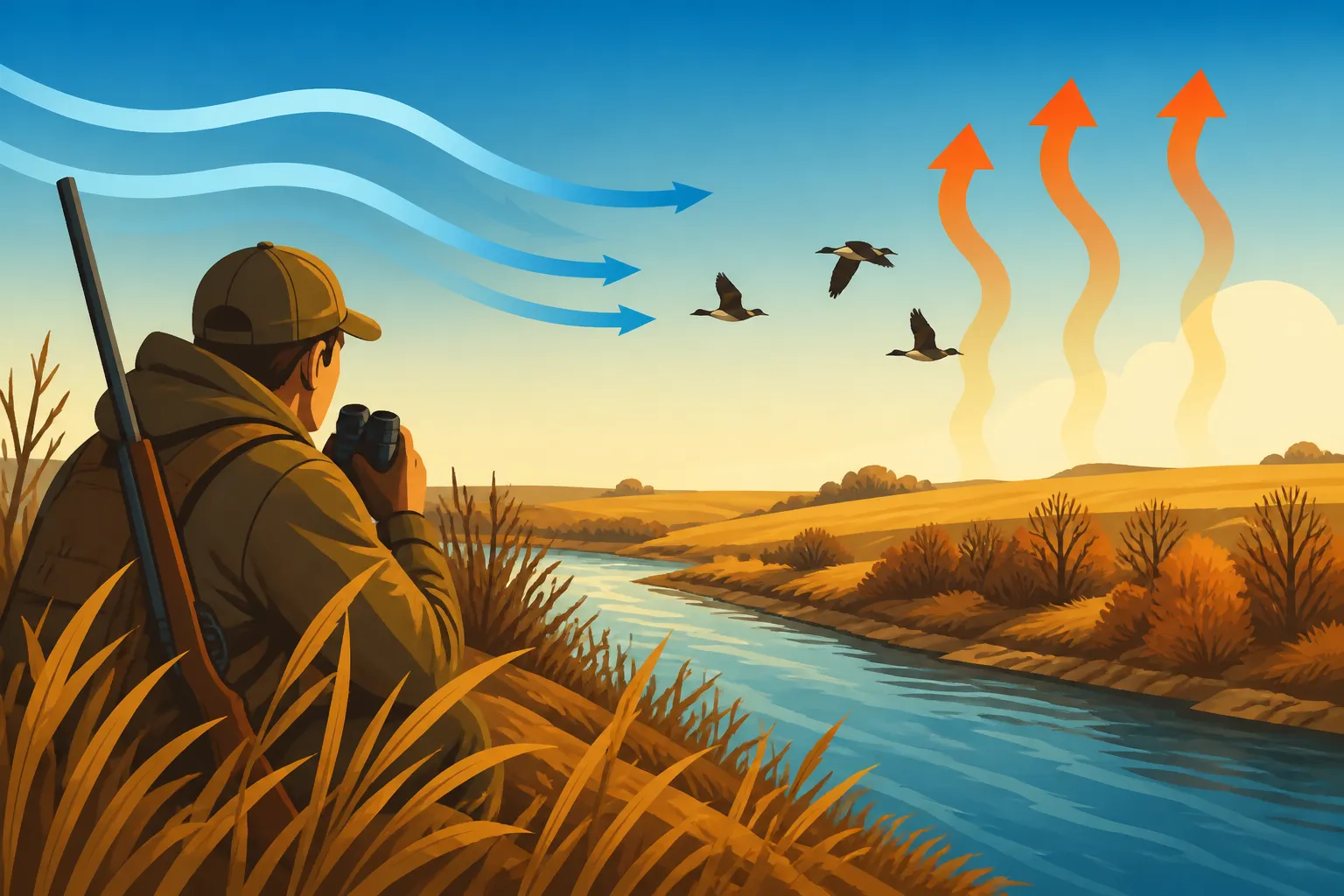
Thermals are the unseen hand that often dictates deer movement in river bottoms, particularly during the transition periods of morning and evening. They are driven by temperature differences and air density, creating predictable (yet easily disrupted) vertical air movement that can completely override the prevailing wind.
Morning Thermals: Uphill Flow
As the sun begins to rise and warm the landscape, the higher ground—the bluffs, ridges, and fields above the river bottom—heats up first. This warming causes the air over these elevated areas to become less dense and rise. As this warm air ascends, it creates a vacuum, pulling in cooler, denser air from the lowest points of the river bottom up and out of the drainage. This is your classic "uphill thermal." In a Kansas river bottom, this means your scent, which might have been sinking straight down or drifting along the river overnight, will now begin to rise and be carried up towards the higher ground. A common scenario is a buck traveling back to higher bedding areas, expecting the rising thermal to carry any danger up and away from his path. Setting up on the downwind side of a known travel corridor, slightly elevated, might seem logical, but if the thermal is drawing your scent directly uphill, you're busted. You need to position yourself so your scent rises behind or away from the anticipated deer travel route, taking into account the thermal's direction.
Evening Thermals: Downhill Flow
As the sun sets and the day cools, the process reverses. The higher ground, which absorbed so much solar energy during the day, cools down much faster than the river bottom itself or the water within it. The air over these cooler, higher elevations becomes denser and begins to sink, flowing down into the river bottom and along the contours of the drainage. This is your "downhill thermal." Your scent will now tend to sink and travel along the lowest points, eventually flowing downstream with the water. Deer moving from bedding areas on higher ground down towards evening food sources in the bottom often rely on this sinking thermal to carry any potential danger ahead of them. For an evening hunt, setting up low, near a creek crossing or a pinch point where deer might move towards a food source, requires careful consideration of this sinking air. You'll want to be above the deer's likely approach, with your scent funneling away and downstream.
When Thermals Override Prevailing Wind
This is the tricky part, and it often leads to busted hunts if you're not paying attention. On days with very light or variable prevailing winds, thermals can become the dominant force in the river bottom. Imagine a day with a weak 3-5 mph crosswind. While that might seem manageable, if a strong thermal is pulling your scent directly uphill in the morning, that weak crosswind becomes almost irrelevant for a deer approaching from below. Thermals are most predictable around dawn and dusk, but they can be disrupted by strong fronts or even cloud cover. A heavy overcast sky might prevent the ground from warming quickly enough to establish a strong morning thermal, making the prevailing wind more influential throughout the day. Conversely, on a dead calm, sunny evening, a powerful downhill thermal can be your biggest ally or enemy. Understanding these nuances, especially when combined with factors like Hunting Terrain Funnels in Flat Country that converge air currents, is key to success.
Strategic Stand Placement and Access Considering Air Movement
Getting into your stand without spooking deer and choosing the right spot to sit are two of the most critical aspects of hunting any animal, but they're magnified tenfold in the tricky world of river bottoms. Every decision about approach, setup, and exit must be made with the utmost respect for the invisible currents of wind and thermals.
Identifying Thermal Sinks and Corridors
River bottoms are naturally full of thermal sinks and corridors. A "thermal sink" is essentially the lowest point in the drainage where cool air will collect, especially during the evening and night. Think of a deep ravine or a low-lying pocket along the river's edge. Deer know these spots intimately and will often bed just above them, using the sinking air to carry scent away. "Corridors" are the pathways the air takes as it flows up or down the drainage – usually along the main river channel or a prominent creek draw. Deer often travel these same corridors. When you're scouting, pay close attention to the topography. Look for slight depressions, ravines, and the main flow of the river. These are not just physical travel routes for deer but also predictable highways for air. Identifying these can help you anticipate where your scent will go and where deer will likely move. A good tool for visualizing this is a mapping application like GoHunt, which often has topographic layers that can highlight these features. Don't forget to implement advice from posts like Reading a Kansas Creek Bottom for Deer Sign to further refine your understanding of these areas.
Access Routes That Don't Spook Deer
Your approach and exit strategy are just as important as your stand location. In a river bottom, you're often walking through a deer's bedroom or primary travel corridor. In the morning, with an uphill thermal, it's often best to access your stand from higher ground, walking down to your position after the thermal has started to rise, taking your scent up and away from deer still in the bottom. Conversely, in the evening, with a downhill thermal, approaching from below your stand and staying low might keep your scent from drifting into bedding areas above. Always try to hug the downwind side of the thermal or prevailing wind during your approach, so your scent blows into an area you've already walked through or an area you know doesn't hold deer. This strategic thinking is detailed in "Access Routes That Do Not Bump Deer." It can be a real challenge to get in and out clean, but it's the difference between seeing deer and pushing them out of the country before your hunt even begins.
Optimal Stand Height and Angle
There’s a common misconception that getting higher in a treestand will always put you above a deer’s nose. While a higher stand can help your scent dissipate more quickly and clear some ground-level swirling, it doesn't make you invisible to a whitetail. In a river bottom, your scent will still travel, albeit from a higher elevation, and those thermals and microcurrents can still carry it in unexpected directions. Generally, a stand height of 20-25 feet is a good starting point to offer some advantage in scent dispersal and better visibility, but the real key is angling your stand correctly. You want your primary shooting lanes to be where deer are expected to travel, and your scent to be carried behind them or into a non-critical area. Consider using a mobile setup, like a saddle, which allows you incredible flexibility to adjust your setup based on the specific wind and thermal conditions of the moment. Posts like "Mobile Hunting With a Saddle in Kansas" provide great insights into this adaptable style of hunting that's perfect for complex river bottom environments.
Adapting to Changing Conditions on the River
Kansas weather is famously unpredictable. A calm, sunny morning can quickly turn into a blustery, cloudy afternoon. River bottoms exacerbate these changes, making adaptability a cornerstone of successful hunting. You can plan all you want, but you will encounter shifts, and how you react determines your outcome.
Midday Shifts and Stalling Thermals
The midday period in a river bottom can be the most confounding. After the morning thermals have done their work, and before the evening thermals kick in, the air can become stagnant or, worse, entirely unpredictable. As the sun climbs high, the entire landscape warms up more uniformly, and the distinct thermal patterns might "stall" or become highly erratic. You might notice your wind indicator just barely drifting, then swirling, then settling in an unexpected direction. This is often when deer are bedded, but if they decide to move, your scent could be carried anywhere. During these midday hours, especially on warmer days, it's often safer to be out of the stand, or at least in a stand that offers maximum flexibility for wind changes. If you are staying in, commit to obsessive wind checking every few minutes and be prepared to move if conditions become too volatile.
Dealing with Frontal Changes
Nothing changes the wind game quite like an approaching cold front or a major weather system. These fronts bring significant atmospheric pressure changes and can entirely alter the prevailing wind direction and strength, often overriding any localized thermal effects. A strong north wind accompanying a cold front will typically dominate, pushing air south regardless of what the sun is doing. It’s crucial to check weather forecasts frequently, not just for temperature and precipitation, but specifically for wind direction and strength changes throughout your planned hunt. If you see a front coming, anticipate that your meticulously planned stand might become unusable within a few hours. This is where having multiple stand locations scouted for different wind directions, or employing methods like a mobile saddle setup, becomes paramount. Understanding patterns like Cold Front Movement in December is essential for effective preparation.
Adjusting Tactics on the Fly
Flexibility is your best friend when hunting river bottoms. If the wind shifts unexpectedly and starts blowing your scent directly into a known bedding area or travel corridor, you have a few choices:
- Move: If you have another stand pre-set for that wind, or if you're hunting mobile with a saddle and climbing sticks, a quick, quiet relocation might be your best bet. Remember to be mindful of your Climbing Sticks Versus a Climber when making these decisions.
- Hang Tight and Hope: This is rarely a good strategy, especially for mature deer. You might get lucky, but more often, you'll simply educate the deer that move through.
- Spot and Stalk: If the terrain allows and you have the skills, a carefully executed spot-and-stalk might be an option, again, always working the wind and thermals to your advantage.
The key is to not be afraid to change your plans. Sticking to a "perfect" stand when the wind has betrayed you is a recipe for frustration. Continuously use your wind indicators, observe the environment, and be ready to adapt. This real-time decision-making, supported by good mapping tools and weather data (like that found on GoHunt), is what separates consistently successful hunters from those who just hope for the best.
Gear and Scent Control for River Bank Hunting
When hunting river bottoms, the erratic nature of wind and thermals amplifies the need for meticulous scent control and specialized tools. Your gear choices can either hinder or greatly aid your ability to remain undetected.
The Importance of Scent Control in Tricky Air
In an environment where your scent can be picked up, carried, dropped, and swirled in every direction imaginable, scent control isn't just a good idea – it's absolutely non-negotiable. Forget the idea that you can get away with a little scent in a river bottom; it's practically a guarantee that a mature whitetail will bust you. Start with your hygiene: shower with unscented soap and shampoo before every hunt. Wash all your hunting clothes in scent-free detergent and store them in airtight containers or bags, away from any household odors. Dress layers when you get to your hunting area, avoiding unnecessary walking in your hunting clothes. Pay particular attention to your hat and gloves, as these are often overlooked sources of human scent. While discussions about Ozone and Scent Control Claims continue, the foundation remains diligent basic scent elimination practices. Always carry a small spray bottle of scent eliminator for a quick refresh, especially after handling gear or walking through brush.
Specialized Wind Indicators
As discussed earlier, basic puff bottles are a start, but for the intricate air currents of a river bottom, you need more sophisticated tools. Milkweed seeds are invaluable because their fine, light filaments show even the most subtle air movement at various heights. Release several at once and watch how they disperse; it's like a real-time thermal map. Another trick is to carry a few small, brightly colored pieces of lightweight yarn or thread. You can hang these from a small branch near your stand to give you a constant visual on the wind's direction and relative strength. Some hunters even incorporate small, battery-operated mini fans that blow a continuous stream of powder, giving a clearer, sustained visual of the wind. The key is constant vigilance and having tools that provide a detailed, ongoing picture of the air currents around your stand, especially during critical periods like When the Kansas Rut Peaks.
Packable Stands and Mobile Hunting Considerations
Given the unpredictability of river bottom winds and thermals, fixed stand locations, while sometimes effective, can often become liabilities. The ability to move and adapt quickly is a huge advantage. This is where packable stands, climbing sticks, or saddle hunting setups truly shine. A lightweight treestand and a set of climbing sticks allow you to quickly set up in a new location if the wind shifts, or to scout a promising area on the fly. Saddle hunting, in particular, offers unparalleled mobility and flexibility. You can quickly ascend a tree, hunt from almost any angle, and reposition with minimal effort, making it ideal for those dynamic river bottom environments. Thinking about Saddle Hunting on Kansas Public Land could give you the edge you need to stay on top of those tricky winds. No matter your chosen method, the goal is to be able to get into a spot, hunt it effectively for a few hours, and then silently move to a better location if the conditions demand it, rather than sticking to a compromised setup. Also, consider your Cold Weather Stand Clothing choices carefully, as moving quickly might mean shedding or adding layers to manage your scent and comfort.
River Bottom Air Movement Guide
| Feature | Morning Thermals (Sunrise – Mid-morning) | Evening Thermals (Late Afternoon – Sunset) | Prevailing Wind (General) |
|---|---|---|---|
| Air Movement | Cool, dense air from bottom rises up out of drainage towards higher ground. | Warm air from bottom cools, becomes dense, and sinks down into drainage. | Horizontal flow, influenced by larger weather patterns. |
| Scent Direction | Rises uphill and outward from the bottom. | Sinks downhill and along the lowest points of the drainage. | Carried in the direction of the wind (but subject to local swirls). |
| Ideal Setup (Hunter) | Above anticipated deer travel, with scent rising behind or away. | Below anticipated deer travel, with scent sinking away and downstream. | Downwind of expected deer travel, ideally with terrain blocking direct flow. |
| Deer Movement | Often moving from lower feeding areas to higher bedding, using rising air for safety. | Often moving from higher bedding areas to lower feeding, using sinking air for safety. | Depends on food sources, bedding, and thermal interactions. Often use terrain funnels. |
| Key Challenge | Scent rising directly into travel corridors from below. | Scent sinking directly into travel corridors from above. | Unpredictable swirls, eddies, and microcurrents due to terrain. |
Disclaimer
Hunting is an inherently dangerous activity. Always prioritize safety, adhere to all local and state regulations, and obtain appropriate licenses and permits. The advice provided in this guide is for informational purposes only and should not replace proper training, experience, or professional guidance. Hunting conditions can change rapidly, and hunters are responsible for their own safety and decisions in the field.