Nest Predation and Turkey Numbers
It's incredibly disheartening to witness the struggle of Kansas' wild turkey populations, and for many of us who cherish chasing those spring gobblers, the decline in sightings is a stark reality. One of the most insidious, yet often unseen, factors contributing to this trend is nest predation. This guide aims to pull back the curtain on why turkey nests are so vulnerable, identify the primary culprits, and explore the complex interplay of environment and management that impacts the future of our turkey flocks.
The Harsh Reality of Turkey Nest Predation in Kansas
For anyone who's spent a chilly spring morning trying to coax a tom into range, the thought of a turkey nest being destroyed before the poults even hatch is a tough pill to swallow. Yet, the reality in Kansas, and across much of the wild turkey's range, is that nest predation is a significant hurdle for population growth. It's not just a minor annoyance; it's a major reason why we've seen a noticeable shift in Kansas Wild Turkeys and the Population Decline in recent years. This isn't just about a few eggs; it's about the very foundation of the next generation of birds.
Think about the sheer effort a hen puts into laying a clutch of eggs, incubating them diligently for nearly a month, and then trying to raise those fragile poults. When a nest fails due to predation, all that effort is wasted. It means fewer poults surviving to adulthood, which directly impacts the overall Kansas Turkey Population Trends we observe from year to year. The impact is cumulative, slowly chipping away at the resilience of the local flocks. Hunters feel it when scouting their favorite spots, only to find fewer birds or smaller groups than in years past.
Why Nests Are So Vulnerable
Turkey hens are ground-nesting birds, a strategy that, while effective in some ways, comes with inherent risks. Their nests are typically a shallow depression scratched out on the ground, often hidden under thick cover, but still easily accessible to a wide array of predators. The hen relies heavily on camouflage and stillness to protect her clutch. During the long 28-day incubation period, she's essentially a sitting duck, locked onto her nest for hours on end, only leaving for short periods to feed and drink. This extended period of vulnerability is a huge factor.
The scent left by the hen, the eggs, and even her droppings can be a beacon for scent-oriented predators. Furthermore, while the hen does an incredible job of blending in, a keen-eyed predator, or even one just passing by on a random foraging path, can stumble upon a nest. Unlike a deer fawn that can move shortly after birth, turkey eggs are static targets until they hatch. Any disturbance or detection during this crucial incubation phase often leads to the complete loss of the nest, which underscores Why Kansas Turkey Numbers Fell isn't just one factor, but many interlinked challenges.
The Ripple Effect on Turkey Populations
The failure of individual nests has a direct, cascading effect on the overall health and density of Kansas' turkey populations. Each lost nest means a reduction in the annual poult crop, which is the engine of population growth. If the nesting success rate is consistently low, year after year, the population simply can't replace itself. We see fewer jakes the following spring, fewer adult hens breeding, and eventually, a noticeable decline in the number of birds on the landscape. This is why a focus on improving nesting success is so critical for long-term turkey management.
Consider a healthy hen that lays a clutch of 12 eggs. If that nest is predated, that's 12 potential poults that won't make it to join the flock. Multiply that by dozens or hundreds of hens across a county, and the numbers quickly become staggering. This impact is compounded by other factors affecting turkey survival, such as poor Turkey Poult Survival and Rainfall during the brood-rearing phase. Even if a nest successfully hatches, the poults face an immediate gauntlet of threats in their first few weeks of life. When both nesting success and poult survival are low, the population finds itself in a precarious position, making future hunting opportunities less predictable.
Who Are the Culprits? Common Nest Predators in Kansas
It's easy to picture a hungry coyote as the primary villain, but the truth is, a diverse cast of characters contributes to turkey nest predation in Kansas. From clever mammals to stealthy reptiles and opportunistic birds, the list is surprisingly long. Understanding who these predators are and how they operate is the first step in comprehending the challenge. Often, it's not one species that causes the most damage, but the cumulative pressure from many different ones, sometimes even pets, that takes the heaviest toll.
| Predator Species | Primary Method of Detection | Common Impact on Nests | Habitat Association |
|---|---|---|---|
| Raccoon | Scent, opportunism | Eats eggs, kills poults | Timber, water, farmsteads |
| Opossum | Scent, opportunism | Eats eggs, kills poults | Varied, dense cover |
| Skunk | Scent | Eats eggs | Varied, grasslands, ditches |
| Coyote | Scent, sight, opportunism | Eats eggs, kills hen/poults | Open country, timber edges |
| Bobcat | Scent, sight | Kills hen/poults, eats eggs | Dense cover, timber |
| Snake (various) | Scent, heat-seeking | Eats eggs, poults | Grass, rocks, timber |
| Crow | Sight | Eats eggs | Open country, near timber |
| Fox (red/gray) | Scent, sight | Kills hen/poults, eats eggs | Varied, open country, edges |
| Feral Hog | Scent, rooting | Destroys nests, eats eggs | River bottoms, dense cover |
Mammalian Marauders
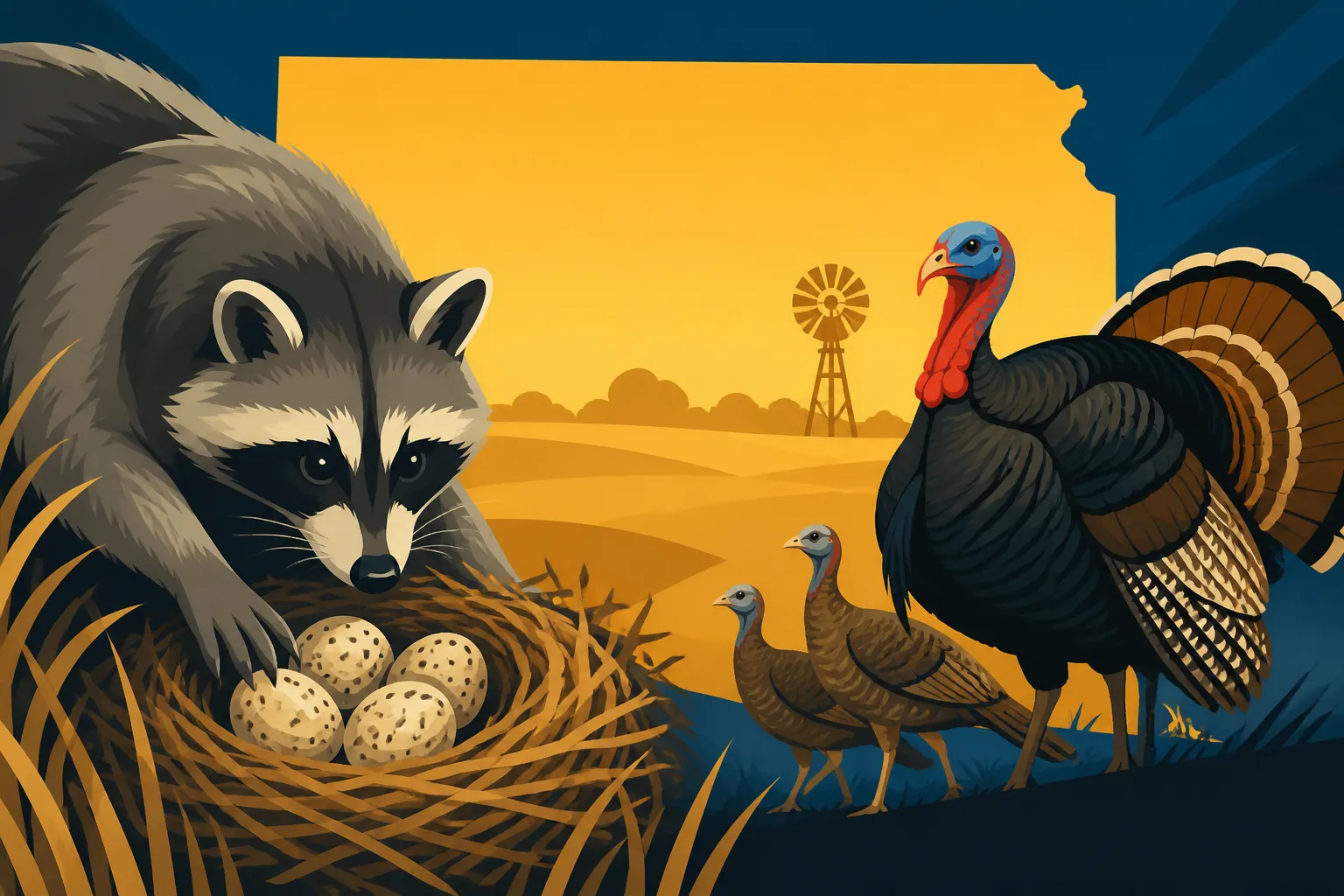
Raccoons, opossums, and skunks are arguably some of the most consistent and destructive nest predators. These nocturnal foragers are incredibly adept at finding nests, primarily through their keen sense of smell. Raccoons, in particular, are notorious for systematically raiding nests. They are clever, agile, and abundant across most of Kansas, especially in areas with timber, water sources, and agricultural fields. An opossum, while perhaps less agile, is equally opportunistic and will devour an entire clutch of eggs if it finds a nest. Skunks are another common culprit, often leaving behind a tell-tale odor after a successful raid.
Beyond these smaller omnivores, larger predators like coyotes, bobcats, and foxes also play a significant role. While they might prey on eggs, their impact can be even more devastating as they are capable of killing the nesting hen herself, in addition to her eggs or newly hatched poults. Coyotes are incredibly adaptable and their populations are robust throughout Kansas. A coyote patrolling a field edge or a creek bottom can easily stumble upon a nest. Similarly, bobcats, with their stealth and predatory skill, pose a serious threat to both eggs and adult birds, especially in areas with good cover, which aligns with how they operate in habitats where deer might be found, as discussed in CRP Acres and Kansas Deer Numbers.
Avian and Reptilian Threats
It's not just mammals that seek out turkey nests. Crows, for example, are highly intelligent and opportunistic birds. They use their keen eyesight to spot nesting hens or even the subtle disturbances around a nest site. Once a nest is located, a flock of crows can quickly descend and decimate a clutch of eggs. Their presence can be a frustrating sight for landowners and hunters alike, knowing the damage they can inflict on future turkey numbers.
Snakes, particularly larger species found in Kansas, also contribute to nest predation. While they might not actively hunt for nests in the same way a raccoon does, they will readily consume eggs or even newly hatched poults if they encounter them. A large rat snake or bull snake could easily swallow an entire turkey egg. Their silent, stealthy movement makes them particularly effective, as the hen might not detect them until it's too late. The cumulative effect of all these different predators, each employing its own tactics, creates a relentless pressure on nesting hens.
Habitat, Weather, and Predator Impact: A Complex Relationship
The impact of nest predation isn't static; it ebbs and flows with the quality of the habitat and the vagaries of the weather. It's a complex ecological dance where environmental factors can either offer a buffer or create a perfect storm, making nests more or less vulnerable. Understanding this relationship is key to appreciating why turkey numbers can fluctuate so dramatically and why simple solutions are rarely effective. This is where truly informed conservation efforts, sometimes aided by detailed mapping tools like those offered by GoHunt, can make a difference in identifying critical areas.
For example, a severe drought might reduce natural food sources for predators, driving them to rely more heavily on easy meals like turkey eggs. Conversely, a habitat rich in diverse cover and alternative prey might dilute predator pressure on turkey nests. It's never just one thing; it's a dynamic system where every piece influences the next. This interconnectedness highlights why broad-stroke management often falls short without considering the localized ecological context.
The Role of Habitat Quality
High-quality nesting and brood-rearing habitat is the first line of defense against nest predation. When hens have access to dense, robust cover, they can better conceal their nests. Think about tall, native grasses, thick plum thickets, or areas of undisturbed timber with good undergrowth. These types of habitats provide both visual and olfactory concealment, making it harder for predators to locate nests. If the habitat is sparse or fragmented, hens are forced to nest in suboptimal locations, increasing their chances of being discovered. This is a common issue in heavily agricultural areas where suitable nesting cover might be limited to narrow strips or fencerows.
Furthermore, a diverse habitat provides alternative food sources for predators. If a coyote can easily find mice, voles, or rabbits in healthy grasslands, it might be less inclined to actively search for turkey nests. Habitat management that promotes overall ecosystem health can indirectly benefit turkey nesting success. This includes practices like planting native grasses, managing timber stands for diverse understory, and protecting wetlands. For landowners, understanding how to improve these features on their property can be crucial, which is where resources on topics like Kansas Landowner Permission Basics might come into play for larger-scale efforts. Using tools like GoHunt can help identify existing cover and plan for enhancement.
How Weather Influences Success
Weather patterns can profoundly impact both nesting success and predator activity. A prolonged period of cold, wet weather during the nesting season can be detrimental. Hens might be forced to sit tighter on their nests to keep eggs warm, increasing their exposure to predators. Heavy rains can flood nests in low-lying areas, or make the scent of a nest more apparent to olfactory predators like raccoons. These conditions can also reduce poult survival directly, even if the eggs hatch successfully, as young poults are highly susceptible to hypothermia and drowning. This connection to Turkey Poult Survival and Rainfall is undeniable.
On the other hand, a hot, dry spring might reduce the amount of dense, green cover available for nesting, forcing hens to choose less secure sites. It can also make water sources more concentrated, inadvertently drawing both turkeys and predators to the same locations. The timing of weather events is also critical. A late spring snow or a sudden cold snap after poults have hatched can wipe out an entire brood. These environmental stressors, when combined with consistent predator pressure, create a formidable challenge for turkeys trying to reproduce and rebuild their numbers.
Managing Predator Impact: What Can Be Done (and What Can't)
Addressing the issue of nest predation is complex and requires a multi-faceted approach. There's no single magic bullet, and expectations need to be realistic. Hunters and land managers often feel a sense of frustration, wanting to "do something" to help the turkeys, but understanding the limits of our influence is important. The goal isn't necessarily to eliminate all predators—which is impossible and undesirable for ecosystem health—but to balance the scales in favor of nesting turkeys.
For individuals keen on understanding the lay of the land, tools like GoHunt's mapping features can be instrumental in identifying potential nesting cover, escape routes, and even areas where predator sign might be concentrated. This kind of detailed reconnaissance can inform more targeted management actions, whether on private property or when considering areas for Run-and-Gun Turkey Tactics on Kansas Walk-In Ground on public ground. It's about working smarter, not just harder.
Localized Predator Control
Targeted, localized predator control can be a tool in specific situations, particularly on private land where intensive management is feasible. This usually involves trapping and removing common nest predators like raccoons, opossums, and skunks during the late winter and early spring, just before the turkey nesting season begins. The aim is to temporarily reduce the local density of these predators during the most critical time for turkey reproduction. However, it's a labor-intensive effort that requires consistent follow-up, as these predators are highly mobile and populations can rebound quickly.
It's important to note that broad-scale predator extermination is neither practical nor ethical, and can have unintended negative consequences for the ecosystem. The focus should always be on strategic, well-planned efforts in specific areas to alleviate pressure during critical nesting periods. For those looking to implement such measures, familiarizing oneself with local regulations regarding trapping and removal is paramount. Understanding Kansas Wildlife Disease Monitoring can also play a role, as some predators are vectors for diseases that can impact wildlife.
Habitat Enhancement as a Long-Term Solution
Perhaps the most effective long-term strategy for mitigating nest predation is through robust habitat enhancement. Creating and maintaining diverse, dense nesting cover and secure brood-rearing areas provides turkeys with the best chance of successful reproduction. This means planting warm-season grasses, managing timber to create a mosaic of open and brushy areas, and protecting existing shrub thickets. Hens that have ample, high-quality cover are simply better at hiding their nests and their poults.
Good habitat also ensures that hens are healthier and more resilient, able to withstand the stresses of nesting and brood-rearing. This involves providing reliable food sources and water, which also benefit a wide range of other wildlife. Landowners working to create better turkey habitat are making an investment that pays dividends for the entire ecosystem. It's a foundational approach that addresses the root cause of vulnerability, giving turkeys the tools they need to thrive. This kind of planning can be greatly assisted by detailed mapping and land management features found in applications like GoHunt, allowing users to visualize and plan habitat improvements directly on aerial imagery.
Hunter Responsibility and Expectations
As hunters, our role in addressing nest predation primarily revolves around supporting sound wildlife management practices and advocating for habitat conservation. While individual efforts on private land can make a difference, the broader challenge requires collaborative, science-based approaches. This includes supporting programs that incentivize habitat improvements on private lands, understanding and respecting regulations related to predator control, and contributing to organizations dedicated to turkey conservation.
It's also crucial to maintain realistic expectations. Wildlife populations are cyclical, and many factors beyond human control—like large-scale weather events—will always play a role. However, by understanding the challenges, especially the insidious pressure of nest predation, we can become more informed stewards of the resource. Continuing to educate ourselves on turkey biology and management, for example, by learning about Calling a Henned-Up Kansas Gobbler and other behaviors, helps us appreciate the intricate lives of these birds and the efforts required to ensure their future.
Disclaimer
This article is for general informational purposes only and does not constitute professional advice. Laws, prices and regulations vary by location and change over time. Consult a qualified professional for guidance on your specific situation.