Access Routes That Avoid Bedding Areas
We’ve all been there: slipping into the woods before dawn, heart pounding with anticipation, only to hear that tell-tale snort and crashing through the timber as a deer blows out of its bed, long before you even reach your stand. It’s incredibly frustrating, and it feels like you’ve just sabotaged your entire hunt before it even began. The truth is, how you get to and from your stand or hunting location is just as crucial as the location itself. This guide is all about mastering the art of the stealthy approach, helping you understand how to design and execute access routes that consistently avoid bumping deer from their bedding areas in Kansas, giving you the best chance at a successful and quiet hunt.
Understanding Deer Bedding Habits in Kansas
To effectively avoid deer, you first need to understand where they prefer to rest and hide. Deer aren't just randomly plopping down anywhere; they're incredibly strategic about their bedding choices, always prioritizing safety, warmth (or coolness), and proximity to food and water. Ignoring these preferences is a surefire way to walk right through their living room.
Key Bedding Locations in Different Kansas Habitats
Kansas offers a diverse landscape, and with it comes a variety of preferred bedding cover for whitetails. Knowing these spots is paramount.
In the rolling plains and agricultural areas, which make up a significant portion of Kansas, deer often bed in thick CRP (Conservation Reserve Program) grasses. These dense, chest-high fields provide excellent concealment from both predators and human activity. Bucks, especially, will often seek out the tallest, thickest pockets within these fields, or even slightly elevated areas that offer a vantage point. Don't be fooled by the openness of farm country; a buck can vanish in a seemingly sparse patch of grass. Similarly, standing crops like corn or milo, particularly during the early archery season, are absolute deer magnets. They offer incredible cover and a readily available food source, often acting as temporary bedding areas where deer will spend their entire day without moving far. Understanding how deer utilize CRP Grass and Where Bucks Bed can be a game-changer for your scouting.
As you move into areas with more timber, such as river bottoms and creek draws, the bedding changes. These areas provide vertical cover and often deeper, cooler shade, which is vital during warm early seasons. Deer will gravitate towards thick cedar thickets, which offer excellent thermal cover in winter and dense visual obstruction year-round. These evergreens are nature's deer blind. You’ll also find deer bedding in brushy draws, often just slightly off the main timber block but close enough for a quick escape into heavier cover. Even a small, gnarly patch of multiflora rose or honeysuckle can hold deer. Large, mature timber stands don't usually offer primary bedding unless they have a very thick understory, but the edges of these blocks, especially where they transition into dense brush or CRP, are prime real estate. If you’re hunting in areas with Cedar Thickets as Bedding Cover, pay close attention to the prevailing winds.
Factors Influencing Bedding Site Selection
Deer are constantly evaluating their environment, and several factors dictate where they choose to bed down. It's a complex equation of safety and comfort.
First and foremost is wind direction. Deer almost always bed with the wind at their back, allowing them to detect danger approaching from behind with their nose, while their eyes and ears cover their front. This is why a sudden shift in wind can completely alter a deer's bedding choice, sending them scurrying to a new location that provides the same wind advantage. Topography, even subtle changes, plays a huge role too. A slight rise, a ditch, or even a levee along a field edge can offer a crucial vantage point or hide a deer completely. In flat country, any minor elevation change can become a preferred bedding spot because it allows a deer to see over its surroundings. A buck might bed on a slight ridge within a CRP field, or just inside a creek bank, to gain a visual advantage.
Pressure is another massive factor. Heavily hunted areas will see deer seeking out the most inaccessible, thick, and overlooked spots to bed. This means they might forgo ideal food-proximate bedding for areas that offer maximum security. Food and water proximity are also key, especially when deer are trying to conserve energy. During the rut, bucks might bed closer to known doe hangouts. In early season, deer will bed close to reliable water sources like ponds or creek beds, especially during warm weather. Understanding these nuances, like how deer adapt to Hunting Pressure Patterns on Kansas Public Land, is crucial for successful hunting year after year.
Principles of Stealthy Access Route Planning
Once you know where deer are likely to be, the next step is planning how to get to your hunting spot without alerting them. This isn't just about being quiet; it's about being invisible to their keen senses. Think of it like a chess match – you're trying to outmaneuver an opponent with superior sensory abilities.
Utilizing Wind and Thermals for Your Approach
The wind is your best friend and your worst enemy in deer hunting. Your scent is the easiest way for a deer to bust you, making wind direction the single most critical factor in planning your access. You must always approach your stand with the wind in your face or on a crosswind, ensuring your scent cone is blowing away from potential bedding areas and your ultimate stand location. Never, ever walk directly downwind of where you suspect deer are bedding or feeding. It's a guaranteed way to send them packing.
Thermals, which are rising and falling air currents, complicate things, especially in areas with elevation changes, even subtle ones like creek banks or timbered ridges. In the morning, as the sun rises, air warms and begins to rise (uphill thermals). This means your scent will be carried upwards. In the evening, as the air cools, it sinks (downhill thermals), carrying your scent downwards. This phenomenon is particularly noticeable in river bottoms or creek draws. So, if you're hunting an evening stand in a river bottom, approaching from above and walking downwind might seem smart, but if the thermals are falling, your scent will sink directly into the bottom, alerting anything below. Conversely, for a morning hunt, an uphill approach might keep your scent above deer as thermals rise. It's a delicate balance and requires paying close attention to current conditions, which you can learn more about in Wind and Thermals on a River Bank.
Visual Cover and Noise Reduction
Deer have incredible eyesight, especially for movement, and their hearing is highly attuned to unnatural sounds. This means you need to be both unseen and unheard.
When planning your route, prioritize paths that offer maximum visual cover. This could be walking along the back side of a timbered ridge, sticking to the deep shadows of a creek bottom, or utilizing the cover of tall grass or standing crops. Avoid silhouetting yourself against the sky, especially when cresting rises or walking along open field edges. Even subtle dips in terrain, fence lines, or hedgerows can provide enough visual breaks to keep you hidden. Many mapping apps, like the excellent tools available on GoHunt, allow you to visualize topography and potential cover.
Noise reduction is equally vital. Wear soft, quiet clothing that won't rustle against branches. Avoid jingling keys, clanking gear, or loose items in your pockets. Walk slowly and deliberately, placing each foot carefully to avoid snapping twigs or shuffling leaves. If you must cross an open area, do it quickly and quietly, ideally during a natural break in deer movement or when their attention is diverted. Sometimes, walking on a softer surface, like a damp path or through dewy grass, can significantly reduce your noise signature. The goal is to blend into the natural sounds of the environment, making you just another rustle in the woods, not an alarm bell. Remember, you want to be able to follow Access Routes That Do Not Bump Deer.
Time of Day and Hunter Traffic Considerations
The time you choose to access your stand can drastically impact your success, especially concerning deer activity and other hunters.
For morning hunts, arriving well before legal shooting light is essential. Deer are often still active, moving from feeding areas back to beds, or lingering in transition zones. Giving yourself ample time to walk in slowly, quietly, and set up in the dark reduces the chance of bumping deer already in the area. The cover of darkness is your friend. However, this also means knowing your route intimately to avoid getting lost or making unnecessary noise.
Evening hunts present a different challenge. Deer will begin moving from bedding areas towards food sources as dusk approaches. You want to be in your stand and settled long before this movement starts. This often means accessing your stand in the mid-afternoon, giving the woods time to settle down after your disturbance. On public lands or popular Walk-In Hunting Access (WIHA) tracts, considering other hunters' movements is critical. If everyone walks the same path, deer quickly learn to avoid it. Varying your approach or timing can help reduce the impact of Hunting Pressure Patterns on Kansas Public Land. Using tools like GoHunt to scout and plan alternate routes can be invaluable.
Practical Application: Designing Your Access Routes
Knowing the theory is one thing, but putting it into practice requires careful planning and adaptability. This is where your scouting and mapping skills come into play.
Mapping and E-Scouting for Ideal Paths
The first step in designing effective access routes happens long before you ever set foot in the woods. E-scouting from home using satellite imagery and topographic maps is a game-changer. Services like GoHunt, onX Hunt, or Google Earth allow you to meticulously study the terrain, identify potential bedding areas, and trace out the quietest, most concealed paths.
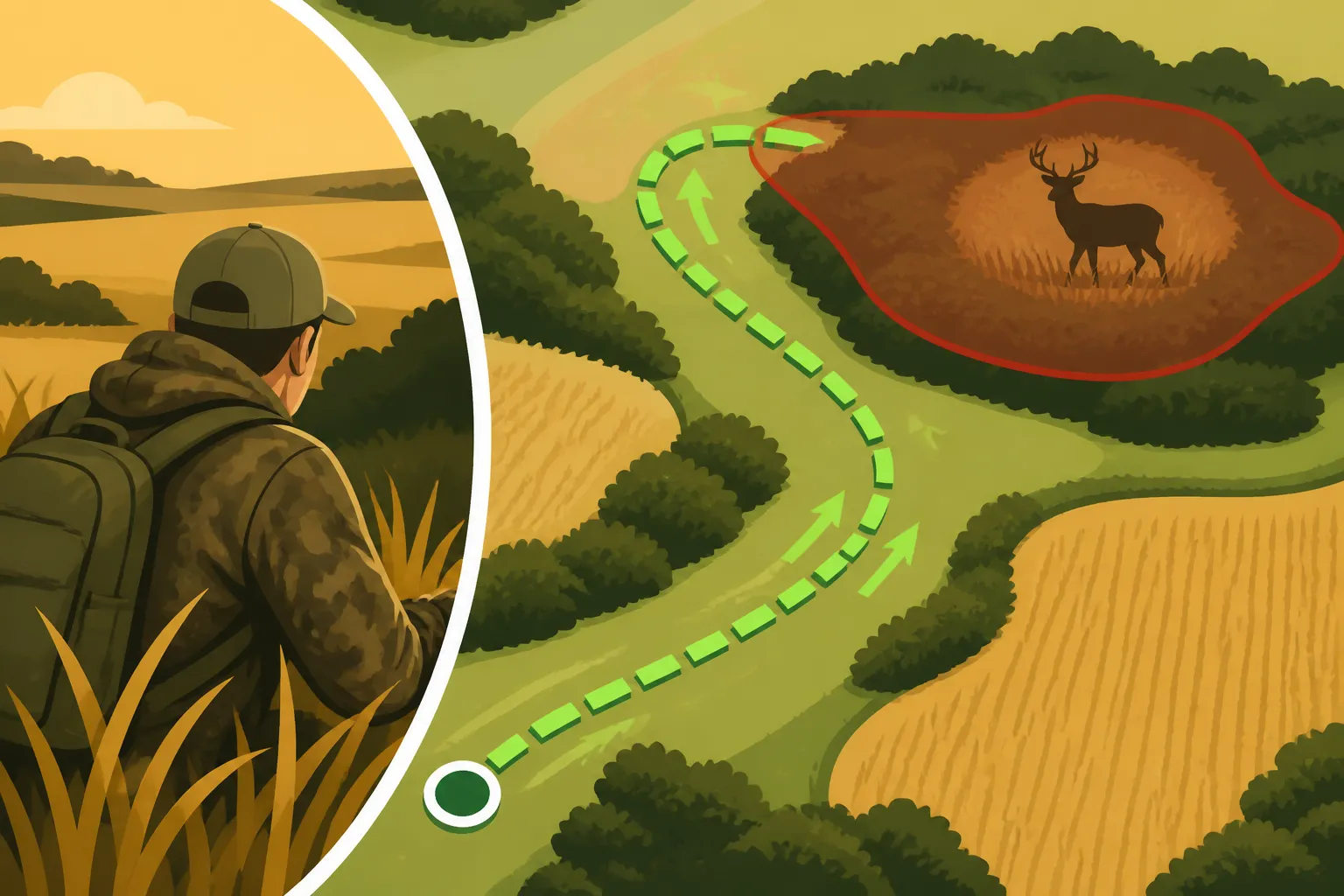
Start by marking all known or suspected bedding areas. These might be thick cedar patches, dense CRP fields, river bottom oxbows, or standing corn. Then, mark your desired stand locations, which should be based on food sources, travel corridors, or pinch points. Now, draw lines connecting your parking spot to your stand, making sure these lines avoid the bedding areas. Look for natural funnels or barriers that can serve as your highway. This could be a drainage ditch, a fenceline with tall weeds, the backside of a timber block, or a creek bed (if it's dry and quiet). For example, if you're hunting a timber point jutting into a crop field, your access might be along the opposite edge of the timber, using the trees as a visual and sound buffer. You can find more tips on this in E-Scouting Kansas Farm Country From Home.
When e-scouting, pay close attention to:
- Contour Lines: Identify low spots, ridges, and terrain breaks that offer cover.
- Vegetation Changes: Look for transitions from open fields to dense brush or timber.
- Waterways: Creeks, ditches, and river channels can sometimes provide excellent concealed access, but be mindful of thermals and water levels. Learning to identify specific deer sign, like in Reading a Kansas Creek Bottom for Deer Sign, will help you confirm these areas on the ground.
- Property Lines/Fences: These often create edges that deer use, but also lines that can offer you cover.
Always map out at least two or three different access routes for each stand, accounting for varying wind directions. Having options means you won't be forced to compromise your approach on a given day.
Real-World Scenarios and Adjustments
Let's imagine a few common Kansas hunting scenarios and how to apply these principles.
Scenario 1: Hunting a Timber Edge Bordering a Large Crop Field
You've identified a stand site on the inside corner of a standing cornfield, where deer transition between bedding in a thick woodlot and feeding in the corn. The primary bedding area is deep within the timber.
- Bad Access: Walking directly along the cornfield edge, exposing yourself to deer already in the field or approaching the timber.
- Good Access: Approaching from the back of the timber, well away from the cornfield and the expected deer movement. Utilize a ditch or a slight ridge line behind the main timber block for visual cover. Once you get parallel with your stand, slowly and quietly angle into the timber, keeping the wind in your face, and slip into your stand. If the wind isn't right for this approach, consider a different stand or wait for a different day. For more on this, check out Hunting Inside Corners of Crop Fields.
Scenario 2: Hunting a CRP Field with a Central Bedding Area
You've scouted a mature buck bedding in a particularly thick patch of CRP in the middle of a large field. Your stand is on a small, isolated timber point adjacent to the CRP, offering a shot opportunity when the buck eventually moves.
- Bad Access: Walking directly through the CRP field or along its most obvious edge.
- Good Access: This requires careful wind planning. If the wind allows, circle wide around the entire CRP field, staying as far from the bedding area as possible, possibly using a road ditch or fenceline for cover. Approach the isolated timber point from the side opposite the bedding area, ensuring your scent is blowing away from the CRP. The key here is not disturbing that central bedding spot. Using a detailed map from GoHunt can help you visualize these wide, sweeping approaches.
Here's a quick table to summarize some common access route types:
| Access Route Type | Pros | Cons | Best Use Case |
|---|---|---|---|
| Creek Bottom/River Bank | Excellent visual cover, muffles sound | Can be muddy, noisy with water, thermals can be tricky | Approaching stands in timbered draws or river bottoms |
| Field Edge (Opposite Side) | Relatively easy walking | Less visual cover than timber, requires good wind | Skirting large fields to access timber points |
| Backside of Ridge/Timber | Keeps you hidden from main deer activity | Might be longer, more physically demanding | Approaching stands on ridge lines or deep timber |
| Tall Standing Crops | Incredible visual and scent concealment | Very noisy, easy to bump deer already inside, seasonal | Early season access to interior field stands |
| Brushy Draw/Fence Line | Good visual cover, natural travel corridors | Can be noisy pushing through brush, limited options | Accessing stands in transition areas |
Remember to always be prepared to adjust. A sudden wind shift, unexpected deer movement, or encountering another hunter might require you to abort an approach or quickly find an alternative. That's why having multiple pre-scouted routes is so important.
Avoiding Common Access Route Mistakes
Even experienced hunters can make mistakes with their access, often due to complacency or underestimating a deer's senses. Being mindful of these pitfalls can save your hunt.
The Dangers of "Easy" Routes
It's tempting to take the path of least resistance: the old two-track road, the well-worn game trail, or the straightest line from your truck to your stand. But these "easy" routes are often the most problematic. Deer are incredibly adept at recognizing patterns, especially human patterns. If you consistently use the same path, deer will quickly learn to avoid that area during certain times of the day, or worse, they'll simply blow out before you get close.
Think about it: an old farm road might be easy to walk, but it often lacks visual cover and carries your scent over a wide area. A well-used deer trail is a convenient path, but it's also a highway for deer, meaning you're far more likely to encounter them unexpectedly and at close range, leading to a blown encounter. These routes often cut directly through or too close to active bedding or feeding areas simply because they're the most direct. The lesson here is that the most convenient route for you is rarely the most effective or stealthy route for hunting. This concept ties directly into the idea of Hunting Kansas Walk-In Land Without Burning It Out, where thoughtful access prevents educating deer to your presence.
Over-Pressuring Entry and Exit Points
Just like you can over-pressure a stand, you can absolutely over-pressure your access routes. Constantly walking the same path, leaving too much scent, or making too much noise can turn even a good access route into a liability. Deer will start to associate those areas with human presence and shift their patterns.
To combat this, try to vary your access points if possible, especially on larger tracts of land or WIHA properties. Even subtle variations, like walking 10 yards to the left or right of your usual path, can make a difference. Minimize the amount of scent you leave behind by showering with scent-free soap, wearing clean hunting clothes, and using scent-control sprays. Avoid touching vegetation unnecessarily.
Your exit strategy is just as important as your entry. Many hunters are less careful on their way out, but a noisy or scent-laden exit can ruin the next day's hunt. If possible, plan an exit route that takes you away from prime bedding areas, even if it's a longer walk. If you must walk through an area where deer might be, move slowly and deliberately, just as you would on your entry.
The goal is to be a ghost in the woods. Plan your approach meticulously, respecting the deer's senses and their need for security. By understanding where they bed, how wind and thermals affect scent, and utilizing cover to your advantage, you'll significantly increase your chances of slipping into your stand undetected and having a successful hunt in Kansas.
Disclaimer
Hunting is an inherently dangerous activity. Always prioritize safety, understand and obey all local, state, and federal hunting regulations, and ensure you have proper training and equipment. The information provided here is for educational and entertainment purposes only and should not replace professional guidance or official regulations.