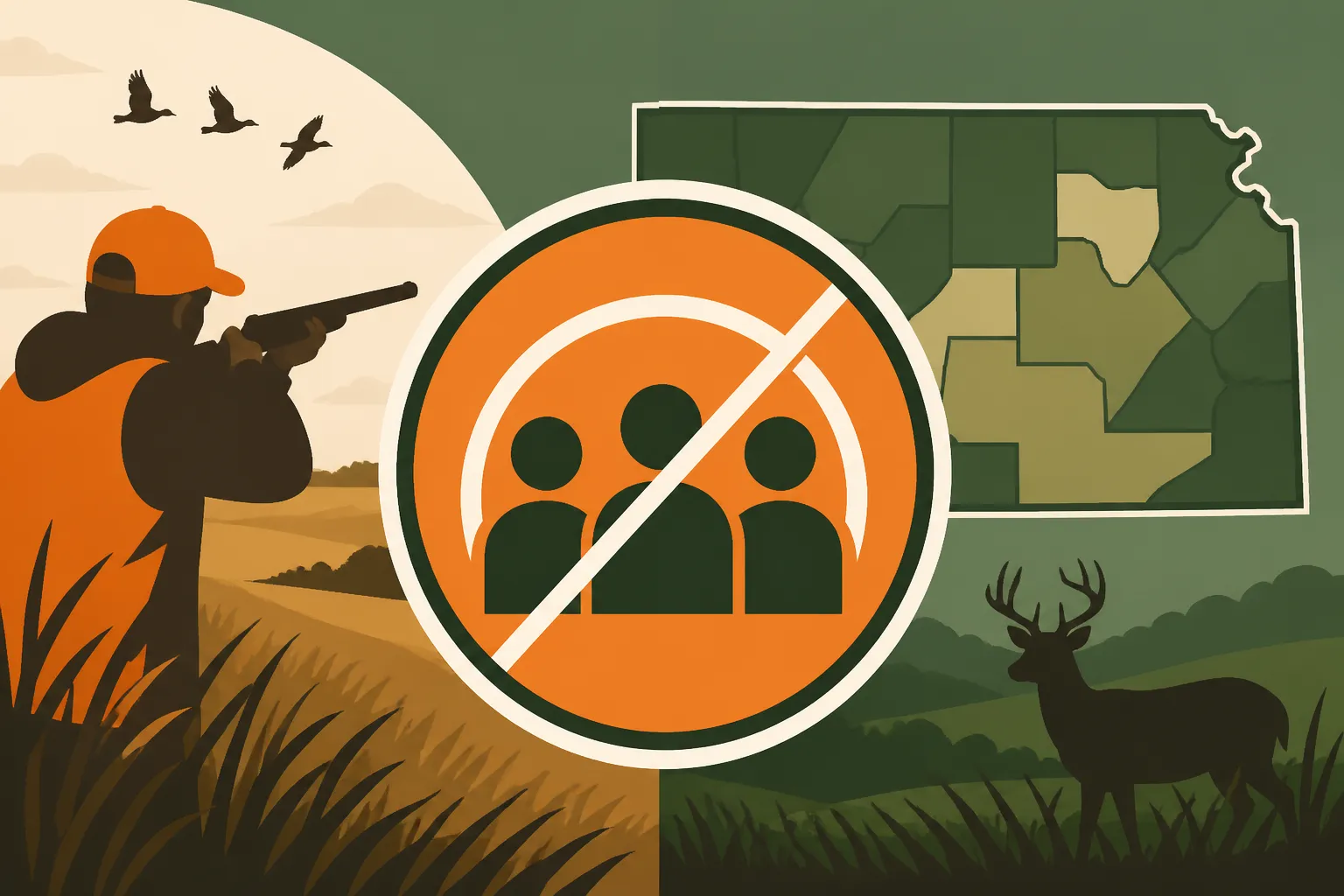
Daily Capacity Limits on iWIHA Tracts
It's incredibly frustrating, isn't it? You've spent hours poring over maps, driven miles to a promising public land spot, only to pull out your phone and see that familiar "Capacity Reached" message on the iWIHA app. All that effort, all that anticipation, sometimes even an early morning alarm, feels wasted. This guide is all about demystifying Kansas's iWIHA daily capacity limits, explaining why they exist, how they actually work, and, most importantly, how you can strategize to still get your hunt in without tearing your hair out.
The Frustration of iWIHA Capacity Limits and What They Mean
Let's be real, the idea of limiting hunter numbers on a public tract can feel like a slap in the face when you're just trying to enjoy the outdoors. We’ve all been there: you meticulously planned your day, got all your gear ready, and then the digital gatekeeper says, "Nope, not today." It's enough to make you wonder if public land is even worth the effort sometimes. But these capacity limits, while annoying in the moment, are put in place for a few key reasons that ultimately aim to improve the hunting experience for everyone and manage the wildlife resources effectively.
Understanding the iWIHA Program and Its Intent
First, a quick refresher on iWIHA. The "i" stands for "interactive," distinguishing these tracts from the standard Kansas Walk-In Hunting Access (WIHA) program. While both are fantastic programs that open up private land to public hunting, iWIHA tracts have specific, often smaller, acreage and are managed with a real-time check-in/check-out system via the KDWP Go Outdoors Kansas platform. This system is crucial for enabling the daily capacity limits.
The intent behind iWIHA is noble: to offer a higher quality, less pressured hunting experience on particular parcels. Think about it from a land manager's perspective, or even a landowner's. If an exceptional 80-acre timber block consistently sees 20 hunters a day, it's not long before deer patterns are disrupted, the hunting experience becomes less enjoyable due to crowding, and the resource itself could suffer from over-pressuring. The capacity limits are designed to prevent exactly this. They aim to disperse pressure, give hunters a better chance at encountering unmolested game, and preserve the quality of the habitat. It doesn't make the "Capacity Reached" message any less painful when you're standing there, but understanding the why can help temper the immediate frustration. It's about trying to balance access with quality, a tough tightrope walk for any wildlife agency. If you're looking for more general information, our guide on How Kansas WIHA Works dives deeper into the overall program.
Why Some Tracts Fill Up Faster Than Others
Not all iWIHA tracts are created equal, and neither are their capacity limits or how quickly they fill. Some might have a limit of 3 hunters, while others can accommodate 10 or more. The factors that influence how fast a tract reaches its capacity are pretty straightforward:
- Proximity to Population Centers: Tracts near Wichita, Topeka, or Kansas City often see higher traffic simply because more hunters live nearby. They're easy day trips.
- Perceived Quality: If a particular iWIHA tract has a reputation for holding big bucks or high pheasant numbers, word spreads fast, and hunters will flock to it. Online forums and local chatter can quickly highlight these "honey holes."
- Habitat Type: A prime piece of timber that acts as a natural funnel or a dense CRP field known for holding birds will naturally attract more attention than a less diverse landscape.
- Time of Year and Season: During prime times like the Kansas rut or the opening weekend of pheasant season, all public land, including iWIHA, sees increased pressure. A tract that might be open mid-week in October could be full before dawn on a November Saturday. For more insights on pressure, read our article on Hunting Pressure Patterns on Kansas Public Land.
The reality is, these desirable spots fill up quickly. It's not a conspiracy; it's just basic supply and demand playing out in the hunting world. This knowledge, however, can be leveraged to help you predict when and where you might encounter these frustrating capacity limits.
Navigating the iWIHA Check-In System and Capacity Realities
Okay, so you understand why the limits exist. Now, let's talk about the practical side of dealing with them. The process itself is digital, designed for efficiency, but it can still be a source of anxiety. Knowing exactly how it works and what to expect can save you a lot of headache.
The Digital Gatekeeper: Checking In and Out
The cornerstone of the iWIHA system is the KDWP's Go Outdoors Kansas mobile app or its corresponding website. This is your portal to checking into and out of designated iWIHA properties. Here's a general overview of the process:
- Locate the Tract: You'll use the app or the Kansas Hunting Atlas online (a fantastic tool, by the way, for Using the Kansas Hunting Atlas Online) to find iWIHA tracts. They're clearly marked, and the app will show you which ones are "i" tracts.
- Initiate Check-In: When you arrive at or near your desired iWIHA tract, you open the app, select the tract, and attempt to "check in." The system uses your phone's GPS to confirm you are within an appropriate range of the property.
- Capacity Check: This is the critical moment. The app will instantaneously tell you if there is space available. If the tract's daily capacity has not been met, you'll be able to successfully check in, and your spot is secured. You are then "on the property" digitally.
- "Capacity Reached": If the maximum number of hunters for that day has already checked in, the app will display a message stating "Capacity Reached" or something similar. At this point, you cannot access the property for hunting, even if you physically walk onto it. Your only option is to wait for someone to check out.
- Check Out: When you finish your hunt, you must check out using the app. This releases your spot, making it available for another hunter. This is a crucial step that some forget, inadvertently keeping a spot occupied longer than necessary.
It's important to remember that these limits are enforced digitally. There might not be a physical sign or gate telling you to turn around. The system relies on your compliance. Trying to hunt an iWIHA tract after it's shown "Capacity Reached" on your app is a violation of the rules, plain and simple.
The Waiting Game: Does it Ever Open Up?
This is where the real-world frustration hits hard. You've driven an hour, it's still dark, and the app says "Capacity Reached." So, what now? Do you wait? Does it ever open up?
The answer is, sometimes, but it’s rarely guaranteed. People do check out. A hunter might come out early, tag out, or simply decide to try another spot. The problem is, you don't know when that will happen, or if someone else is also waiting and checks in before you can.
Imagine this scenario: you're waiting in your truck at the edge of an iWIHA tract. You refresh your app every few minutes, hoping for an opening. Another hunter, perhaps just as eager, is doing the same thing from their vehicle a mile down the road, or even from their home if they're close enough to the tract's virtual boundary. When a spot opens, it's a race to hit that "check in" button. This can feel incredibly inefficient and can waste precious hunting time, especially in the early morning or late afternoon when game movement is highest. It's a gamble, and for many, the uncertainty simply isn't worth it. This is where planning with tools like GoHunt can really shine, allowing you to scout alternatives quickly.
Real-World Examples and Predictable Pressure Points
Certain iWIHA tracts have become legendary (or infamous, depending on your perspective) for how quickly they fill. During the peak of November's rut, prime timber tracts with good deer sign near population centers can be full by 4:30 AM on a Saturday. Similarly, on the opening day of pheasant season, expanses of CRP or milo fields in western Kansas will see limits hit just as fast.
Consider a popular iWIHA tract like one within the range of Public Land Deer Hunting in Kansas or any tract known for holding good numbers of deer near areas like Topeka or Kansas City. These spots often have small capacities (e.g., 2-4 hunters) and can be full for the entire morning, sometimes even the whole day, on weekends during the firearm season. If you're planning to hunt one of these high-demand spots, especially on a Saturday or Sunday, you absolutely need a Plan B, C, and maybe even D.
| Factor | High Likelihood of Capacity Limit Reached | Low Likelihood of Capacity Limit Reached |
|---|---|---|
| Day of Week | Saturday, Sunday, Holiday | Weekday (Tuesday-Thursday) |
| Time of Day | Pre-dawn, first hour after sunrise; last hour before sunset | Mid-morning, early afternoon |
| Season & Species | Peak Deer Rut (Nov), Opening Pheasant/Quail, Early Duck | Late season, less popular species (e.g., small game in non-prime areas) |
| Tract Reputation | Known "honey holes," high success rates | Lesser-known, harder-to-access, lower density |
| Weather Conditions | Mild, clear, post-front good conditions | Extreme cold/heat, heavy rain/snow, high winds |
| Acreage & Habitat | Small, prime timber or dense cover | Large, open fields with limited cover |
| Proximity to Cities | Close to major population centers | Remote, rural areas |
This table isn't foolproof, but it gives you a general idea of when to expect maximum competition for those coveted iWIHA spots.
Strategies to Maximize Your Chances on iWIHA Tracts
Given these realities, simply showing up and hoping for the best is a recipe for disappointment. Smart planning and a flexible mindset are your greatest assets. It's about working with the system and anticipating hunter behavior.
Timing is Everything: Be an Early Bird (or a Patient Owl)
The most straightforward strategy for popular iWIHA tracts is to get there early. And by early, I mean really early. If legal hunting light is 6:30 AM, you should probably be at the tract, checked in, and preparing your walk by 5:00 AM. This gives you a significant advantage, especially on weekend mornings or during peak rut. If you're struggling to locate good public land, check out our guide on Finding Public Access in Kansas.
However, "early bird" isn't the only strategy. If you can't be first, being patient might be your second best bet. Some hunters will leave mid-morning for breakfast or to switch spots. If you're flexible and can hunt a longer day, sometimes a spot opens up between 9:00 AM and 11:00 AM, or even in the early afternoon. This is less ideal for prime game movement, but if getting any hunt in is the goal, it's an option.
Weekday Versus Weekend Hunting: A Stark Contrast
This is perhaps the most impactful strategy for dealing with capacity limits. The difference in pressure between a Saturday and a Tuesday can be absolutely night and day. If your schedule allows, prioritize hunting iWIHA tracts on weekdays, particularly Tuesday, Wednesday, or Thursday. You'll often find fewer hunters, less competition for spots, and a more relaxed hunting experience.
Weekday hunting not only increases your chances of securing a spot but can also lead to encounters with deer that haven't been pushed and prodded all weekend. They might be more likely to stick to their natural patterns, which you can often discern through Reading a Kansas Creek Bottom for Deer Sign or by studying satellite imagery. For a deeper dive into this topic, our article on Weekday Versus Weekend Public Land offers more insights.
Always Have a Backup Plan (or Three)
This cannot be stressed enough: never go into an iWIHA hunt with only one target tract. If you do, you're setting yourself up for disappointment. Before you leave home, identify at least two or three alternative iWIHA tracts (or even regular WIHA or state wildlife areas) within a reasonable driving distance.
Use mapping applications like GoHunt to mark these backup locations on your phone. GoHunt's detailed maps allow you to overlay public land boundaries and quickly identify nearby options. This way, if your primary iWIHA spot is full, you can immediately navigate to your next choice without wasting valuable hunting time figuring out where to go next. Sometimes, driving an extra 15-20 minutes to a less popular (but still productive) tract is well worth the effort to avoid the "Capacity Reached" frustration. You can find more comprehensive advice on preparing for your hunts in our guide, Scouting Kansas Walk-In Tracts Before the Opener.
E-Scouting and Physical Scouting: Knowing Your Options
E-scouting from home is an indispensable tool for hunting iWIHA, especially when dealing with capacity limits. Before you ever leave your driveway, use satellite imagery, topographic maps, and plat maps (often available through apps like GoHunt or BaseMap) to:
- Identify Multiple Tracts: Don't just look at one. Pinpoint several iWIHA properties in your target area.
- Analyze Access Points: Where are the parking areas? Are there multiple ways to enter the property? Sometimes less obvious access points can lead to less pressured parts of a tract.
- Locate Key Habitat Features: Where's the bedding cover, food sources, and water? Where are the natural funnels or pinch points? Our guide on E-Scouting Kansas Farm Country From Home provides excellent tips for this.
- Check iWIHA Rules: Confirm the specific rules for each tract regarding things like Portable Stand Rules on Kansas Public Land or overnight storage.
Physical scouting, even a quick drive-by, can reveal recent hunter sign, parking situations, and give you a feel for the terrain that satellite imagery can't always capture. Knowing multiple tracts intimately means you can pivot quickly if your primary plan falls through.
Hunting Under-Pressured iWIHA Tracts
The secret sauce to consistent success on public land often lies in finding those overlooked spots. While popular iWIHA tracts are known, many others fly under the radar. How do you find them?
- Look for smaller, less-obvious tracts: Everyone gravitates to the big, easy-to-access parcels. Sometimes, a tiny 40-acre iWIHA that requires a longer walk or has less "glamorous" habitat can be gold, precisely because it's ignored.
- Target tracts with diverse habitat, not just prime: An iWIHA tract that's mostly open field might have a small, overlooked creek bottom or a shelterbelt that holds deer. Hunters often dismiss these in favor of dense timber.
- Hunt during off-peak times: This goes back to weekday hunting, but also includes late season, bad weather days, or even midday hunts when most hunters are taking a break.
- Expand your search: Don't just focus on the most popular units. Research Kansas Deer Units and What Each Holds and look at less-pressured units that still have decent iWIHA acreage.
By thinking outside the box and being willing to put in a little extra effort, you can find quality hunting on iWIHA even when the "premier" spots are full. And remember, always adhere to the principles of Leaving No Trace on Walk-In Ground to preserve these resources for others.
The Broader Impact of Capacity Limits on Kansas Public Hunting
While capacity limits can feel like a personal affront, they are part of a larger picture of wildlife management and public land stewardship. Understanding their broader implications can help you appreciate the goals, even if the execution sometimes causes a headache.
Influencing Hunter Dispersal and Deer Movement
One of the primary goals of iWIHA capacity limits is to distribute hunter pressure more evenly across the landscape, or at least prevent unsustainable pressure on specific small parcels. Without these limits, those highly attractive spots would become "hunter magnets," leading to several negative consequences:
- Increased Pressure on Game: Deer, pheasants, and other game animals would be constantly harassed, altering their patterns, making them more nocturnal, and pushing them off the public land entirely onto neighboring private ground where they might be inaccessible.
- Degraded Hunting Experience: No one enjoys walking into a hunting area only to find boot tracks every 10 yards or another hunter already set up within sight of their stand. Limits aim to minimize these close encounters.
- Safety Concerns: More hunters in a small area naturally increases the risk of accidents.
By capping hunter numbers, KDWP hopes to maintain a semblance of "wildness" on these tracts, allowing animals to follow more natural patterns and reducing the overall stress on the local wildlife. This can contribute to better deer herd health and more consistent opportunities for those who do get in.
The Trade-Off: Quality Versus Quantity of Access
Capacity limits represent a clear trade-off: fewer hunters on a given parcel at any one time (quantity of access) in exchange for a potentially higher-quality experience for those who are there. This is a crucial debate in public land management across the country.
For some hunters, the frustration of being turned away outweighs any perceived improvement in quality. They argue that any public access is better than none, and limiting access alienates hunters. Others strongly advocate for quality, believing that a crowded experience is not a true hunting experience at all. The iWIHA program, with its limits, leans towards prioritizing quality, aiming to make those hunts more enjoyable and productive. It’s an attempt to manage what we have responsibly, ensuring that the next generation still has quality places to hunt, not just places.
The Future of iWIHA and Potential Changes
The iWIHA program is dynamic, and KDWP regularly evaluates its effectiveness. This means the rules, the number of tracts, and even the capacity limits themselves could change over time. Factors that might influence these changes include:
- Hunter Feedback: KDWP is attentive to hunter experiences and frustrations. If there's overwhelming feedback about specific issues, they might adjust.
- Wildlife Population Trends: If deer or bird populations decline in areas with iWIHA, capacity limits might be adjusted to further reduce pressure. Conversely, if populations are robust, some limits might be relaxed or new tracts added.
- Landowner Enrollment: The program relies on willing landowners. Changes in agricultural practices, land ownership, or incentives could impact the amount of land available for iWIHA.
- Technological Advancements: The check-in system itself could evolve, potentially offering waiting lists, notification systems, or more sophisticated ways to manage hunter flow.
Keep an eye on the KDWP website and their annual hunting regulations summary for any updates or changes to the iWIHA program. It's a fantastic resource, and understanding it can make all the difference in your Kansas hunting season.
Comparing WIHA and iWIHA Rules
To further clarify, here's a table comparing some key aspects of regular WIHA and iWIHA tracts, especially concerning access and management.
| Feature | Standard WIHA Tracts | iWIHA Tracts (Interactive WIHA) |
|---|---|---|
| Check-in/Check-out | Not required | Mandatory via Go Outdoors Kansas app/website |
| Daily Capacity | No limits on hunter numbers (first-come, first-served) | Strict daily limits enforced digitally |
| Pressure Management | Relies on natural dispersal, can get crowded | Actively manages pressure for a quality experience |
| Acreage | Can range from small to very large | Often smaller, more focused parcels |
| Real-time Status | No real-time info on hunter numbers | Real-time info on availability (capacity) |
| Access | Drive up, park, walk in | Drive up, park, check in digitally, then walk in |
| Common Use | General deer, upland bird, small game hunting | Often targeting specific high-quality experiences for deer or birds |
This table highlights why iWIHA tracts, despite their smaller numbers, often command more attention and are subject to these capacity challenges.
Disclaimer
The information provided in this guide is for general informational purposes only and is not intended as legal advice. Hunting regulations in Kansas can change, and it is the responsibility of every hunter to consult the most current Kansas Department of Wildlife, Parks and Tourism (KDWP) regulations and statutes before engaging in any hunting activities. Always verify specific rules and access requirements for any public or private land you intend to hunt.