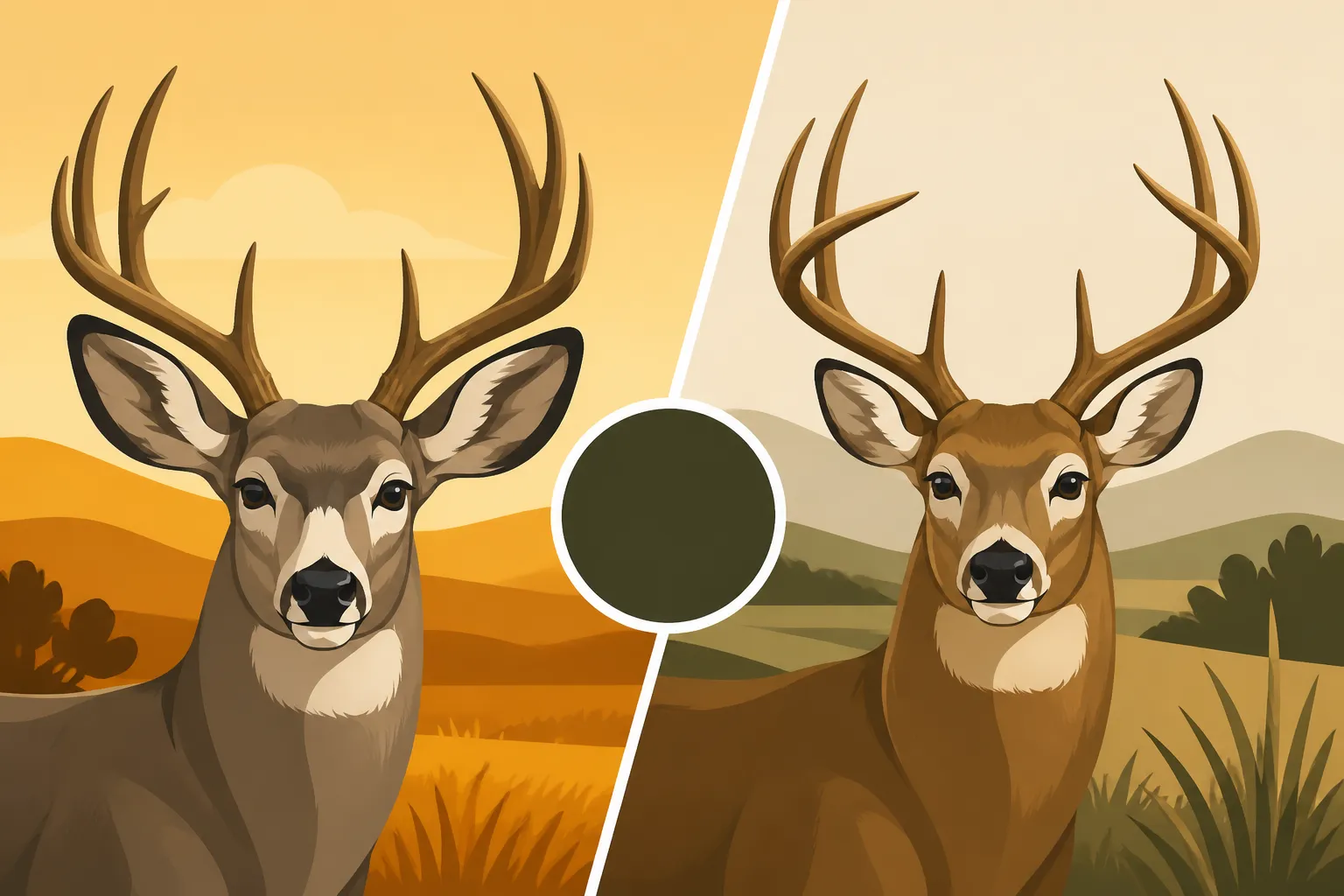
Telling a Mule Deer From a Whitetail
For any hunter new to western Kansas, or even seasoned veterans venturing into different units, there's a common moment of hesitation: "Is that a whitetail, or a mule deer?" In areas where their ranges converge, telling these magnificent animals apart can be surprisingly tricky, yet it's absolutely vital for legal and ethical hunting. This guide will walk you through the distinctive characteristics, habits, and habitats that will help you confidently identify whitetail and mule deer in the Kansas landscape.
The Basics of Deer Identification in Kansas
The vast plains and agricultural lands of Kansas are primarily known for their robust whitetail deer population, but as you push west, particularly into the rugged breaks and canyons, you enter the realm of the mule deer. The distinction isn't just academic; it has real implications for your hunt.
Why Distinguishing Matters
Understanding the differences between whitetail and mule deer goes far beyond just satisfying your curiosity. When you're out in the field, especially during hunting season, accurate identification is paramount. Kansas has very specific regulations concerning the hunting of each species, and misidentifying your target could lead to serious legal repercussions. For instance, non-residents typically draw a permit for a "Whitetail Either-Sex" or "Whitetail Antlerless" deer, but if you're hoping to harvest a mule deer, you generally need to have applied for and drawn a specific mule deer stamp, which is a much more difficult tag to acquire. Many general deer permits in Kansas are whitetail-only. You absolutely do not want to fill a whitetail tag with a mule deer, or vice versa, if your tags don't cover both.
Moreover, the hunting strategies for each species can vary significantly. Whitetails are masters of concealment, preferring to stick to dense cover, timbered creek bottoms, and the edges of crop fields. They're often patterned around specific food sources and bedding areas, requiring stealthy approaches and well-placed stands. Mule deer, on the other hand, are more creatures of open, expansive country. They might cover vast distances, often using elevation changes and subtle folds in the terrain for cover. What works for a whitetail in a river bottom might be completely ineffective for a mule deer browsing on a windswept prairie. Knowing your quarry helps you adapt your tactics for success.
Overlap Zones in Western Kansas
While whitetail deer are found statewide, and are the dominant species in the eastern two-thirds of Kansas, mule deer are almost exclusively found in the western third of the state. However, it's not a hard line in the sand. There are specific transition zones where you're very likely to encounter both species within the same habitat, sometimes even in the same field.
Units in southwestern and northwestern Kansas, such as Unit 1, Unit 2, Unit 3, and Unit 18, are prime examples of these overlap areas. In these units, you might find whitetails clinging to the narrow timber belts along river systems like the Arkansas or Republican, or tucked into shelterbelts and plum thickets. Meanwhile, mule deer will typically be found out on the open grasslands, in rugged canyons, or around isolated cedar thickets on the high plains. But sometimes, a large CRP field with a winding creek through it can hold both. For a deeper dive into their territories, you can explore the information on Mule Deer Range in Western Kansas. It's in these areas that keen observation becomes absolutely essential, because a single property could hold both species, and you need to be certain which one you're looking at before you make a move. The Kansas Department of Wildlife, Parks and Tourism (KDWP) provides excellent maps and data, often available through platforms like GoHunt, which can help visualize these population distributions.
Antler Characteristics: The Most Obvious Clue
When trying to distinguish between a whitetail and a mule deer, especially a buck, the antlers are usually the first and most definitive feature to examine. While there can be exceptions and variations, their typical growth patterns are distinct.
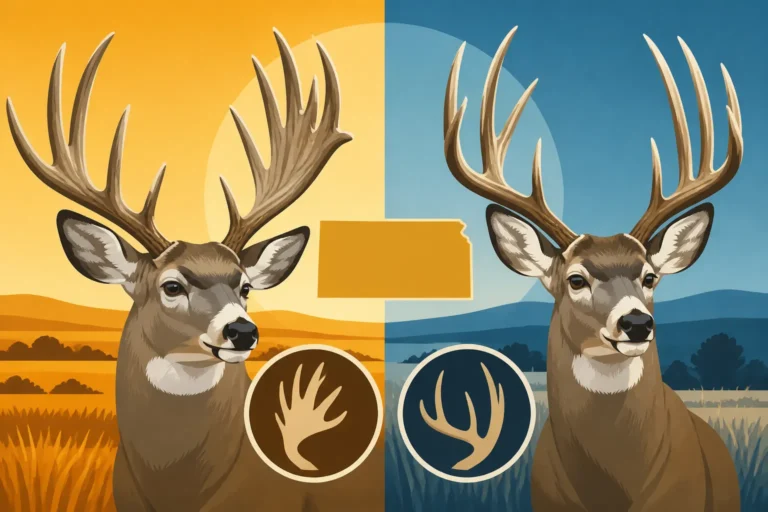
Whitetail Antler Growth Main Beam
The defining characteristic of a whitetail buck's antlers is the presence of a strong, forward-curving main beam. From this main beam, individual tines (or points) typically grow upward in a singular, unbranched fashion. Imagine the main beam as the "trunk" of a tree, with distinct, unbranched "branches" (tines) sprouting off it.
For example, a typical 8-point whitetail (a 4×4 using Western count, or usually expressed as 4 points on each side in Eastern parlance) will have four distinct points rising from each main beam. These points are generally G1 (brow tines), G2, G3, and G4, all originating individually from the main beam. Even a trophy 10-point (5×5) will follow this pattern, with a G5 tine still coming off the main beam without branching. The main beam itself will often sweep forward and then inward, creating a characteristic "basket" or "U" shape when viewed from the front. This structure is incredibly consistent across the species, making it a reliable identifier.
Mule Deer Antler Growth Bifurcation
In stark contrast, mule deer antlers are renowned for their "bifurcation" pattern, which simply means they branch, then branch again. Instead of a single main beam with individual tines, mule deer antlers typically fork. A common mule deer buck will often have a main beam that grows upward and then splits into two points. Each of these two points can then split again.
So, a typical 4×4 mule deer buck (often referred to as a "four-point" in western terminology) will have a main beam that forks into two, and then each of those two forks again, resulting in four points on each side, but created by a series of splits, not individual tines off a continuous beam. It creates a more open, often "Y-shaped" or "C-shaped" appearance with less inward curvature than a whitetail. You won't see a long, unbroken main beam with points strictly growing off one side; instead, you'll see a series of symmetrical forks. For a visual comparison, checking out resources on Mule Deer Antler Shape Differences can be incredibly helpful. Platforms like GoHunt often compile photos and data, helping you visualize these key differences side-by-side.
Antler Color and Texture
While antler shape is the primary indicator, subtle differences in color and texture can sometimes offer additional clues, though these are often less reliable due to environmental variables. Whitetail antlers tend to range from a dark chocolate brown to a lighter, almost bone-white, depending on factors like the deer's diet, the minerals in the soil, and how much they've rubbed against trees. The texture can be smooth or fairly rough, with prominent burrs at the base.
Mule deer antlers, while also varying, often seem to have a slightly lighter overall appearance, sometimes a creamier or more weathered brown. This isn't a hard-and-fast rule, as a mule deer rubbing in dark soil can stain its antlers, and sun bleaching affects both species. However, when comparing many examples, you might notice a subtle distinction. What's more consistent is that the overall structure and symmetry of the bifurcation in mule deer antlers often appears more rugged and heavy-boned in certain regions compared to the finer points of some whitetails. Again, looking at a range of photos on wildlife identification sites or scouting resources like GoHunt can help you train your eye to these nuanced differences beyond just the branching pattern.
Body and Tail: Key Physical Distinctions
Beyond the antlers, the deer's body shape, ear size, and especially its tail offer some of the most consistent and definitive ways to differentiate between a whitetail and a mule deer, particularly when dealing with does or young bucks.
Tail Differences: The Dead Giveaway
If you can get a clear view of the deer's tail, especially when it's agitated or moving, you've got your most reliable identifier. This is often the "dead giveaway" in the field.
A whitetail deer, as its name suggests, possesses a broad, flat tail that is dark brown on top but stark white on the underside and edges. When alarmed or running, a whitetail will typically raise its tail high, fanning it out like a flag. This "flag" waves back and forth, presenting a brilliant white target that serves as an alarm signal to other deer in the area. It's an unforgettable sight once you've witnessed it. Whether they are walking or running, the distinctive movement and color of the whitetail's tail are incredibly noticeable and a prime identifier. Even a quick glimpse of that white flag disappearing into the timber is usually enough to confirm it's a whitetail.
Mule deer, conversely, have a much narrower, rope-like tail. This tail is typically off-white or cream-colored for most of its length, but it culminates in a distinct, often bushy, black tip. When a mule deer is running, it generally holds its tail down or only slightly flared, rather than flagging it high like a whitetail. The movement is usually more of a swivel or waggle from side to side, or sometimes it can be held straight out, but never that upright, bright white flag. The black tip is the crucial identifying mark here. If you see a deer running away with a black-tipped, skinny tail held low, it's almost certainly a mule deer. For close-up comparisons of these features, resources discussing Telling Mule Deer From Whitetails at Distance provide excellent detailed images.
Ear Size and Shape
Another key physical characteristic that sets mule deer apart is their impressive ears. Again, their name gives a strong hint: "mule" deer are so called because their ears are disproportionately large, very similar in size and shape to those of a mule. These ears are broad, rounded at the tips, and can be quite long, sometimes appearing almost comically large relative to their head. They are constantly swiveling, picking up the slightest sounds in their typically open environments.
Whitetail deer, in comparison, have smaller, more pointed ears. While certainly functional and capable of picking up sound, they are proportionate to the deer's head size and don't stand out nearly as much as a mule deer's ears do. If you see a deer with ears that look too big for its head, almost like satellite dishes, you're looking at a mule deer. This difference can often be seen even at a considerable distance, especially if the deer is facing you or quartering away slightly.
Body Size, Coloration, and Gait
Beyond the tail and ears, there are noticeable differences in overall body conformation and how these deer move. Mule deer generally have a stockier, heavier build than whitetails. They often appear more robust, with a broader forehead and a thicker neck. Their coloration tends to be a more uniform grayish-brown, especially during the winter months, with a white rump patch that extends up past the tail. Their face often has a more distinct dark marking on the forehead and a lighter gray or white muzzle. In summer, they can have a reddish-brown coat, but still often retain a grayer tone than whitetails.
Whitetail deer, by contrast, typically appear more slender and athletic. Their summer coat is a richer reddish-brown, transitioning to a grayer or brownish-gray in winter, but often maintaining a warmer tone than mule deer. Their white rump patch is less pronounced, largely confined to the underside of the tail, and their face often appears uniformly brown or reddish-brown with a white eye ring and muzzle.
Perhaps the most distinctive behavioral difference is their gait. When a mule deer is spooked or moving at speed, it often employs a unique bounding motion called "stotting" or "pronking." This involves all four feet pushing off the ground at the same time, with the deer bouncing stiff-legged, almost like a pogo stick. It's an incredibly efficient way to move over rough, broken terrain. Whitetails, on the other hand, typically run with a more fluid, graceful stride, alternating their footfalls. They will often lower their head and weave through cover, whereas a mule deer will often hold its head high during its stiff-legged bound. This difference in movement is often discernible even at long distances and can be a powerful identifier when other features are obscured.
Habitat and Behavior: Contextual Clues
While physical characteristics are the most reliable identifiers, understanding the preferred habitats and typical behaviors of whitetail and mule deer in Kansas can provide valuable contextual clues, especially when physical features are hard to discern.
Preferred Habitats in Kansas
Kansas offers a diverse landscape, and both deer species have adapted to specific niches within it. Whitetail deer are incredibly versatile and thrive across the entire state, but they particularly dominate in areas with ample cover and water. You'll find them in abundance along the timbered river bottoms and creek draws that crisscross the state, using the dense trees and brush for bedding and concealment. They are also highly adapted to agricultural landscapes, frequently found in and around corn, milo, and soybean fields, which provide both food and cover. Shelterbelts, small woodlots, and thick plum thickets are also prime whitetail hangouts, offering them the security they crave. For more on where whitetails live, check out Kansas Deer Habitat in Crop Country.
Mule deer, however, are creatures of the open plains and rugged, broken country of western Kansas. Their stronghold is in the high plains region, where vast expanses of native grass are interspersed with canyons, draws, and cedar breaks. They utilize the terrain itself for cover, often bedding on a leeward slope or in the bottom of a draw, relying on their keen eyesight and hearing to detect threats. While they will utilize narrow timber strips along major rivers in the west, they are less tied to dense woods than whitetails. The areas where these two species overlap, often at the transition from farm ground with some timber to more open, arid rangeland, are where identification becomes most challenging. Finding more information on Mule Deer and Whitetail Overlap can help you pinpoint these specific zones.
Social Structure and Alertness
Differences in social structure and how each species reacts to perceived threats also offer subtle cues. Whitetail deer are often observed in smaller family groups, typically a doe and her fawns, or a small bachelor group of bucks during much of the year. They are known for their extreme wariness; a whitetail will often "melt" into cover at the first sign of danger, using its camouflage and stealth to avoid detection. They rely heavily on scent and sound, and their immediate reaction to a threat is often to freeze, then sneak away through the thickest cover available, only to "flag" and bound away if truly pushed.
Mule deer, in contrast, frequently form larger, more open social groups, especially in the winter months. You might see several does and their fawns, or even mixed groups of bucks, feeding together in open country. While certainly not oblivious to danger, mule deer often seem to exhibit a different kind of alertness. They tend to rely more on their superior eyesight in open landscapes, and when spooked, they are more likely to run a significant distance across open ground, often stopping to look back to assess the threat. For insights into their population distribution, refer to Mule Deer Numbers in Western Kansas. Observing these behavioral patterns can provide additional hints when you're trying to make a positive identification from afar. GoHunt is a fantastic resource for checking historical harvest data and population trends that might inform where each species is more prevalent.
Movement Patterns
The way whitetail and mule deer move, both casually and when alarmed, is another behavioral distinction that can help you tell them apart. Whitetails are masters of stealth and evasion. They prefer to navigate their environment by sticking to established trails, fence lines, and the cover offered by brush and timber. When they're not fully alarmed, they often move with a deliberate, almost cautious walk, pausing frequently to scan their surroundings, often flickering their small ears. If they sense danger, their first instinct is typically to sneak away silently, using every bit of available cover to their advantage. They are adept at remaining unseen, almost disappearing into seemingly sparse vegetation.
Mule deer, accustomed to more open landscapes, tend to move with less reliance on dense cover for their everyday travel. While they'll certainly use terrain features like draws and ridges, they are more comfortable crossing open areas. When a mule deer is alerted, particularly by a visual threat, it's very common for them to engage in their characteristic "stotting" or "pronking" gait, bounding away stiff-legged. They might cover hundreds of yards in this fashion before pausing, often on a slight rise, to look back at whatever spooked them. This behavior contrasts sharply with a whitetail's tendency to run flat-out into the nearest thicket and disappear. Observing these distinct movement patterns can be a valuable tool for identification, especially when you catch a glimpse of a deer moving quickly across a field or ridge line.
Challenges and Exceptions to the Rules
While the differences between whitetail and mule deer are generally clear, nature loves to throw a curveball. There are situations where distinguishing between the two can become genuinely challenging, even for experienced hunters.
Hybrids and Atypical Racks
One of the most perplexing challenges comes from the possibility of hybridization. In areas where whitetail and mule deer ranges extensively overlap, cross-breeding can occasionally occur, resulting in a hybrid deer that displays characteristics of both species. These hybrids are relatively rare but can possess a confusing blend of features – perhaps a whitetail-like body with a mule deer's black-tipped tail, or antlers that show some bifurcation but also a strong main beam. Thankfully, the incidence of these true hybrids is low in Kansas, but it's a possibility to be aware of.
More commonly, atypical antler racks can lead to confusion. A whitetail buck might grow a non-typical rack with drop tines, kickers, or even some minor points that appear to fork, making it look somewhat like a mule deer's bifurcated antlers. Conversely, a mule deer buck might have an unusual growth pattern that appears more linear than typical for the species. This is why relying on multiple identification points – tail, ears, body shape, and gait – is crucial, especially when you encounter an antler configuration that just doesn't quite fit the typical mold. Even seasoned hunters sometimes struggle with highly atypical racks, and it reinforces the need for thorough observation.
Fawn and Doe Identification
When antlers aren't present, distinguishing between whitetail and mule deer becomes significantly more difficult, especially with fawns. Without the definitive antler patterns, you're left to rely on the more subtle physical and behavioral traits. For does and fawns, the tail becomes the absolute primary identifier. Look for the broad, white-undersided flag of the whitetail or the rope-like, black-tipped tail of the mule deer.
Ear size is the second most reliable feature: those noticeably larger "mule" ears on a mule deer doe or fawn are usually quite evident. Body size and shape can also offer clues, with mule deer generally appearing a bit stockier and having that grayish overall hue, but these can be subtle and influenced by age and nutritional status. Observing their gait is also key; watch for the stiff-legged pronk of a mule deer versus the fluid run of a whitetail. It's a skill that requires practice and patience, and often you'll need to watch the deer for an extended period to catch all the necessary visual cues. Sometimes, using online resources like GoHunt to compare photos of does and fawns side-by-side can help train your eye before you head out into the field.
Environmental Factors Affecting Appearance
The environment itself can conspire to make deer identification challenging. Poor lighting, such as dawn, dusk, or heavily overcast conditions, can obscure coloration and fine details. A deer covered in mud or wet from rain can also have its coat color and texture significantly altered, making standard comparisons difficult. Distances can also play tricks on the eyes; what looks like a broad whitetail tail at 300 yards might, upon closer inspection, reveal a black-tipped mule deer tail.
Consider the time of year as well. Deer coats change between summer and winter, with both species growing thicker, often grayer coats for cold weather, which can subtly alter their appearance. Whitetail bucks shed their antlers typically in late winter, and mule deer follow a similar schedule, meaning for several months of the year, all bucks will appear antlerless. In these situations, reverting to the tail, ears, body shape, and gait becomes even more critical. Always take your time, use good optics, and try to observe the animal from multiple angles before making a definitive identification.
Practical Tips for Field Identification
Being able to confidently identify a whitetail from a mule deer in the field is a skill that develops with practice. Here are some practical tips to help you make accurate identifications and ensure a successful, legal hunt in Kansas.
Use Optics Wisely
One of the most critical tools in your identification arsenal is a good set of optics. High-quality binoculars and spotting scopes are not just for finding deer; they are essential for distinguishing between species, especially at a distance where subtle features like tail shape or antler growth patterns might be difficult to discern with the naked eye. When you spot a deer, resist the urge to immediately raise your rifle. Instead, take your binoculars and carefully observe the animal.
Start by looking at the overall body shape and coloration. Then, systematically move to the most definitive characteristics: the tail (is it broad and flagging white, or rope-like with a black tip?), the ears (are they small and pointed, or large and mule-like?), and finally, if it's a buck, the antler configuration (forward-curving main beam with individual tines, or bifurcated forks?). Pay attention to its gait – does it run with fluid strides or a stiff-legged bounce? By taking your time and using your optics effectively, you greatly increase your chances of making a positive identification.
Consult Resources and Practice
Before you even step foot in the field, invest some time in learning the key differences. Field guides specific to North American deer are excellent resources, as are the Kansas Department of Wildlife, Parks and Tourism (KDWP) regulations and online information. Many online hunting forums and websites, like GoHunt, offer side-by-side comparisons, photos, and even videos that highlight the distinctions.
Practice makes perfect. Spend time looking at photos and videos of both whitetails and mule deer, trying to identify them based on the characteristics discussed in this guide. Challenge yourself to identify does and fawns, not just antlered bucks. The more you familiarize yourself with their typical appearances and behaviors, the quicker and more accurate you'll become in the field. Understanding the Kansas Deer Unit Map and which units are known for mule deer (and therefore require a mule deer stamp, like those discussed when looking at Which Kansas Units Allow a Mule Deer Stamp and Kansas Mule Deer Stamp Cost) can also inform your expectations and heighten your awareness in certain regions.
When in Doubt, Assume It's a Mule Deer
This might sound counterintuitive, but in Kansas, especially in the western units where both species coexist, it's often best to err on the side of caution. Since mule deer tags are often harder to acquire or are species-specific, if you have a whitetail-only tag and you're unsure, it's safer to assume the deer you're seeing is a mule deer and hold off on taking a shot. This protects you from a potential wildlife violation. Always double-check your permits and be absolutely certain of your target's species before you commit to a shot. Ethical hunting demands positive identification.
It's also important to be aware of regulations regarding carcass transport, especially if you're traveling across state lines. Understanding CWD Rules for Taking a Kansas Deer Home often requires you to be clear about the species you've harvested. By applying these practical tips and maintaining a vigilant, cautious approach, you'll be well-prepared to confidently identify the deer you encounter in Kansas and ensure a legal and responsible hunt.
| Feature | Whitetail Deer | Mule Deer |
|---|---|---|
| Antlers | Main beam curves forward; tines grow upward from main beam without branching. | Antlers "fork" or "bifurcate" repeatedly (Y-shape). |
| Tail | Broad, flat, dark brown on top, white underneath; "flags" high when alarmed. | Narrow, rope-like, white with distinct black tip; held down or slightly out when running. |
| Ears | Smaller, more pointed, proportionate to head. | Very large, broad, rounded ("mule-like"). |
| Body Size | Generally more slender, agile. | Stockier, heavier build, broader forehead. |
| Coloration | Reddish-brown (summer), grayish-brown (winter); less distinct facial markings. | Grayish-brown (uniform); distinct darker forehead, lighter muzzle. |
| Gait | Fluid, graceful run; head low, weaves through cover. | "Stotting" or "pronking" (all four feet bound simultaneously); head high, runs across open ground. |
| Preferred Habitat | Timbered river bottoms, creek draws, dense cover, agricultural fields, shelterbelts. | Open plains, rugged canyons, draws, cedar breaks, high country; relies on terrain for cover. |
Disclaimer
The information provided in this guide is for general informational purposes only and does not constitute legal advice. Hunting regulations can change, and it is the hunter's responsibility to review and understand the most current regulations published by the Kansas Department of Wildlife, Parks and Tourism (KDWP) before engaging in any hunting activities. Always refer to official KDWP resources for the most accurate and up-to-date rules.