Hunting Terrain Funnels in Flat Country
It can feel incredibly daunting when you're staring out at what seems like endless, flat Kansas farmland, trying to figure out where a whitetail buck might even begin to travel with purpose. Without dramatic elevation changes or thick, winding timber blocks, pinpointing deer movement patterns can seem like an impossible task. But trust me, even in the flattest terrain, deer are creatures of habit, and they rely on subtle cues to move efficiently. This guide is all about demystifying those seemingly featureless landscapes and teaching you how to identify and effectively hunt the terrain funnels that dictate deer movement in open country.
Understanding the Concept of Terrain Funnels in Flat Landscapes
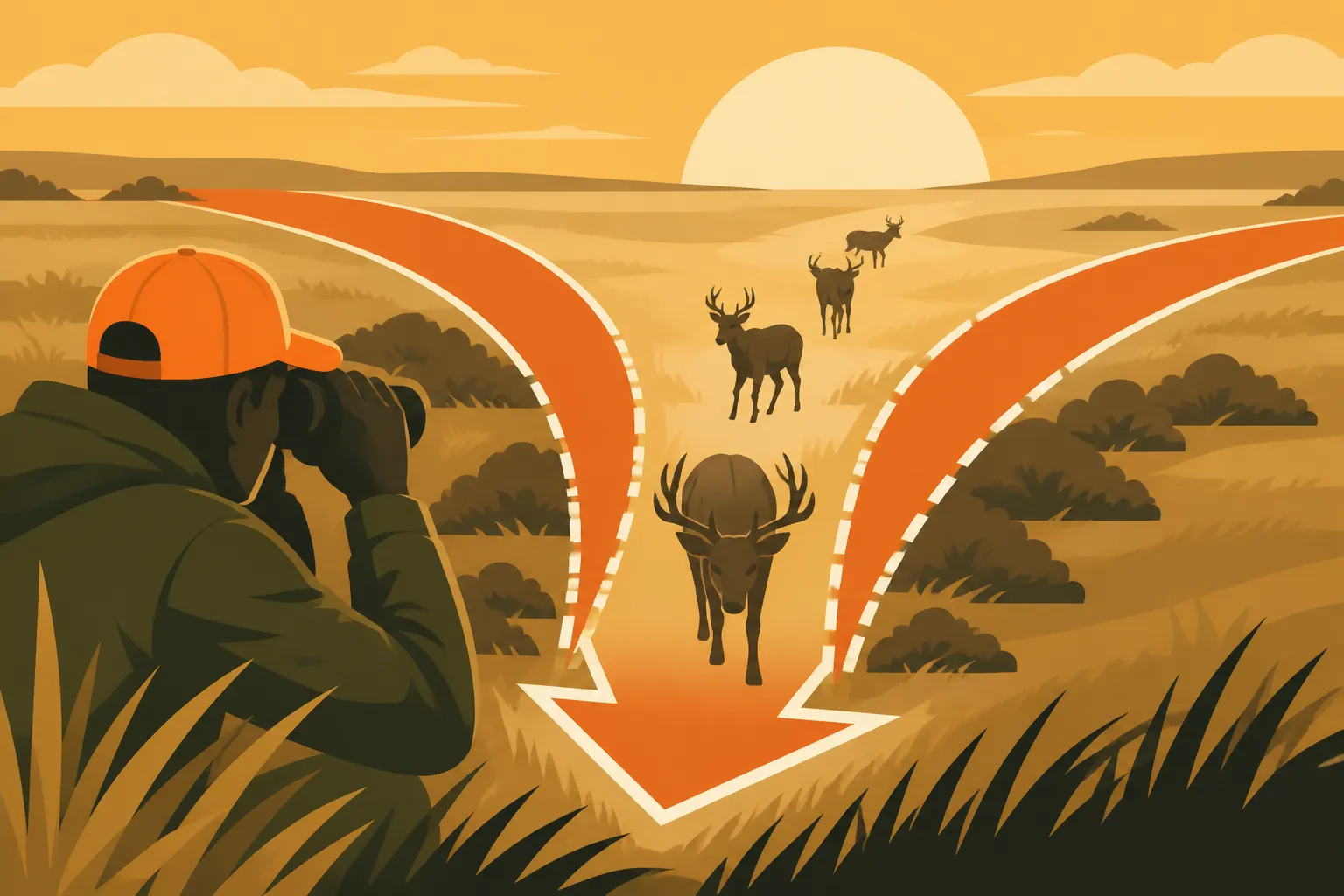
When most hunters think of "terrain funnels," their minds often jump to steep mountain saddles, narrow canyons, or deep creek bottoms in more rugged regions. But here in Kansas, where the landscape often stretches out like a giant, green (or golden) tablecloth, the concept of a funnel takes on a much more subtle, yet equally critical, meaning. Deer, whether they're traveling to feed, seeking cover, or cruising during the rut, will always choose the path of least resistance or the path that offers the most security. Our job as hunters is to recognize these natural corridors, even when they're not immediately obvious.
What Makes a Funnel in Flat Kansas?
In flat Kansas, a terrain funnel isn't necessarily a massive geographical feature; it's often a pinch point created by the convergence of different habitat types or minor topographical variations. Imagine a wide-open field, but then a slender line of timber juts out, forcing deer traveling along its edge into a narrower strip. Or perhaps a subtle rise in elevation that deer prefer to skirt around, rather than walk over, creating a well-worn path. These might seem insignificant to us, but to a deer navigating a vast, exposed landscape, they are critical pathways.
For example, a low-lying ditch or a shallow creek bed might not be a deep canyon, but it offers just enough cover and a slight depression to hide movement from potential predators. Deer will naturally gravitate towards these subtle linear features, especially when moving between bedding and feeding areas. Similarly, a small isolated patch of dense timber or even a thick CRP field can act as a bedding area, and the most secure, efficient routes leading from it to a food source will become funnel points. We're looking for anything that constricts or directs deer movement from a broader area into a narrower one.
Why Deer Use Funnels So Religiously
Deer, by their very nature, are survivors. Every movement they make is a calculation of energy expenditure versus safety. This fundamental drive is precisely why they use funnels so religiously, especially in flat country where exposure is a constant threat. Think about it: why would a deer walk randomly across a wide-open wheat stubble field when a nearby fence line lined with brush or a narrow timber strip offers concealment and a clear, predictable travel lane? They won't. They'll use the cover.
During the rut, these funnels become even more magnetic. Bucks aren't just looking for efficiency; they're actively scent-checking and covering ground in search of does. A natural choke point concentrates deer, increasing the likelihood of encountering other deer. This predictability is a double-edged sword: it makes deer movement easier to anticipate for hunters, but it also means those routes are heavily traveled and sometimes more exposed to human intrusion if not approached carefully. Understanding Deer Density by Kansas Unit can help you appreciate just how many deer might be using these same funnels in a given area, making proper identification and approach even more critical.
Identifying Key Funnel Types in Open Country
Identifying funnels in flat country requires a keen eye and a shift in perspective. You're not looking for the grand, dramatic features you might see in mountainous regions. Instead, you're looking for the nuanced transitions and subtle directional cues that deer pick up on instinctively. This is where a lot of your pre-season scouting, both digital and on-the-ground, really pays off.
Subtle Elevation Changes and Drainage Ditches
Kansas might be flat, but it's rarely perfectly level. There are always subtle contours, dips, and rises that create natural drainage patterns, and these often become prime deer travel routes. A barely perceptible ridge that runs for a quarter-mile can be enough to deter a deer from crossing directly over it if they can skirt its base with less effort or more cover. Likewise, natural drainage ditches, even if they're only a few feet deep, offer a significant advantage for deer seeking to remain undetected.
Consider a situation where a slight rise elevates one field above another. Deer moving from a bedding area in a distant timber block to a feed field on the lower side will often follow the natural curve of that subtle elevation change, rather than climbing over the hump. These often funnel into small draws or washouts. Even a dry streambed, winding through a pasture, can serve as an interstate for deer. They'll drop into the low spot, using the banks for cover, feeling secure as they move. It’s a bit like Reading a Kansas Creek Bottom for Deer Sign – the principles are the same, just scaled down for flatter land. When using mapping tools like GoHunt, pay close attention to contour lines, even if they're spread far apart; these indicate slight elevation changes that are often ignored by the untrained eye but cherished by deer.
Timber Lines, Shelterbelts, and Fence Rows
These linear features are some of the most obvious and productive funnels in flat Kansas. A strip of timber, whether it’s a natural woodline along a creek or a man-made shelterbelt, provides crucial cover and acts like a magnet for deer. They’ll travel parallel to these lines, using the visual obstruction to their advantage, especially during daylight hours. A shelterbelt, often planted as a windbreak around a farmstead, is essentially a linear block of cover in an otherwise open landscape. Deer will use these extensively for travel and sometimes even for bedding.
Imagine a quarter-mile long shelterbelt that connects two larger timber blocks or two different food sources. Deer will naturally be "funneled" into this narrow strip as they transition between areas. Similarly, fence rows, particularly those overgrown with briars, small trees, and tall weeds, offer just enough cover for deer to feel safe traveling along them. Even a plain wire fence with just a little brush on one side can direct deer movement. They'll follow these lines until they find a convenient crossing point, which then becomes a major pinch point. Hunters often overlook these "soft" funnels, but ignoring them means missing out on prime opportunities. If you want to learn more about how to scout these, take a look at Shelterbelts and Timber Points in Kansas Farm Country.
Crop Field Inside Corners and Narrow Strips
In Kansas, where agriculture reigns supreme, crop fields play a massive role in deer movement, and they create some of the most effective funnels. An "inside corner" of a crop field is where two sides of the field meet at a sharp angle, forming a protected pocket or an area where deer feel less exposed. These corners often accumulate thicker vegetation, offering cover right at the edge of a food source. Deer love these spots because they provide quick access to food while maintaining an immediate escape route into cover.
Similarly, narrow strips of crops or cover that extend into larger fields are absolute goldmines. Think of a long, slender finger of standing corn that juts out into a soybean field. Deer will often follow the edge of that corn for security, treating it like a tunnel. These strips concentrate deer traffic significantly, as they offer the most secure path into or across a field. Or perhaps a narrow strip of uncut grass or timber separates two massive crop fields. This strip, no matter how thin, becomes the primary travel corridor for deer moving between those fields. Learning about Milo and Corn Stubble Deer Patterns can really enhance your ability to interpret these agricultural funnels.
Scouting and Confirming Funnel Activity
Identifying potential funnels on a map is one thing; confirming that deer are actually using them and understanding how they're using them is another. This is where diligent scouting, both digital and physical, becomes absolutely crucial. You need to verify your assumptions and get boots on the ground to paint a complete picture of deer movement.
E-Scouting with Aerial Imagery and Topo Maps
Before you ever step foot in the field, fire up your favorite mapping application. Tools like GoHunt are invaluable for e-scouting, especially in flat terrain where subtle features can be hard to spot from the ground. Start by looking at detailed satellite imagery. Scan for those linear features: timber lines, shelterbelts, fence rows, and the edges of different crop fields. Pay close attention to how these features connect larger blocks of cover with feeding areas. Look for inside corners in crop fields or narrow strips of cover that act as bridges.
Next, overlay topographical maps. Even if the contour lines are far apart, they reveal subtle elevation changes. Identify those slight rises or depressions that could guide deer. Look for areas where contours pinch together, indicating a natural choke point. You might notice a barely visible drainage that runs through an otherwise flat pasture – that's a potential funnel. Using the public/private land layers on your GoHunt map can also help you identify potential access points and areas where deer might feel more secure because they border private property, affecting how they use nearby public funnels. Mark all these potential funnels as waypoints, creating a preliminary plan for your on-the-ground scouting.
Boots on the Ground: Reading the Sign
Once you’ve identified potential funnels from your e-scouting, it’s time to get out there and confirm them. There's simply no substitute for walking the ground. Start at one end of a suspected funnel and slowly work your way along it. What you're looking for is deer sign: tracks, scat, rubs, and scrapes. The more concentrated the sign, the more active the funnel. Look for well-worn trails that disappear into or emerge from the funnel. These are highways.
Pay attention to where deer are actually crossing fences or ditches within the funnel. These specific crossing points are often the absolute best places to set up. If you find multiple rubs and scrapes along a timber line or a shelterbelt, you know bucks are actively cruising and scent-checking that funnel. Don't just scan; get down and look closely at the ground. Tracks in dusty areas, fresh droppings, and signs of browsing can tell you not only that deer are using the area, but also the direction they're traveling and how recently they've been there. This hands-on verification is critical for truly understanding deer movement by Kansas River oxbows and creek crossings.
Using Trail Cameras to Pattern Funnel Traffic
Trail cameras are your best friends when it comes to confirming and patterning funnel activity, especially when you're dealing with limited time or vast expanses. Once you've identified a likely funnel and found some promising sign on the ground, strategically place your cameras. Position them to cover the main trails within the funnel, or at key pinch points like fence crossings, narrow timber strips, or inside corners of crop fields.
Let your cameras soak for a week or two, if possible, before checking them. This gives you a true picture of deer movement without disturbing the area too frequently. What you're looking for is not just if deer are using the funnel, but when and how. Are bucks using it primarily at night, or are there consistent daylight encounters? Are they moving in specific directions during certain times of the day? Are they bachelor groups, does with fawns, or cruising bucks? This intel is priceless for timing your hunts. For instance, if you're trying to figure out When the Kansas Rut Peaks, cameras on a busy funnel can give you real-time information about buck activity. Remember to position your cameras discreetly, especially on public land, and always check local regulations regarding their use.
Strategic Stand Placement for Funnel Hunting
Once you've identified and confirmed an active terrain funnel, the next crucial step is strategically placing your stand or blind. This isn't just about putting it where you see the most tracks; it's about considering every single variable that could impact your hunt, from the wind to your access route.
Playing the Wind and Sun
In flat country, where thermals aren't as strong or predictable as in hilly terrain, wind direction becomes the absolute king of stand placement. Deer rely heavily on their sense of smell, and if your scent is blowing into the funnel, your hunt is over before it begins. Always, and I mean always, set up with the wind in your favor, blowing your scent away from where you expect deer to approach or travel. This often means having multiple stand locations for a single funnel, allowing you to pick the right one based on the day's wind.
Beyond scent, consider the sun. A rising or setting sun directly in your eyes can make it incredibly difficult to spot approaching deer, identify their sex, or make an ethical shot. Likewise, having the sun directly behind you might cast a long, obvious shadow or silhouette you against the sky, making you highly visible to deer. Try to position yourself so the sun is to your side or even slightly in the deer's eyes if possible, giving you an advantage. Early morning hunters often face the sun in the east, so consider setting up on the west side of a funnel if deer approach from the east, and vice versa for evenings.
Access and Exit Routes That Don't Spook Deer
You can find the best funnel in Kansas, but if your access and exit routes bust deer every time you hunt it, it's useless. Your approach to and departure from your stand must be as stealthy and undetectable as possible. In flat country, this often means utilizing existing cover, low spots, or field edges to minimize your silhouette. Walking directly across an open field to get to your stand is a recipe for disaster.
Try to find routes that keep you out of the deer's likely travel patterns and out of sight. This might mean taking a longer, more circuitous path, walking in a drainage ditch, or hugging the very edge of a timber line. If you're hunting an inside corner of a crop field, approach along the outside edge of the field, or even better, through a timber block that shields your movement. Pay attention to how deer approach the funnel themselves. If they're coming from a particular direction, make sure your access doesn't intersect their path. When you’re thinking about how to get to your stand without disturbing the wildlife, think about Access Routes That Do Not Bump Deer.
Stand Types and Concealment for Flat Terrain
The choice of stand or blind is also critical in flat country. With less topographical relief, getting above deer movement or blending seamlessly into the environment is paramount.
- Treestands: If there are suitable trees along your funnel (timber lines, shelterbelts), an elevated treestand is often ideal. It gets your scent up and away and provides an excellent vantage point. However, in Kansas, suitable trees might be sparse. If you're using a treestand, make sure to brush it in well, breaking up your outline. Mobile setups, like using a saddle, can also be highly effective for quickly adapting to active funnels. Consider learning about Mobile Hunting With a Saddle in Kansas to maximize your flexibility.
- Ground Blinds: In areas where trees are scarce or non-existent, a ground blind becomes a necessity. These can be particularly effective in thick CRP fields, overgrown fence rows, or along the edges of standing crops. The key is extreme concealment. Brush your blind in thoroughly, making it disappear into the natural vegetation. Don't just set it up; pile natural debris (corn stalks, branches, weeds) around it so it looks like part of the landscape. Ensure you have clear shooting lanes from the blind without exposing yourself. For tips on maximizing concealment, check out Ground Blind Brushing In.
- Natural Cover: Sometimes, the best "stand" is simply finding natural cover. A large cedar thicket, a dense plum patch, or even a deep, brushy drainage can provide enough concealment for a ground setup. The advantage here is zero footprint and maximum stealth.
Here's a quick look at how different funnel types might influence your stand placement:
| Funnel Type | Characteristics | Best Stand Strategy | Ideal Wind Direction | Notes |
|---|---|---|---|---|
| Subtle Drainage Ditch/Draw | Offers low-lying cover, slight elevation change. | Ground blind or treestand on upwind bank looking down into ditch. | Across or into funnel | Great for deer moving between bedding & feeding, often overlooked. |
| Timber Line/Shelterbelt | Linear cover strip, connects larger cover blocks. | Treestand inside the timber, or ground blind brushed into edge. | Parallel to timber, away from travel | Deer often parallel these for security. Focus on pinch points. |
| Overgrown Fence Row | Minimal cover, but directs movement in open areas. | Ground blind heavily brushed in, or low treestand if available. | Across fence, away from travel | Focus on fence crossings. Very subtle, but highly effective. |
| Crop Field Inside Corner | Protected pocket at crop edge, transition zone. | Ground blind on the corner, or treestand just inside adjacent timber. | Out of corner, into open field | Deer feel safe entering/exiting field here. Consider access. |
| Narrow Crop Strip (e.g., Corn) | Linear cover extending into open field, "tunnel" effect. | Ground blind brushed into the end or side of the strip. | Blowing along the strip, away from entry | Excellent for concentrating movement into the field. |
| CRP Grass Edge | Edge between thick bedding and open areas. | Ground blind within the CRP, or elevated stand overlooking edge. | Blowing from CRP to open field | Deer skirt these edges. Look for trails leading out. |
Adapting Tactics to Different Seasons and Deer Behavior
Deer behavior isn't static; it shifts dramatically with the seasons, influenced by breeding cycles, food availability, and hunting pressure. A funnel that's red hot in September might be completely ignored in December. To be consistently successful, you need to understand these seasonal nuances and adapt your funnel hunting tactics accordingly.
Early Season and Water Funnels
During the early archery season, especially in September here in Kansas, heat and hydration are major drivers of deer movement. Temperatures can still be quite warm, even hot. This means deer are often seeking shade and frequent trips to water sources. Funnels that lead directly to, or pass very close to, a reliable water source become prime locations. Think about a timber line or a brushy drainage that ends at a pond or a creek, or even just a low spot that holds standing water after a rain. These become magnet funnels.
Hunters focusing on early season should prioritize scouting funnels that offer cool, shady travel routes and connect bedding areas to water and early-season food sources like alfalfa or acorns. Consider an inside corner of a soybean field that abuts a creek bottom. Deer will travel the creek for cover and water, then pop out into the corner for feeding. Setting up on these "water funnels" or pathways leading to water can be extremely effective. You might even want to explore Early-Season Bowhunting Over Water for more specific advice on this tactic.
The Rut and Cruising Lanes
When the Kansas rut kicks into high gear, typically in late October and November, deer behavior transforms, and funnels become even more critical for intercepting cruising bucks. During this period, bucks are actively seeking does, covering vast amounts of ground. They're less predictable in their individual movements but highly predictable in their choice of travel routes. They'll use funnels as efficient "cruising lanes" to scent-check for does.
Focus on funnels that connect larger blocks of timber, bedding areas, or areas with high doe concentrations. A narrow timber strip between two ag fields, a brushy fence line that parallels a doe bedding area, or a subtle draw cutting through a pasture will be heavily used by bucks looking for receptive does. They’ll run these lines, often stopping to check scrapes or rub trees along the way. Your job is to be waiting. This is often when you'll see bucks traveling during daylight hours, making it an exciting time to be in a funnel. For specific strategies during this period, definitely read up on Hunting the Kansas Pre-Rut in Late October and First Week of November Stand Choice.
Late Season Food Source Funnels
As winter sets in and temperatures drop, deer shift their focus back to survival, primarily finding calorie-rich food sources. Late-season hunting in Kansas often revolves around standing grain fields like corn or milo, cut bean fields with residual waste grain, or even winter wheat. Funnels that directly lead to or offer secure access to these critical food sources become hotspots. Deer will move from secure bedding cover to these food plots, often in large groups, and funnels dictate their travel.
Imagine a dense cedar thicket or a block of timber acting as a bedding area, with a standing cornfield a half-mile away. The deer won't just walk straight across the open stubble. They'll use the most secure funnels available: a brushy drainage, a shelterbelt, or a narrow finger of timber connecting the two. Your stand placement should be tight to the funnel, preferably between the bedding and the food. Look for heavy trails, especially if snow is on the ground, indicating repeated use. Being patient and enduring the cold in these prime late-season funnels can lead to incredible success, as deer movement becomes highly concentrated. This strategy is closely tied to the principles of Late-Season Food Source Hunting.
Remember, regardless of the season, applying these funnel hunting strategies in Kansas means being adaptable, meticulous in your scouting, and patient in your execution. The big bucks that roam these flat lands are smart, but they are also creatures of habit, and funnels are their predictable pathways.
Disclaimer
Hunting is an inherently dangerous activity. Always prioritize safety, follow all local, state, and federal hunting regulations, and obtain appropriate licenses and permits. The information provided in this guide is for informational purposes only and does not constitute professional advice. It is your responsibility to ensure you are hunting safely, ethically, and legally.