Cedar Thickets as Bedding Cover
Finding consistent, reliable deer bedding in the vast, often open landscapes of Kansas can feel like searching for a needle in a haystack. Many hunters struggle to pinpoint where deer feel safe enough to rest, especially mature bucks that are masters of evasion. This comprehensive guide will peel back the layers of cedar thickets, revealing why they are magnets for whitetails and how you can effectively locate and hunt these crucial bedding areas, giving you a distinct advantage in the field.
The Undeniable Appeal of Cedar Thickets for Kansas Deer
In a state known for its wide-open agricultural fields and extensive grasslands, dense cover can be surprisingly scarce. This is where cedar thickets shine, offering a sanctuary that few other habitat types can match. For whitetail deer, especially those elusive mature bucks, these thickets represent safety, comfort, and a strategic advantage against predators, including us hunters. Understanding why deer prefer cedars is the first step toward effectively hunting them.
Why Cedars Offer Unmatched Thermal and Visual Security
Imagine being a deer in the middle of a brutal Kansas winter, with arctic winds whipping across the plains, or a scorching August afternoon under a relentless sun. Cedar thickets provide an immediate answer to both extremes. Their dense, interlocking needles offer unparalleled thermal regulation, creating a microclimate within their boughs. In winter, this dense foliage acts like a living windbreak, insulating deer from chilling gusts and accumulating snow. The air inside a thicket can be noticeably warmer and calmer than the exposed areas just yards away.
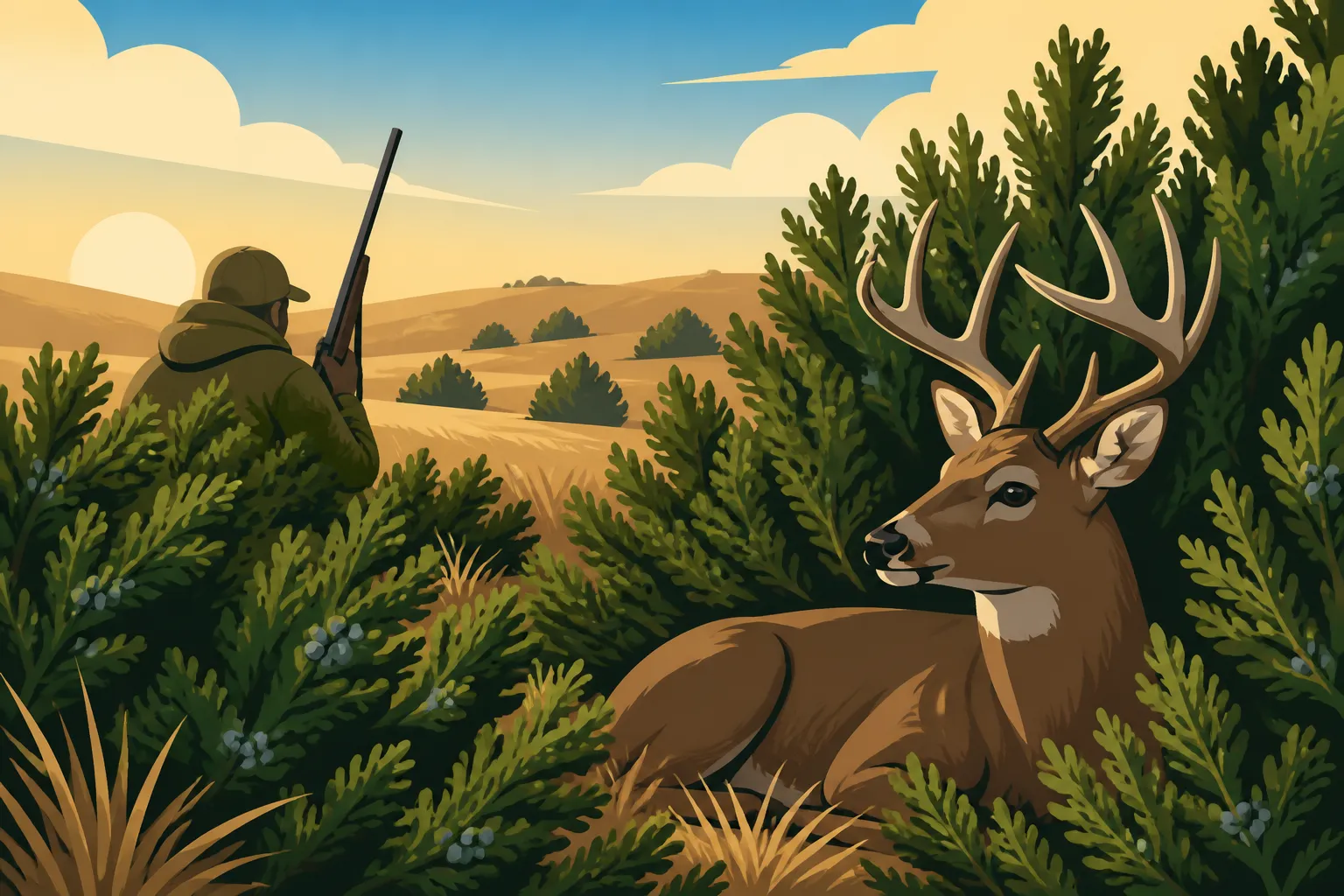
Conversely, during the oppressive heat of summer and early fall, these same thickets provide deep, cool shade, helping deer regulate their body temperature and conserve energy. This year-round thermal advantage is a huge draw. Beyond comfort, the visual security is immense. The thick, often thorny branches and dense, dark green needles create a nearly impenetrable screen. A buck bedded deep within a cedar thicket is virtually invisible from even a short distance, offering peace of mind from human intrusion and other predators. This sense of security is paramount for deer, allowing them to rest undisturbed during daylight hours.
Reading a Cedar Thicket's "Layers" for Bedding Preferences
Not all cedar thickets are created equal in the eyes of a whitetail. You can't just look at a green blob on an aerial map and assume it's prime bedding. Deer, especially mature bucks, are discerning, often preferring specific "layers" or characteristics within these thickets. A young, sparse patch of cedars might offer some visual cover but little thermal protection or true security. Conversely, a mature, old-growth thicket with interlocking canopies and dense undergrowth is a completely different beast.
When you're studying a thicket, look for areas where the canopy is so thick that light barely penetrates, creating a dark, secluded interior. These are often the core bedding areas. Mature bucks will frequently bed on the downwind side of a thicket's interior, allowing them to smell danger approaching from behind while using their eyes and ears to detect movement from other directions. Don't overlook subtle elevation changes within or immediately adjacent to a thicket either; even a slight rise can give a bedded buck a critical advantage in terms of visibility or swirling winds, helping them stay one step ahead of approaching threats.
Locating and Interpreting Deer Sign in Cedar Thickets
Once you understand why deer favor cedar thickets, the next step is to accurately locate where they’re using them and what kind of sign they're leaving behind. This requires a methodical approach, especially when dealing with such dense cover. Your goal is to gather information without alerting the very animals you're trying to hunt.
Scouting Cedar Thickets Without Bumping Deer
Scouting cedar thickets effectively is an art form, especially during hunting season when bumping deer can ruin an area for weeks. The key is extreme caution and utilizing the elements. The off-season, particularly late winter after sheds have dropped, is your best friend for physically venturing deep into these areas. During this time, you can be more aggressive with your approach, mapping out trails, pinpointing bedding craters, and identifying escape routes without the same risk of blowing deer out. Even then, move slowly, use the wind to your advantage, and pay attention to every broken twig and disturbed leaf.
When scouting during the season, or if you can't get in during the off-season, remote scouting is essential. Modern mapping tools are invaluable here. Technologies from companies like GoHunt allow you to scrutinize aerial imagery, identifying the densest parts of a thicket, potential entry/exit points, and how these thickets connect to other cover or food sources. You can also trace subtle terrain features, like small draws or ditches, that deer might use as hidden travel corridors into and out of the cedars. This kind of E-Scouting Kansas Farm Country From Home gives you a massive leg up before ever stepping foot in the woods. Always remember that the less intrusion, the better the thicket will hold deer.
What to Look For: Rubs, Scrapes, and Trails within the Thicket
Once you're in or around a thicket, the sign deer leave behind tells a story. Look for well-worn trails leading into and out of the densest parts of the cedars. These aren't just random paths; they are highways. Primary trails will be packed down and wider, indicating consistent use, often by multiple deer. You might find parallel trails where bucks and does have separate routes, though they often converge. As you move deeper, look for "bedding craters" – flattened, often bowl-shaped depressions in the leaves or grass where deer have bedded down repeatedly. These are gold, especially if you find multiple in a tight area, indicating a core bedding zone.
Beyond beds and trails, keep an eye out for rubs and scrapes, which become more prevalent as the season progresses, particularly during the pre-rut and rut. Rubs on cedar trees themselves or on deciduous trees bordering the thicket indicate buck activity. Fresh rubs with exposed wood are recent, while older, darker rubs mean the activity happened earlier. Scrape lines, especially along the edges or within the thicket's interior, are critical. Look for an overhanging branch, a cleared patch of ground beneath it, and often tracks and urine odor. The presence of rubs and scrapes, especially a "community scrape" used by multiple deer, suggests not just travel, but active, social behavior and potentially core buck habitat. This information, combined with terrain analysis, helps you create a comprehensive picture of deer movement and security within the thicket.
Hunting Strategies for Cedar Thicket Bedding Areas
Knowing where deer bed is one thing; hunting them effectively without pushing them out is another entirely. Cedar thickets demand respect and a well-thought-out strategy. Their dense nature can be both a blessing and a curse, offering incredible cover for deer but also making access and shot opportunities challenging for hunters.
Approaching a Cedar Thicket for a Morning or Evening Hunt
The approach to a cedar thicket bedding area is arguably the most critical part of your hunt. A careless entry can ruin your hunt before it even begins. For a morning hunt, your goal is to get into your stand or blind well before daylight, ensuring you don't spook deer moving towards their beds at first light. This means using a quiet, concealed Access Routes That Avoid Bedding Areas, often paralleling a topographical feature or taking advantage of a ditch or hedgerow for cover. Always choose a route that keeps your wind out of the bedding area. For an evening hunt, you're looking to intercept deer as they leave the thicket to feed. Again, a stealthy approach is vital, using terrain and residual cover to hide your movement.
Consider the wind, always. It dictates everything around cedar thickets, as the dense cover can create localized eddies and unpredictable shifts. It’s often best to set up on the downwind side of where you expect deer to exit, giving you a chance to intercept them before they cross your scent cone. This might mean setting up 100-200 yards away in a travel corridor or along a field edge, rather than right on the thicket itself. Utilizing a highly mobile setup, like a saddle with climbing sticks, allows for incredibly quiet and versatile entry and exit. Being proficient in Mobile Hunting With a Saddle in Kansas can make the difference between a successful hunt and a missed opportunity in these sensitive areas.
Stand Placement and Wind Considerations Near Cedars
Effective stand placement near cedar thickets means walking a tightrope between proximity and stealth. You want to be close enough for a shot but far enough not to alert deer. Never position yourself directly upwind of a known bedding area; it’s a recipe for disaster. Instead, try to be crosswind or, ideally, slightly downwind from the primary travel corridor that deer use to enter or exit the thicket. This gives you the best chance of intercepting a deer without your scent blowing directly into their sanctuary. Always consider how the wind will behave throughout your sit – not just when you arrive.
Beyond wind, visual concealment is key. Cedars themselves offer incredible screening, but if you're setting up in an adjacent deciduous tree, pick one that offers good background cover and breaks up your silhouette. If you opt for a ground blind, ensure it's meticulously brushed in. Learning how to properly apply Ground Blind Brushing In techniques can make your blind virtually invisible to deer. Think about the angle of the sun and how it might impact your visibility or cast shadows. Remember, mature deer living in cedar thickets are highly attuned to their environment, and any anomaly will be noticed. GoHunt's detailed aerial maps can help identify subtle clearings or edges where you might find a good setup tree or a spot for a blind that offers shooting lanes into the thicket's perimeter trails.
Midday Tactics and Pressure Hunting Cedar Beds
Most hunters focus on the first and last hours of daylight, and for good reason—deer are most active then. However, cedar thickets can be prime spots for midday activity, especially during the peak of the rut or on cold, blustery days when deer are seeking refuge. During the rut, a cruising buck might check the edges of a thicket for receptive does throughout the morning, sometimes even bedding down nearby for a few hours before continuing his search. On particularly nasty weather days, deer may adjust their bedding location within the thicket, moving deeper for more protection or slightly out to catch a bit of sun if it breaks.
While generally advisable to avoid pressuring bedding areas, there are specific scenarios where a strategic, light bump might be considered, particularly on large, sprawling public land tracts. This is a tactic that requires extreme caution and a full understanding of Hunting Pressure Patterns on Kansas Public Land. For instance, if you know deer are frequently bedding in a particular section but rarely moving during daylight, a very slow, quiet walk-through on a strong crosswind might push them out to another edge or into an ambush. However, this carries a high risk of educating deer and should only be attempted when other tactics have failed, and you have an exit strategy that doesn't blow out the entire area. For the most part, patience and ambush on the periphery are better strategies than direct intrusion.
Cedar Thickets in Different Kansas Landscapes
The effectiveness and role of cedar thickets can vary significantly depending on the overarching landscape in Kansas. From the timbered river bottoms of the east to the wide-open plains of the west, cedars provide critical cover, but how deer interact with them changes with their surroundings. Understanding these nuances helps you tailor your scouting and hunting efforts.
Cedars in Eastern Kansas Timber and River Bottoms
In Eastern Kansas, where larger blocks of timber and extensive river bottoms are more common, cedar thickets often serve a slightly different purpose. Here, they might not be the only available cover, but they often act as supplementary or preferred bedding areas within a larger ecosystem. You'll frequently find cedars growing in disturbed areas, along the edges of agricultural fields adjacent to timber, or mixed in with other deciduous trees in draws and creek beds. In these environments, they can create incredibly dense "bedroom" sections within a more diverse forest.
Deer might utilize the broader timber for feeding and travel but retreat to the impenetrable security of cedars for their core bedding. They are especially critical along major waterways. Learning to decipher deer movement in these complex areas, perhaps by focusing on Scouting Kansas River Bottoms and Creek Draws, can reveal how deer transition from the open bottomlands to the security of an elevated cedar patch. These thickets often provide refuge from prevalent hunting pressure in more accessible timber, becoming the default safe zone for older bucks that have survived a few seasons.
Isolated Cedar Patches in Open Western Kansas
Head west, and the role of cedar thickets becomes even more pronounced, almost singularly important in the vast, open plains. In landscapes dominated by grasslands, crop fields, and subtle breaks, an isolated cedar patch can be an absolute magnet for deer, often the only substantial thermal and visual cover for miles. These patches, even small ones, stand out like green islands in a sea of brown and gold. Bucks, in particular, will seek out these sanctuaries for bedding, especially if they offer even a slight elevation advantage or are situated within a shallow draw that provides some windbreak.
These isolated thickets are often found along creek drainage, old homesteads, or in areas where past land use has allowed them to take root. For a hunter, these are prime targets for e-scouting, as they are easily identifiable on aerial imagery. Companies like GoHunt can help you identify these critical cover patches, allowing you to focus your physical scouting efforts. They represent undeniable hubs of deer activity, drawing deer from surrounding feeding areas. Hunting these isolated patches requires extreme precision with wind and approach, as deer will often spot you from a long way off in the open country. Understanding Best Stand Locations in Flat Farm Country becomes even more critical when these isolated cedar thickets are the main attraction.
| Feature | Dense, Mature Cedar Thicket | Sparse, Young Cedar Patch |
|---|---|---|
| Cover Quality | Excellent visual and thermal, impenetrable, year-round | Moderate visual, limited thermal, easily seen through |
| Wind Protection | High; acts as a significant barrier against cold winds | Low to moderate; offers partial protection |
| Deer Preference | Primary bedding, especially for mature bucks and during severe weather | Secondary bedding, temporary refuge, travel corridors, doe/fawn groups |
| Scouting Approach | Very cautious, exterior observation, off-season entry, use optics/e-scouting | Easier to scout, can approach more directly but still be mindful |
| Hunting Strategy | Ambush travel routes in/out, wind-driven setups on periphery, careful entry/exit | Intercept travel through, potential for midday bumps, faster setups |
Disclaimer
Hunting is an inherently dangerous activity. Always prioritize safety, understand and follow all Kansas Department of Wildlife, Parks and Tourism regulations, and obtain proper licenses and permits. This guide offers tactical advice, but individual results may vary, and successful hunting depends on numerous factors, including skill, ethics, and responsible outdoor practices.