European Mount Versus Shoulder Mount
You just walked up on the biggest whitetail of your life in a Kansas creek bottom, and before the adrenaline fades, your guide asks the question that can change everything: “Are you caping him or going European?” Most hunters freeze, because that choice affects cost, shipping, wall space and how the buck gets handled in the next hour. This guide breaks down European mount versus shoulder mount so you can decide before you ever pull the trigger.
What Each Mount Actually Is
Before we compare them, it helps to be clear about what each option involves. I have stood in more than a few taxidermy shops listening to hunters describe what they want, and half the time they are using the words loosely. Getting the terms straight now saves confusion later, especially when you are talking to an outfitter, a taxidermist and a shipping company all in the same week.
The European Mount
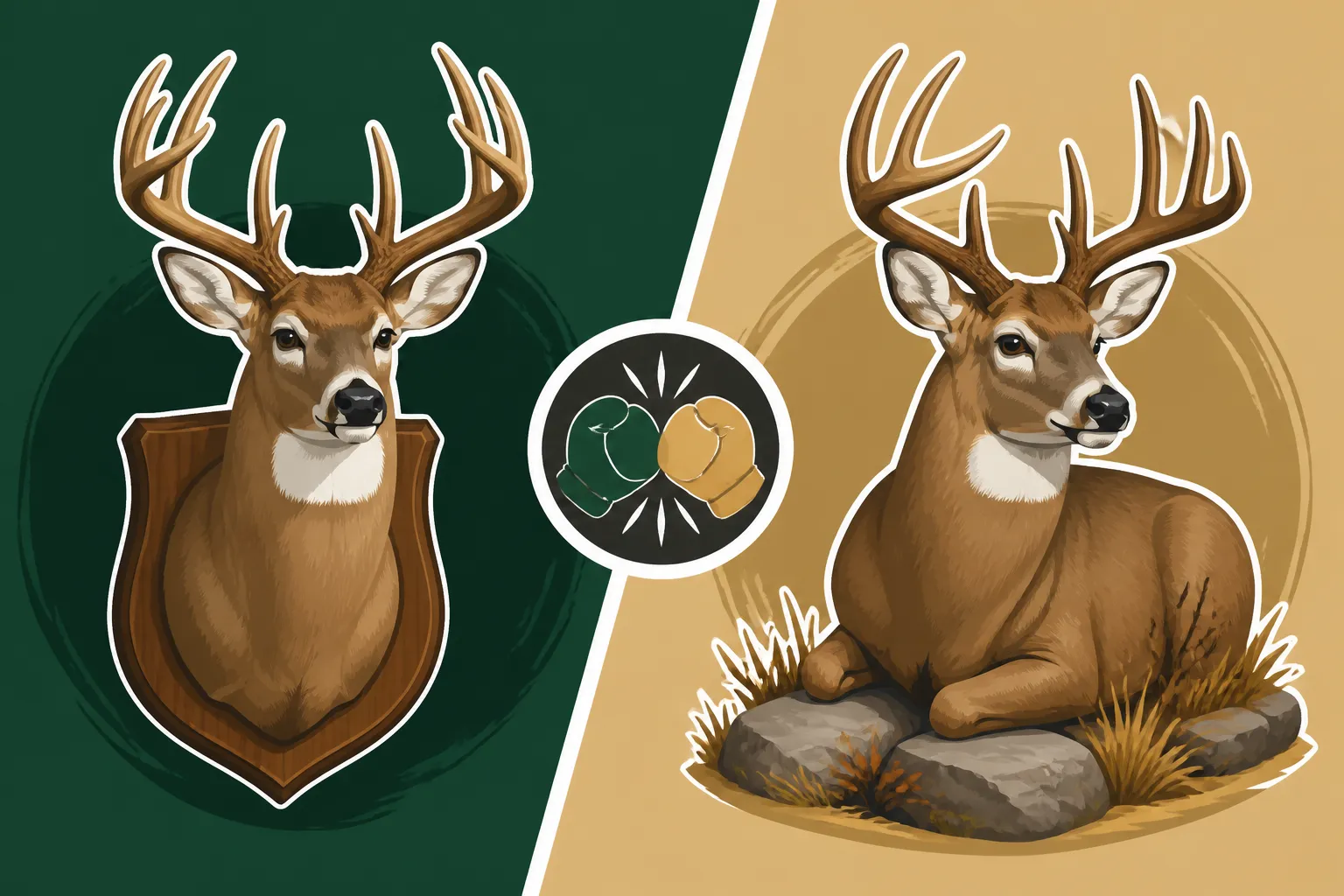
A European mount, often called a Euro mount or skull mount, is the cleaned skull of the animal with the antlers attached. All of the hide, flesh and tissue are removed, usually through a combination of simmering, beetle cleaning or maceration, followed by degreasing and whitening. The finished product is a bright, clean skull that can hang on a plaque, sit on a pedestal or rest on a shelf.
The appeal is in its simplicity. A European mount puts the focus entirely on the antlers and the bone structure. Many hunters love the clean, modern look, and it fits into homes where a full shoulder mount would feel out of place. It also tends to be quicker and less expensive to produce.
There are variations, too. Some hunters choose a full skull with the lower jaw removed, which is the most common style. Others go for a skull cap or antler plaque mount, which keeps only the top of the skull with the antlers attached on a wooden or synthetic plaque. Some even choose painted or dipped skulls in camouflage patterns or custom designs.
The Shoulder Mount
A shoulder mount is what most people picture when they think of taxidermy. The taxidermist uses the hide, or cape, from the head, neck and shoulders and stretches it over a carefully shaped form. Glass eyes, sculpted details around the nose and ears, and careful finishing work bring the animal back to a lifelike appearance. The antlers are attached to the form, and the whole thing is mounted on the wall.
Shoulder mounts come in several poses. A straight-on wall pedestal mount faces forward. A semi-sneak or full sneak pose drops the head as if the buck is sneaking through cover. Left or right turns angle the head toward one side, which can help fit a room’s layout. Each pose changes the mood and the amount of wall space needed.
The result is dramatic. A well-done shoulder mount captures the animal as you saw it in the field, and for many hunters that memory is exactly what they want hanging on the wall.
Where the Two Styles Came From
Shoulder mounts have been the standard in North American deer camps for generations. For much of the twentieth century, a caped buck over the fireplace was simply what you did with a good deer, and many older hunters still see it as the only proper way to honor a trophy. The craft has improved enormously over the decades, with better forms, better tanning and far more lifelike eyes and facial detail than the stiff mounts you might remember from an old tavern wall.
European mounts, as the name suggests, draw on a long tradition in Europe of displaying antlers and skulls on plaques rather than recreating the whole head. In North America, they were once seen as the budget option or something you did with a buck that did not quite make the cut. That perception has changed dramatically. Today, plenty of hunters choose European mounts for their very best animals, and many taxidermists have built entire businesses around skull cleaning.
That shift matters for you because it means neither choice carries the stigma it once did. You can hang a European mount of a giant Kansas buck in your living room and nobody who knows hunting will think you cut corners.
Other Options Worth Knowing
Between and beyond those two classic choices, you can also consider:
- Antler plaque mounts, which preserve only the antlers and a section of skull plate.
- Pedestal mounts, which present a shoulder mount on a freestanding base rather than on the wall.
- Full-body mounts, which recreate the entire animal and require far more space and money.
- Replica skulls with your real antlers, sometimes used when the original skull is damaged or when transport rules make moving the real skull complicated.
For most Kansas deer hunters, though, the real choice comes down to European versus shoulder. That is what the rest of this guide focuses on.
What a Taxidermist Looks For When Your Buck Arrives
When a head or cape lands on a taxidermist’s bench, the first thing they check is condition. For a shoulder mount, they look for hair slippage, cuts or holes in the cape, freezer burn and whether enough hide was left behind the shoulders. Small holes can usually be repaired. Large cuts across the brisket or a cape that was cut too short are much harder to fix, and sometimes a replacement cape has to be purchased.
For a European mount, the taxidermist cares mostly about the skull. A bullet or arrow that broke the skull, a cracked nasal area from a rough drag or a skull sawed incorrectly in the field can limit what is possible. Antler damage, such as a broken tine from a fall, can sometimes be repaired with careful work, but it is far easier to avoid.
Knowing what the taxidermist values helps you handle the animal properly from the moment you walk up to it. Drag a buck you plan to shoulder mount by the antlers with care, avoid dragging it over rocks or barbed wire, and never cut its throat to bleed it. Those little choices in the field show up on the wall years later.
Comparing Cost, Time, Space and Look
Let me lay out the trade-offs in a way that is easier to digest. Prices vary widely by region, by taxidermist and by the size of the animal, so treat the figures below as general ranges rather than quotes.
| Factor | European Mount | Shoulder Mount |
|---|---|---|
| Typical professional cost for a whitetail | Roughly a few hundred dollars | Often several times the cost of a European mount |
| Typical turnaround | A few weeks to a few months | Often six months to a year or longer |
| Wall space needed | Small to moderate | Large, with depth off the wall |
| Field care required | Head with antlers kept cool | Careful caping and fast cooling of the hide |
| Shipping complexity | Simpler, especially once cleaned | Cape needs freezing or salting and careful packing |
| Durability | Very durable if kept away from moisture | Needs protection from sunlight, dust and humidity |
| DIY possible | Yes, with patience | Rarely, best left to professionals |
| Look | Clean, modern, antler-focused | Lifelike, dramatic, traditional |
Cost Differences in Real Life
The cost gap between the two is usually large. A European mount from a professional taxidermist commonly lands in the low hundreds of dollars for a whitetail, while a shoulder mount often runs several times that, especially with a special pose or habitat base. Add shipping, crating and any fees from the outfitter for caping, and a shoulder mount from an out-of-state hunt can easily be one of the biggest single costs of the trip.
That does not mean shoulder mounts are a bad value. If this is your one dream buck, the cost might be worth every penny. But if you are budgeting a Kansas trip that already includes a nonresident permit, an outfitter, travel and processing, it is smart to plan for the mount up front rather than be surprised later. For a big-picture view of trip costs, What a Kansas Guided Deer Hunt Costs is a useful companion read.
How Long You Will Wait
Turnaround is one of the most underrated factors. A European mount can often be finished within a few weeks to a few months, depending on how busy the taxidermist is and which cleaning method they use. A shoulder mount almost always takes longer. Many taxidermists are booked months in advance during and after deer season, and the tanning, drying and finishing work simply takes time.
If you want your buck on the wall before next season, a European mount is far more likely to make it. For a deeper look at timelines, see Timeline for Getting a Mount Back.
Space and Your Home
This is the factor that ends more arguments at home than any other. A shoulder mount of a mature Kansas whitetail can stick out from the wall a long way and needs a good amount of wall height and width. In a small living room or apartment, it can dominate the space. A European mount takes far less room and can be hung in a hallway, office or even a stairwell.
Think about where the mount will go before you decide. Measure the wall. Consider ceiling height, lighting and whether the room gets direct sunlight, which can fade a cape over time. If you already have several shoulder mounts, a European mount can add variety. If this is your first big buck, a shoulder mount might be the centerpiece you have always wanted.
Look, Feel and the Story You Want to Tell
Ultimately, the choice comes down to how you want to remember the animal. A shoulder mount shows the buck as a living animal. A European mount shows it as a trophy of bone and antler. Both are honorable ways to celebrate the hunt.
Some hunters prefer the shoulder mount for their first big buck, then switch to European mounts for later deer. Others mix and match depending on the animal: a shoulder mount for a tall, wide, perfectly symmetrical whitetail, and a European mount for a gnarly, non-typical buck whose antlers tell the whole story. There is no wrong answer.
Caring for Your Mount Over the Years
A mount is a long-term commitment, and both styles need some basic care. European mounts are fairly low maintenance. Dust them occasionally with a soft brush or a gentle blast from a can of compressed air, keep them away from steam and high humidity, and avoid placing them where they will be bumped. A properly degreased and whitened skull should stay bright for many years, although some natural aging is normal.
Shoulder mounts need a bit more attention. Direct sunlight can fade the hair over time, so avoid hanging them across from a big south-facing window. Smoke from fireplaces and cooking can dull the coat, and humidity swings can cause the cape to shrink or crack around the eyes and nose. A light dusting with a soft brush, following the direction of the hair, keeps a shoulder mount looking good. If you notice cracks or loose areas, take it back to a taxidermist sooner rather than later.
Pests are worth mentioning, too. Insects that feed on hides can occasionally damage shoulder mounts that are stored in garages, barns or basements. Keep mounts in climate-controlled living spaces whenever possible.
Family, Inheritance and Moving House
Here is something hunters rarely think about in the moment: what happens to the mount in twenty or thirty years? Shoulder mounts are bulky, and not every family member wants to inherit one. European mounts are lighter, easier to box up and easier to fit into a new home. If you move often, for work or military service, that difference becomes very real.
That is not a reason to skip a shoulder mount on a buck you love. It is just one more factor to weigh. Some hunters handle it by having a shoulder mount for one special buck and European mounts for the rest, so the collection stays manageable over a lifetime.
Making the Call on a Kansas Hunt
Kansas adds a few wrinkles that hunters from other states might not expect. Weather, transport rules, outfitter logistics and the sheer size of Kansas bucks all influence the choice.
Decide Before You Pull the Trigger
The best time to decide is before the hunt. Once a buck is down, you have a narrow window to handle the cape correctly if you want a shoulder mount. A cape that sits too long in warm weather can begin to slip, which means the hair falls out and the cape becomes unusable.
Talk to your outfitter before you arrive. Ask whether their guides cape animals, whether there is a fee, whether they have a walk-in cooler or freezer, and whether they work with a local taxidermist. Many Kansas outfitters have handled hundreds of bucks and have a smooth process in place. For questions to ask ahead of time, see Questions to Ask a Kansas Outfitter.
Platforms like BookYourHunt let hunters compare outfitters and read details on what each hunt includes, which can be a good place to see whether trophy care and caping are part of the package. As always, confirm current details directly with the outfitter and check the platform’s own listings for the latest information.
Caping in Kansas Weather
Kansas archery season opens in September, when daytime highs can still be hot. Early archery hunters need to move quickly to cool a deer, and caping for a shoulder mount adds urgency. In late season or during the December firearm season, cold temperatures make the job much easier, but you still need to get the cape off and frozen or properly salted in a reasonable amount of time.
If you plan to cape the buck yourself, know what you are doing. Cut too short and the taxidermist will not have enough hide to work with. Make the wrong incision and you may ruin the cape. The general rule is to make the cut well behind the front legs, around the body, and up the back of the neck rather than the throat. For a full walkthrough, see Caping a Buck for a Shoulder Mount.
If you are going European, the job is much simpler. Remove the head, keep it cool, and get it to a taxidermist or freezer. You do not need to worry about preserving the hide.
Transport, CWD and Your Home State
Chronic wasting disease has changed how hunters move deer parts across state lines. Kansas has documented CWD, and many states restrict what parts of a deer killed in a CWD-positive area can be brought home. In general, many states allow deboned meat, cleaned skulls or skull plates with antlers, hides and capes without the skull, finished taxidermy, and upper canine teeth, while restricting whole heads and whole carcasses.
That is one reason many out-of-state hunters choose a European mount or have a Kansas taxidermist clean the skull before shipping it home. A cleaned skull is generally much easier to transport than a whole head. If you want a shoulder mount, you can often ship the cape and the cleaned skull plate or have the entire mount completed in Kansas.
Always check both Kansas rules and your home state’s import rules before you leave. For the Kansas side, see Kansas CWD Testing and Carcass Rules. Keep your permit, proof of harvest and any required documentation with the head and antlers during transport as Kansas regulations require.
Shipping Your Trophy Home
Shipping can be done in several ways. Some hunters drive the head or cape home in a cooler. Others leave it with a Kansas taxidermist and pay to have the finished mount shipped later. Still others use a shipping service that specializes in hunting trophies.
Each option has trade-offs. Driving it home is often cheapest, but you need to keep it frozen. Leaving it with a Kansas taxidermist avoids transport issues, but you must trust someone you may never have met in person. Shipping services can be convenient but add cost. For a deeper look, see Shipping a Cape and Antlers Home.
| Shipping Option | Best For | Pros | Cons |
|---|---|---|---|
| Drive it home frozen | Hunters driving to Kansas | Low cost, you stay in control | Requires coolers and ice, transport rules still apply |
| Kansas taxidermist completes mount | Hunters who want a local expert | Avoids moving raw parts across state lines | Must trust a distant shop and pay to ship the finished piece |
| Ship cape and skull to home taxidermist | Hunters loyal to a home shop | Use a taxidermist you know | Requires proper freezing, packing and paperwork |
| Trophy shipping service | Hunters flying to Kansas | Convenient, professional packing | Added cost, timing depends on the service |
Photos and Measurements for the Taxidermist
Before anyone touches a knife, take photos. Lots of them. Shoot the buck from both sides, from the front and from above, with good light on the face, eyes and nose. Capture the shape of the neck and the color patterns around the eyes and muzzle. These details vary from deer to deer, and a skilled taxidermist can use your photos to make the finished shoulder mount look like your buck, not just any buck.
If you can, take a few simple measurements. The distance from the corner of the eye to the tip of the nose and the neck circumference behind the ears help a taxidermist choose the right form. Many outfitters and taxidermists have a simple measuring routine they follow, so ask your guide whether they will handle it.
For a European mount, photos still matter. They help you remember the hunt and give you something to show friends while the skull is being cleaned.
What Outfitters Typically Handle
Every outfitter operates a little differently, but many Kansas outfitters offer some level of trophy care. That can include caping the animal, freezing the cape and head, arranging delivery to a local taxidermist or preparing the trophy for transport. Some include this in the hunt price, while others charge a separate fee. Some only handle caping, leaving the rest to you.
Ask about this in writing before the hunt. Clarify who is responsible if a cape slips or is damaged, whether the outfitter has a freezer large enough for multiple heads and capes, and how long they will hold your trophy if you cannot pick it up right away. For a broader look at outfitter services, see What a Kansas Outfitter Provides.
Scoring Before You Decide
Some hunters like to have a buck scored before deciding on a mount. If the buck scores well enough to enter a record book, you may want to keep the skull and antlers intact for official measurement after the required drying period. Both shoulder mounts and European mounts can still be officially scored, but you should tell your taxidermist about your plans so nothing is done that would interfere with measurement.
A rough green score in the field can also help with the decision. If a buck is far above what you have taken before, it may be worth the extra investment in a shoulder mount. If it is similar to bucks already on your wall, a European mount might be the better way to add variety.
Choosing a Taxidermist
Whether you choose a European mount or a shoulder mount, the quality of the taxidermist matters enormously. Look at their past work in person if possible. Ask how long they have been in business, what their current turnaround time is, what deposit they require and how they handle shipping. Ask whether they guarantee their work and what happens if a cape slips or a skull cracks.
For a European mount, ask how they clean skulls. Beetle cleaning tends to preserve fine bone details, while boiling can damage thin bones if done carelessly. Ask about degreasing too, because a poorly degreased skull can yellow over time. For a shoulder mount, ask about forms, poses, eye placement and how they handle the delicate areas around the nose and ears.
Many hunters find taxidermists through outfitter recommendations. Kansas outfitters often work with local shops near their hunting areas, and those taxidermists are used to handling out-of-state clients. For local options, see Kansas Taxidermists Near Hunting Areas.
Choosing the Right Mount for Your Buck and Your Story
Now let us get practical. Here is how I would think through the decision for different situations.
Matching the Mount to the Animal
Some bucks seem made for a shoulder mount. A mature, heavy-necked whitetail with a classic typical frame looks stunning when mounted with the cape, especially in a sneak or semi-sneak pose. Kansas is famous for these deer, and many hunters who come here are chasing exactly that kind of buck. For more on why Kansas produces such big bucks, Why Kansas Grows Trophy Whitetails is worth reading.
Other bucks really shine as European mounts. A non-typical with kickers, drop tines and stickers can look busy on a shoulder mount but stunning as a clean skull. An old buck with a heavy, gnarled rack may also look great as a European mount, because the focus stays on the antlers and the bone.
Mule deer from western Kansas are a special case. Their wide, branching antlers and big ears make for striking shoulder mounts, but a European mount of a mule deer also shows off the distinctive forked tines. If you are lucky enough to draw a mule deer stamp, think carefully about which option best captures the animal.
Turkeys, Pronghorn and Other Kansas Game
The same decision applies beyond deer, although the options look a little different. For a Kansas turkey, the closest thing to a European mount is a fan and beard mount, which displays the spread tail feathers and the beard on a plaque. A full-body strutting turkey is the dramatic alternative, much like a shoulder mount is for deer. Fan and beard mounts are easy to do yourself, while full-body turkey mounts require a skilled taxidermist and careful field care to protect the feathers.
Pronghorn, which Kansas offers through a limited draw in the western part of the state, are often shoulder mounted because their striking facial markings and coat colors are a big part of their appeal. A European mount of a pronghorn is less common but can look unique, especially since the horn sheaths need special handling during cleaning. For background on these animals, see Kansas Antelope on the High Plains.
Elk, which Kansas offers in very limited numbers, are an even bigger decision. An elk shoulder mount is enormous and needs a large room with high ceilings. Many elk hunters choose a European mount simply because a shoulder mount will not fit in their home.
Displaying Several Mounts Together
If you hunt Kansas more than once, you may end up with several bucks to display. Mixing European and shoulder mounts can create a striking wall. A common approach is to center one shoulder mount and flank it with European mounts at the same height, or line up several European mounts along a hallway as a timeline of your hunts.
Plan the layout before you hang anything. Lay paper templates on the floor or tape outlines on the wall to see how pieces fit together. Leave room for future bucks, too, because most hunters who get hooked on Kansas end up coming back.
Doing a European Mount Yourself
Many hunters enjoy doing their own European mounts. It saves money and adds a personal touch. Here is the general process:
- Remove the head from the carcass and skin it completely, removing as much flesh as possible.
- Remove the eyes, tongue and as much of the brain as you can.
- Simmer the skull, never a hard boil, keeping the antlers out of the water and wrapped to protect them from discoloration.
- Remove the remaining flesh with knives, picks and a pressure washer, working carefully around thin nasal bones.
- Degrease the skull by soaking it in warm water with a degreasing agent, changing the water as it turns cloudy.
- Whiten the skull with a hydrogen peroxide product designed for skull whitening.
- Let the skull dry completely before mounting it on a plaque or hanger.
DIY European mounts take patience, and a few mistakes are common the first time. Simmering too hard can damage the bone, and skipping the degreasing step can lead to yellowing. Many hunters find their second or third skull looks much better than their first. If you hunted out of state, remember that transport rules may require you to clean the skull before you take it home, which could mean doing it in Kansas or hiring a local taxidermist.
Thinking About Budget and the Whole Trip
If your Kansas hunt involves an outfitter, a nonresident permit, travel and lodging, the mount is just one piece of the total cost. Some hunters plan their budgets so that a shoulder mount is affordable only for a buck that truly meets their goals. Others decide in advance that they will go European on every deer and put the savings toward their next hunt.
Planning platforms can help with the bigger budgeting picture. GoHunt, for example, is used by many hunters to research draws and units in several states, including Kansas, and to plan their applications. BookYourHunt can be a way to compare guided hunt packages and what is included. Use whichever tools help you plan, and check their own pages for current details and features.
Questions to Ask Yourself Before You Decide
| Question | If Yes, Consider | If No, Consider |
|---|---|---|
| Is this a once-in-a-lifetime buck? | Shoulder mount | European mount |
| Do you have a large, open wall in a room you love? | Shoulder mount | European mount |
| Are you on a tight budget for this trip? | European mount | Shoulder mount if the budget allows |
| Do you want the mount back before next season? | European mount | Either, depending on taxidermist schedules |
| Is the rack non-typical or unusual? | European mount to highlight antlers | Shoulder mount for a classic frame |
| Are transport rules strict in your home state? | European mount or cleaned skull | Either, with proper paperwork |
| Is the hunt in warm early-season weather? | European mount is simpler | Shoulder mount with fast caping and cooling |
Three Hunters, Three Decisions
Picture a hunter from Pennsylvania on a first guided Kansas archery hunt in late October. On the third evening, a wide, heavy ten-pointer walks into a creek crossing at twenty yards. This hunter has never taken a buck anywhere near that size and has a big empty wall in a new house. The decision is easy: cape it, freeze the cape at camp, and have a Kansas taxidermist recommended by the outfitter handle the shoulder mount so no raw head has to cross state lines.
Now picture a hunter from Georgia on a third trip to Kansas, already with two shoulder mounts at home and a spouse who has politely declared the living room full. This year’s buck is a gnarly, old non-typical with a broken brow tine and character to spare. A European mount shows off every sticker and kicker, costs far less and fits in the home office. The outfitter removes the head, and a local shop cleans the skull before it travels home.
Finally, picture a Kansas resident who hunts a family farm every December firearm season. This hunter shoots a respectable eight-pointer most years and does European mounts at home in the garage, lining them up in the barn as a record of seasons with family. For this hunter, the shoulder mount is reserved for the one buck that someday stands out from all the rest.
When Hunters Regret Their Choice
In my experience, regret usually goes one way. Hunters who chose a European mount for a truly special buck sometimes wish they had gone with a shoulder mount. Hunters who chose a shoulder mount rarely regret it, although some later realize they do not have room for many more. That is why many experienced hunters suggest that if you are truly torn on a special buck, cape it. You can always turn a caped buck into a European mount later, but you cannot add a cape back onto a skull that has already been cleaned.
A practical middle ground is to cape the buck and freeze the cape, then decide after you get home and think about it for a few days. Talk with your taxidermist about how long a properly frozen cape can be stored before it needs to be tanned.
A Decision Path for Your Next Kansas Buck
- Before the hunt, talk with your outfitter about caping, cooling and taxidermy options.
- Check Kansas transport rules and your home state’s import rules.
- Decide in advance what kind of buck would justify a shoulder mount for you.
- When the buck is down, take plenty of photos before any cutting, because those photos help taxidermists capture the animal accurately.
- Cape the buck if there is any chance you want a shoulder mount, and cool or freeze the cape quickly.
- Choose a taxidermist based on quality, turnaround time and logistics.
- Plan shipping or transport with all required paperwork.
- Make your final decision with your home, budget and story in mind.
Disclaimer
This article is for general informational purposes only and does not constitute professional advice. Laws, prices and regulations vary by location and change over time. Consult a qualified professional for guidance on your specific situation.