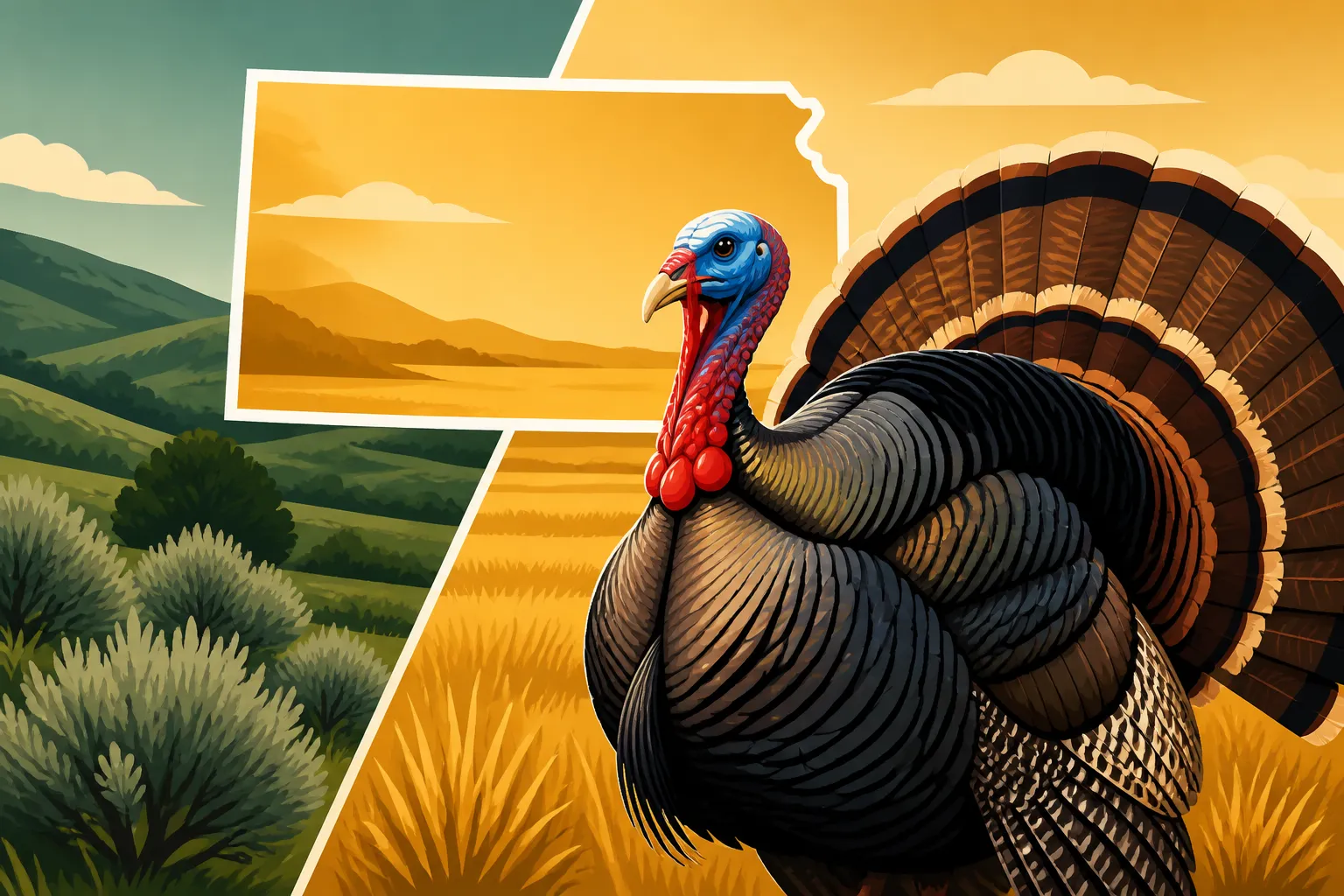
Hybrid Turkeys Where Ranges Meet
There's a unique excitement that comes with chasing wild turkeys in Kansas, but it can also present a head-scratcher when you encounter a bird that doesn't quite fit the mold of a classic Rio Grande or Eastern. This confusion is particularly common in certain areas of our state where these two distinct subspecies naturally intermingle and breed. This guide is dedicated to unraveling the mystery of hybrid turkeys, helping you understand what they are, where to find them, and how to identify these fascinating birds when you're out in the field.
The Blending of Worlds: What Are Hybrid Turkeys?
For many hunters, the image of a Kansas turkey hunt conjures up visions of big, bronze Rio Grandes strutting across open fields or perhaps the deeper, richer tones of an Eastern gobbler emerging from dense timber. But what happens when these two distinct populations meet? That's where the captivating world of hybrid turkeys comes into play, creating birds with a fascinating blend of characteristics.
The Pure Rio Grande and Eastern Turkey Ranges
To truly grasp what a hybrid turkey is, we first need to understand the typical distribution of our main turkey subspecies in Kansas. The Rio Grande turkey is by far the most widespread subspecies across the state, dominating the central and western plains. These birds are generally accustomed to more open country, utilizing riparian corridors, shelterbelts, and farmsteads for cover and roosting. Their plumage tends to be a lighter, more coppery bronze, often with very light buff or tan tail fan tips.
On the other hand, the Eastern wild turkey holds its ground primarily in the forested, more timber-rich regions of eastern Kansas. These are birds of the big woods, preferring dense hardwood forests and substantial creek bottoms. Their plumage is typically darker, a richer, iridescent bronze-green, and their tail fan tips are a distinctive deep buff or chestnut brown. The habitat dictates many of their behaviors, making them often warier and more challenging in dense cover compared to their Rio Grande cousins. You can learn more about the specific traits and populations by reading about Rio Grande Turkeys in Kansas and Eastern and Hybrid Turkeys in Kansas.
How Hybridization Occurs
Hybridization simply refers to the natural process where two different subspecies or species breed, resulting in offspring that carry genetic traits from both parents. In Kansas, this isn't some strange, isolated incident; it's a completely natural biological phenomenon that occurs when the geographical ranges of Rio Grande and Eastern turkeys overlap. As turkey populations expand and contract over time, driven by habitat availability, hunting pressure, and management efforts, these "buffer zones" of overlap naturally develop.
When a Rio Grande hen mates with an Eastern gobbler, or vice-versa, their poults will display a mix of traits. This can happen over generations, leading to birds that might look predominantly one subspecies but carry subtle hints of the other, or birds that are a truly striking blend. This mixing is particularly prevalent along major river systems that cut through the central part of the state, creating corridors of suitable habitat that both subspecies can utilize. It’s a testament to the adaptability of wild turkeys and the dynamic nature of wildlife populations. Understanding Kansas Turkey Population Trends can give you more context on how these ranges have shifted over time.
The Great Divide: Where Rio Grande and Eastern Ranges Converge in Kansas
Knowing that hybrids exist is one thing, but pinpointing where you might actually encounter them is key for hunters. Kansas, with its diverse landscapes, provides a fascinating stage for this intermingling of turkey subspecies.
The Central Transition Belt
The primary "hybrid zone" in Kansas generally runs through the central part of the state, acting as a dynamic border between the eastern forests and the western plains. While there isn't a hard-and-fast line, you'll often find these mixed populations along the major river drainages like the Republican, Solomon, Saline, Smoky Hill, and Arkansas Rivers. These river corridors provide the crucial timber and cover that Eastern turkeys need to survive and expand westward, while the surrounding agricultural fields and open grasslands are classic Rio Grande territory.
Imagine areas around Junction City, Salina, Great Bend, or Hutchinson. In these transition zones, a flock might consist of hens that lean more towards Eastern characteristics, while the dominant gobbler could be a heavily copper-bronzed Rio Grande type. Or, you might see individuals within the same flock displaying a wide array of mixed plumage. This makes hunting these areas both exciting and sometimes a bit confusing for identification purposes! Using mapping tools like those offered by GoHunt can really help you visualize these habitat types and pinpoint potential overlap zones.
Local Factors Influencing Distribution
It's not just the big rivers that dictate where hybrids appear. Many smaller, localized factors play a significant role.
- Creek Draws and Timber Blocks: Even in predominantly open country, a significant creek draw lined with mature timber can create a pocket of Eastern-like habitat far west of their main range. Conversely, large, isolated blocks of timber in eastern Kansas might attract Rio Grandes pushing eastward.
- Agricultural Practices: The patterns of cultivation, the presence of large tracts of CRP (Conservation Reserve Program) ground, and the distribution of food plots can all influence where turkeys roost, feed, and travel, thereby impacting where different subspecies might encounter each other.
- Historical Stocking Efforts: In some areas, past stocking efforts of one subspecies into the range of another could have also contributed to localized hybridization, though modern management aims to maintain the integrity of subspecies where possible.
- Roosting Preferences: Understanding Where Turkeys Roost in Farm Country can give you clues as to how different birds utilize available habitat, influencing where they might cross paths.
Spotting the Mix: Identifying Hybrid Turkeys in the Field
Identifying a hybrid turkey can be one of the most intriguing challenges for a Kansas hunter. It's not always cut and dry, and sometimes it takes a keen eye to notice the subtle blend of features. While pure subspecies have well-defined characteristics, hybrids exist on a spectrum.
Key Visual Cues
The most reliable way to identify a hybrid turkey comes down to a careful examination of its plumage, particularly the primary wing feathers and the tail fan.
Primary Wing Feathers:
- Pure Eastern: The primary wing feathers (the longest flight feathers) will have prominent, distinct bands of black and white. When the wing is folded, this creates a noticeably dark and light striped pattern.
- Pure Rio Grande: The primary wing feathers will have distinct bands of black and buff or tan. This creates a much lighter, almost bleached-out look compared to the Eastern.
- Hybrid: Here's where it gets interesting. A hybrid might have a mix of these patterns. You might see some feathers with a distinctly white band and others with a more tan or buff band. Or, the white bands might appear duller, with a yellowish or brownish tinge, not quite pure white but certainly not as dark as a typical Rio. It's often a mosaic, not a uniform blend.
Tail Fan Tips:
- Pure Eastern: The tips of the tail feathers will be a rich, dark chestnut or chocolate brown, sometimes described as buff.
- Pure Rio Grande: The tips will be a lighter, more pale tan or light buff, sometimes appearing almost white against the darker feather body.
- Hybrid: Similar to the wings, the tail fan can show a blend. You might see some feathers with darker, Eastern-like tips alongside lighter, Rio-like tips. Or, the entire fan might have tips that are an intermediate shade – a medium brown or a dirty buff – not quite dark chestnut and not quite pale tan.
Body Plumage:
- Pure Eastern: Tends to have an overall darker, iridescent bronze-green sheen on the body feathers.
- Pure Rio Grande: Usually displays a lighter, coppery-bronze sheen.
- Hybrid: A hybrid's body color can be a mix. You might see patches of green iridescence alongside coppery hues, or an overall color that just doesn't quite fit either description perfectly.
Behavioral and Vocal Differences
While plumage is the most definitive, seasoned hunters sometimes notice behavioral or vocal characteristics that hint at a hybrid.
- Vocalizations: A pure Rio Grande gobble can often sound a bit rougher or higher-pitched than an Eastern's, which tends to be deeper and fuller. A hybrid might have a gobble that's somewhere in between, or perhaps even a less consistent sound. Sometimes, their yelps or clucks might carry a slightly different cadence or tone that doesn't perfectly match what you'd expect from a pure subspecies in that area.
- Waryness: Easterns are often considered to be more wary and tied to timber, while Rios can be a bit bolder in open country. A hybrid might exhibit a blend of these traits, perhaps being slightly less cautious in open fields than an Eastern, but still more prone to seeking dense cover than a pure Rio. This is highly anecdotal, though, and can be influenced heavily by hunting pressure and individual bird personality.
Here’s a quick comparison table for visual cues:
| Trait | Pure Eastern Turkey | Pure Rio Grande Turkey | Hybrid Turkey (Where Ranges Meet) |
|---|---|---|---|
| Primary Wing Feathers | Distinct Black and White bands | Distinct Black and Buff/Tan bands | Mix of white and buff/tan bands, or dull white/tan |
| Tail Fan Tips | Rich, dark Chestnut or Buff brown | Pale Tan or Light Buff, almost whitish | Intermediate brown, dirty buff, or mixed feather tips |
| Body Plumage Sheen | Dark, iridescent Bronze-Green | Lighter, Coppery-Bronze | Blend of green and copper, or ambiguous overall hue |
| Leg Color | Typically dark, dull gray or blackish | Often reddish or pinkish-gray | Can vary, may lean one way or be intermediate |
Hunting the In-Between: Strategies for Hybrid Turkey Zones
Hunting turkeys in these hybrid zones can be a unique experience. You're not just targeting a single subspecies; you're often calling to birds that might have a mixed genetic heritage, and that can influence how they respond.
Adapting Your Calling Strategy
Because hybrid turkeys can inherit vocal characteristics from both Rio Grandes and Easterns, a hunter's calling strategy often needs to be more flexible. If you're used to a specific type of call for one subspecies, you might find that it doesn't always get the same reaction from a hybrid.
- Versatility is Key: Don't be afraid to switch up your calls. If your sharp, high-pitched Rio yelps aren't cutting it, try introducing some deeper, more guttural Eastern-style yelps or purrs. A variety of calls – slate, box, diaphragm – can give you an edge.
- Listen Closely: Pay extra close attention to the gobblers you hear. Do they have the typical cadence of a Rio, or does their gobble seem a bit deeper and more drawn out like an Eastern? Try to mimic the sounds you're hearing in the field.
- Patience and Observation: Sometimes, the best strategy is to be patient and observe. Watch how a flock behaves when you make different calls. Do they respond better to excited cutting or softer clucks? Don't be too rigid in your approach, especially when dealing with a bird that might have a diverse range of vocal inclinations. This is particularly useful when trying to lure in a Calling a Henned-Up Kansas Gobbler who might be torn between pure and mixed genetics.
Scouting for Mixed Traits and Prime Habitat
Scouting becomes even more critical in hybrid zones. It's not just about finding fresh sign; it's about looking for clues about the turkeys themselves.
- Feather Clues: When you find dusting bowls or strut zones, examine any dropped feathers carefully for the mixed wing and tail feather characteristics discussed earlier. This can confirm you're in a hybrid area.
- Habitat Mapping: Use tools like GoHunt to analyze aerial imagery and topo maps. Look for areas where dense timber associated with river bottoms (prime Eastern habitat) meets more open agricultural fields and scattered shelterbelts (typical Rio Grande country). These transition lines are your sweet spots for finding hybrids. You'll want to identify potential roosting areas, feeding grounds, and travel corridors that bridge these two distinct habitat types. For example, looking at maps for Reading a Kansas Creek Bottom for Deer Sign can also help identify turkey habitat.
- Seasonal Considerations: Remember that turkey behavior changes throughout the season. Early spring might see gobblers more territorial, while later in the season, they might be more concentrated around specific food sources. Adjust your scouting and hunting based on these seasonal shifts.
- Permit Zones: Make sure you're always aware of the specific regulations for your hunting unit. Check the current year's Kansas Spring Turkey Permits and Units to ensure you have the correct permit for the area you plan to hunt. While hybrids are biologically fascinating, state regulations don't typically distinguish between subspecies for permit purposes in Kansas, but knowing the unit's general turkey population is always a good idea.
Hunting hybrid turkeys offers a unique challenge and reward. It requires a deeper understanding of turkey biology, a keen eye for subtle details, and a flexible approach to calling and strategy. The satisfaction of identifying and successfully harvesting one of these fascinating blended birds is a special experience in itself.
Disclaimer
This article is for general informational purposes only and does not constitute professional advice. Laws, prices and regulations vary by location and change over time. Consult a qualified professional for guidance on your specific situation.