Soil Fertility and Antler Growth
Every hunter who dreams of that wall-hanger buck eventually starts asking themselves: what makes some deer grow bigger antlers than others? While genetics and age are undeniably huge factors, there's a silent, often-overlooked hero beneath our feet that heavily influences antler size and health: the very soil these deer live on. This guide will take you on a journey through the fascinating connection between Kansas's diverse soil fertility and the impressive antler growth we often see in our whitetail deer.
The Foundation: How Soil Quality Dictates Deer Nutrition
It might sound overly scientific to talk about dirt, but trust me, understanding the soil is like understanding the blueprint for your deer herd's potential. The healthier and more nutrient-rich the soil, the healthier and more nutrient-rich the plants growing in it. And since deer are what they eat, the quality of their diet directly dictates their overall health, body size, and yes, the size and density of their antlers.
Micronutrients and Macronutrients in the Soil
Think of soil as a giant pantry for plants. This pantry holds two main types of "food" for plants: macronutrients and micronutrients. Macronutrients, like nitrogen (N), phosphorus (P), and potassium (K), are needed in larger quantities. You've probably heard of them from fertilizer bags (N-P-K ratios). Nitrogen drives leafy growth, phosphorus is critical for root development and energy transfer, and potassium helps with overall plant vigor and disease resistance. When these are abundant, plants thrive.
But then there are the micronutrients – things like calcium, magnesium, zinc, copper, and selenium. These are needed in smaller amounts, but they are absolutely non-negotiable for a plant's, and subsequently a deer's, health. If the soil is deficient in any of these, even if the macronutrients are present, the plant won't reach its full nutritional potential. Imagine trying to build a house with plenty of lumber but no nails – it just doesn't work. The geology of Kansas plays a huge role here; some areas naturally have richer, more diverse mineral compositions than others, leading to a natural advantage for local wildlife. This is one of the reasons Why Kansas Grows Trophy Whitetails is such a popular topic.
The Cycle of Nutrients from Earth to Antler
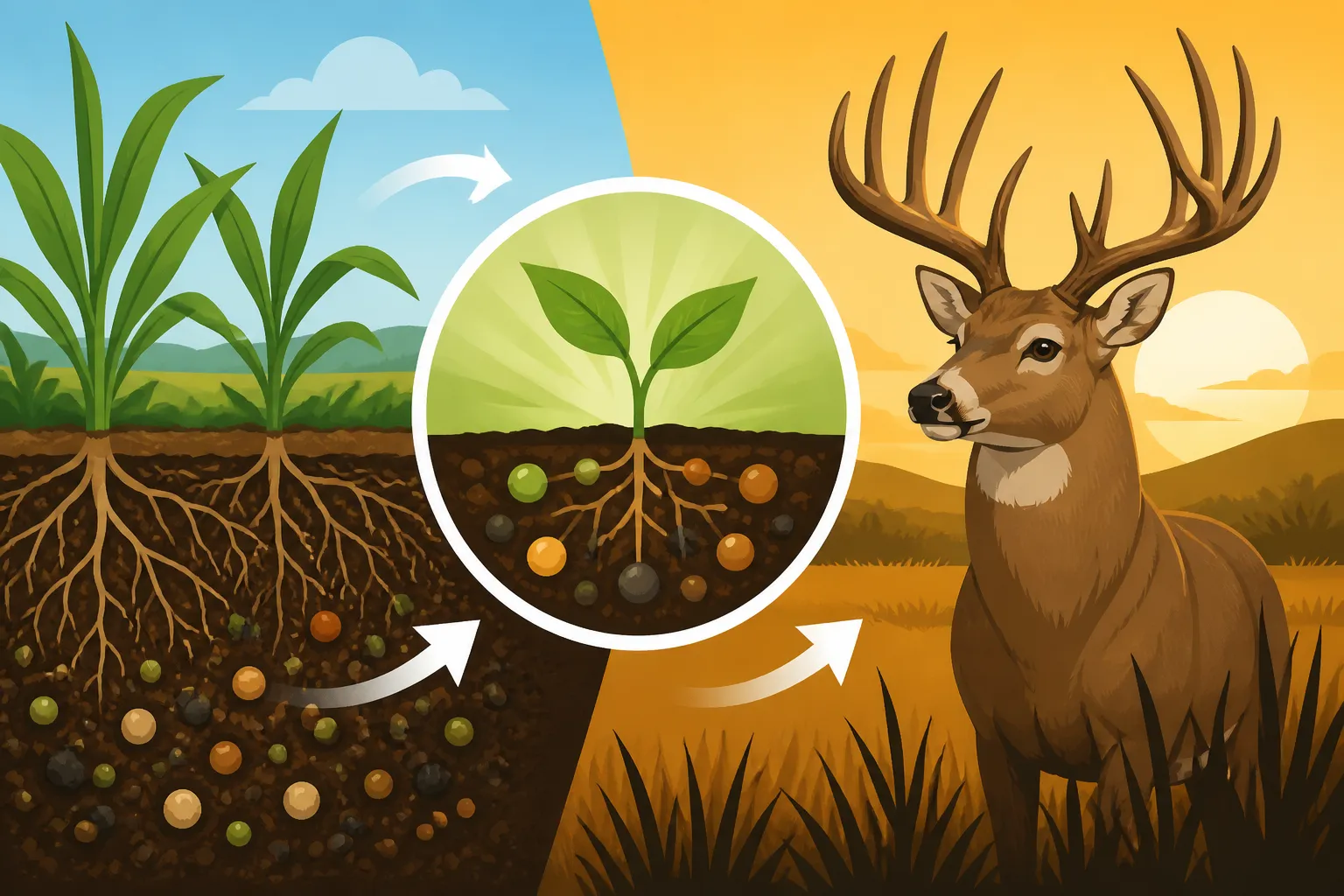
So, how does that phosphorus in the soil end up in a buck's rack? It's a beautiful, intricate cycle. Plants, through their roots, absorb water and dissolved nutrients from the soil. They then convert these elements into carbohydrates, proteins, and fats through photosynthesis. A deer comes along and browses on these plants – chomping down on forbs, munching on leaves, or feasting on mast crops like acorns.
Inside the deer's body, these plant materials are digested, and the absorbed nutrients are put to work. A portion of the calcium and phosphorus, for example, is used for maintaining strong bones, muscle function, and energy. However, during the antler-growing season, a significant amount of these minerals is diverted specifically to antler development. It's an incredible biological feat, with antlers being one of the fastest-growing tissues in the animal kingdom. A buck can only build impressive antlers if its body has an ample supply of these crucial nutrients, year-round. This is especially true in a place like Kansas, with its expansive Kansas Deer Habitat in Crop Country.
Key Nutrients for Robust Antler Development
When we talk about growing big antlers, we're really talking about growing bone. Antlers are, after all, extensions of a buck's skull, and their development demands a significant mineral investment from the deer's body.
Calcium and Phosphorus: The Building Blocks
If antlers are the house, then calcium and phosphorus are the primary bricks and mortar. These two minerals are absolutely paramount for bone density and growth. A deer with insufficient calcium or phosphorus in its diet simply cannot develop large, dense antlers, no matter how good its genetics.
Deer get calcium from a variety of plant sources, including legumes like alfalfa and clover, which are often planted in food plots. Browse species, certain forbs, and even acorns can provide calcium. Phosphorus is also found in many forages and grains. It's not just about the absolute amount, but also the ratio between calcium and phosphorus – typically, deer thrive with a ratio of around 2:1 (calcium to phosphorus). If one is significantly out of balance, the deer's body can struggle to utilize either effectively. When planning your habitat improvements, consider what plants naturally grow on your property or what you could introduce.
Trace Minerals That Matter: Zinc, Copper, Selenium
While calcium and phosphorus steal the spotlight, a host of trace minerals play vital supporting roles that are often overlooked.
- Zinc: Essential for cell division, protein synthesis, and immune function. Healthy, thriving deer are more likely to divert resources to antler growth. Zinc deficiency can lead to smaller body size and reduced antler mass.
- Copper: Important for bone formation, connective tissue development, and iron metabolism. Without enough copper, a deer might struggle with bone strength, which is directly relevant to antlers.
- Selenium: A powerful antioxidant that supports muscle health, immune response, and overall vigor. A deer that is healthy and not fighting off illness can put more energy into growing a big rack.
These trace minerals are typically absorbed by plants from the soil. So, if your soil is poor in these, so too will be the plants, and ultimately, the deer. This is where modern mapping and scouting tools, like those offered by GoHunt, can become incredibly valuable. By researching the geological and soil compositions of different regions or specific properties, you can start to infer the natural mineral availability, giving you a distinct advantage in understanding the deer's potential.
| Mineral Type | Key Role in Antler Growth | Common Natural Sources for Deer in Kansas | Impact of Deficiency |
|---|---|---|---|
| Macrominerals | |||
| Calcium | Primary structural component of antlers | Legumes (clover, alfalfa), forbs, leafy browse | Smaller, less dense antlers; bone weakness |
| Phosphorus | Critical for bone density and energy transfer | Grains (corn, soybeans), forbs, young shoots | Poor antler development; impaired metabolism |
| Potassium | Overall plant health, indirectly deer health | Forbs, grasses, browse | Reduced plant vigor, lower overall forage quality |
| Trace Minerals | |||
| Zinc | Cell division, protein synthesis, immune health | Acorns, soybeans, young forage, browse | Smaller antlers, poor coat quality, weakened immune system |
| Copper | Bone and connective tissue formation | Legumes, forbs, some woody browse | Fragile antlers, bone deformities, anemia |
| Selenium | Antioxidant, muscle health, immune response | Forbs, grasses grown on selenium-rich soils | Reduced vigor, poor muscle development, compromised immunity |
Beyond the Dirt: Habitat Management for Better Antlers
While soil fertility is foundational, it's not the only piece of the puzzle. How you manage the habitat on top of that soil directly influences how deer access and utilize those nutrients.
Food Plots and Native Forage Enhancement
On private land, one of the most direct ways to address potential nutritional gaps is through strategic food plot planting. If your soil tests reveal deficiencies, you can amend the soil and plant specific forage that is high in protein and essential minerals. Alfalfa and various clovers are excellent choices, providing high-quality protein and calcium. Brassicas can offer a late-season punch. Even standing grain crops like soybeans and corn, if left unharvested, provide crucial calories and some minerals, especially as winter sets in. This ties in with practices like Late-Season Food Source Hunting.
But it's not just about planting annual food plots. Enhancing native forage is equally, if not more, important. Many native browse species like sumac, privet, and even thorny multiflora rose are consumed by deer. Encouraging the growth of diverse native forbs and legumes through selective timber stand improvement or controlled burns can provide a year-round buffet of nutrient-rich food. Remember, deer need consistent nutrition throughout the year, not just during the spring and summer antler-growing months. A strong body going into winter means a stronger foundation for antler growth next spring. Understanding Crop Rotation and Deer Nutrition is also key here, as rotating crops can vary the available nutrients.
Understanding Your Specific Kansas Landscape
Kansas is not a monolithic landscape. The rich, deep soils of eastern Kansas river bottoms are vastly different from the more alkaline, thinner soils of the western plains. This geological diversity means that what works in one part of the state might not be effective in another. For instance, river bottoms and creek draws often boast incredibly fertile soils due to centuries of deposited silt and organic matter, making areas mentioned in Scouting Kansas River Bottoms and Creek Draws prime locations for growing big deer.
Using resources like the Kansas Department of Wildlife, Parks, and Tourism (KDWP) habitat maps, NRCS soil surveys, or digital mapping platforms can help you understand the specific soil types on your property or hunting area. These tools can guide your food plot choices and reveal areas naturally inclined to produce better forage. For example, if you know you have highly acidic soil, you'll need to adjust your lime application to bring the pH into a range where plants can efficiently absorb nutrients. Areas with extensive CRP Acres and Kansas Deer Numbers might offer good bedding and some forage, but the quality of that forage for antler growth can vary significantly depending on the underlying soil.
Practical Steps for the Hunter and Land Manager
So, how can you, as a dedicated hunter or land manager, apply this knowledge to improve the antler potential of the deer on your hunting grounds?
Soil Testing and Interpretation
The first and most critical step is to conduct a soil test. This isn't just for farmers; it's an invaluable tool for anyone serious about habitat improvement. You can obtain soil sampling kits from your local extension office or agricultural co-op. Take multiple samples from different areas of your property – food plots, timber edges, native grass fields – to get a comprehensive picture.
Once you receive your results, you'll get a detailed report on your soil's pH, levels of macro and micronutrients, and recommendations for amendments (like lime to adjust pH or specific fertilizers). Don't just look at the N-P-K. Pay close attention to calcium, magnesium, and trace minerals. If you're working with an outfitter or on a lease, discuss their soil management practices. Tools like GoHunt can provide insights into regional soil characteristics, but nothing beats a direct test of your specific parcel. This information empowers you to make informed decisions for your land, whether it's for Food Plots on Leased Kansas Ground or improving native browse.
Holistic Approach to Deer Nutrition
While soil fertility and nutrition are powerful drivers, it's crucial to remember they are part of a larger, interconnected system. Antler growth is largely a function of three main components: genetics, age, and nutrition. You can't change a deer's inherent genetic potential, but you can provide the optimal nutritional environment for it to express that potential. And of course, deer need to live long enough to maximize their growth, as discussed in How Old Kansas Bucks Get Before Harvest.
A truly holistic approach to growing bigger antlers involves:
- Soil Health: Regular soil testing and amending to ensure optimal nutrient availability.
- Forage Quality: Providing diverse, high-quality forage through a mix of food plots and enhanced native vegetation.
- Water Access: Ensuring reliable, clean water sources, especially during dry periods.
- Cover: Offering ample bedding and thermal cover, allowing deer to conserve energy.
- Age Structure: Implementing selective harvest strategies to allow bucks to reach older age classes where antler growth truly explodes.
- Pressure Management: Minimizing disturbance to reduce stress on the herd.
By focusing on these elements, you're not just hoping for bigger antlers; you're actively building the foundation for a healthier, more robust deer herd overall. Every aspect of the deer's environment contributes to its well-being, and by starting from the ground up – literally – with healthy soil, you're making a significant investment in the future of your Kansas hunting experience.
Disclaimer
This article is for general informational purposes only and does not constitute professional advice. Laws, prices and regulations vary by location and change over time. Consult a qualified professional for guidance on your specific situation.