Smoky Hill River Deer Country
Hunting deer in Kansas can be an incredible experience, but tackling a specific, often overlooked region like the Smoky Hill River valley presents its own unique set of challenges. It's easy to feel overwhelmed by the vast, open plains that Kansas is famous for, and assume prime deer habitat is only found in the eastern timber or along major rivers like the Missouri or Kansas River. However, the Smoky Hill River offers a distinct hunting environment, a ribbon of life winding through agricultural land, and understanding its nuances is key to finding success. This guide is here to unravel the secrets of the Smoky Hill, helping you navigate its unique landscape, understand deer behavior within it, and ultimately, put you on some great Kansas whitetails.
Understanding the Smoky Hill River as Premier Deer Habitat
The Smoky Hill River isn't your typical sprawling, wide river system with continuous, dense timber. Instead, it’s a dynamic, meandering waterway that carves through the landscape, creating a linear oasis of cover, food, and water in a predominantly agricultural setting. This makes it an absolute magnet for whitetail deer, providing everything they need to thrive, often in surprisingly concentrated areas.
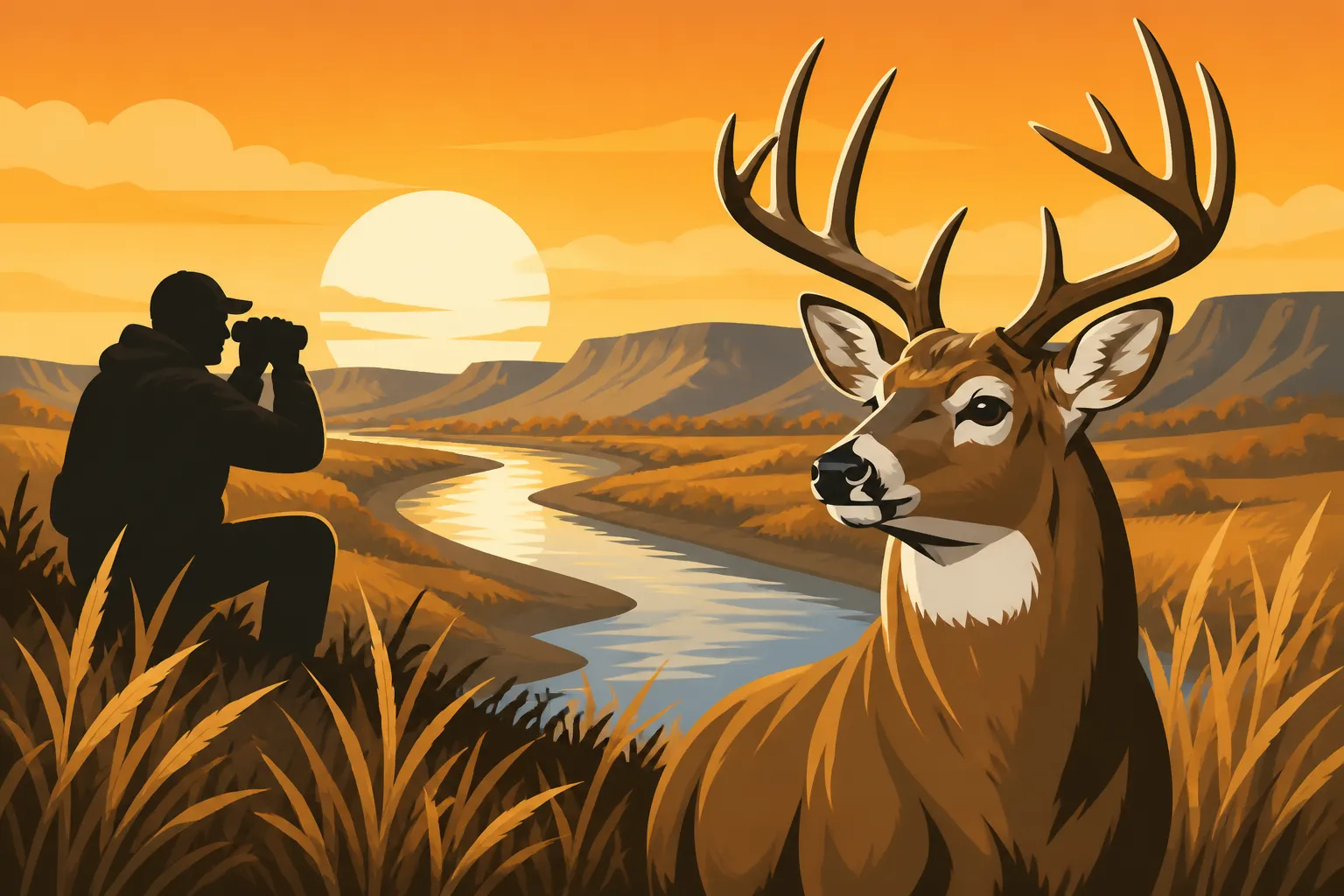
The river bottom itself is a mosaic of habitats. You'll find towering cottonwoods and willows hugging the water's edge, often giving way to dense thickets of young saplings, sumac, and brush further back from the main channel. These areas offer incredible bedding cover and security, especially as hunting pressure pushes deer out of more exposed areas. The river's winding nature also creates numerous oxbows, cut banks, and small tributary creeks that feed into it. These features provide natural funnels and travel corridors that deer use religiously. You might find a buck confidently cruising a bend in the river, using the dense bank cover to shield his movement, or crossing a shallow riffle to access a new bedding area. River Oxbows and Deer Movement can be a real eye-opener in understanding how these natural features dictate deer patterns.
Adjacent to this riverine timber are vast expanses of crop fields, primarily corn, milo, and wheat, with some soybeans mixed in. These agricultural fields serve as the primary food source for deer in the region for much of the year. During the early season, standing corn offers both food and incredible cover, practically a deer's personal fortress. Even after harvest, the waste grain in milo and corn stubble fields provides continuous forage into the late season, drawing deer out of the river bottom for evening feeding. The combination of secure bedding cover in the river timber and abundant food in the nearby fields creates an ideal scenario for growing large, healthy whitetails. It’s all about finding that transition zone where the river habitat meets the food.
Navigating Access and E-Scouting the Smoky Hill
One of the biggest hurdles for hunters, especially those new to the area, is figuring out access along the Smoky Hill River. Kansas is primarily private land, and the river corridor is no exception, often bordered by private farms and ranches. However, there are public land opportunities, and with diligent scouting and smart strategizing, you can absolutely find places to hunt.
The Kansas Walk-In Hunting Access (WIHA) program is a hunter's best friend in this scenario. Many WIHA tracts are located along or near river systems, providing crucial public access. These tracts can be a mix of river bottom timber, adjacent crop fields, or CRP grasslands that border the river. It's absolutely essential to get your hands on the latest WIHA atlas, either in print or through the online Kansas Hunting Atlas, and meticulously scout these areas. Tools like onX Hunt are indispensable here; you can overlay WIHA boundaries with satellite imagery to pinpoint potential access points, identify natural funnels, and scout for bedding areas even before you set foot on the property. GoHunt also offers robust mapping features that can help visualize these properties and plan your approach. Remember, rules for Camping Rules on Kansas WIHA Ground and Blinds and Stands on Kansas WIHA are important to review before you head out.
For private land, establishing relationships with landowners is paramount. This isn't just about knocking on doors the week before the season; it's a year-round effort. Building trust takes time, respect, and often, offering a helping hand. Landowners in the Smoky Hill area might be more receptive to hunters who show genuine interest in managing deer populations, especially if they're experiencing crop damage. When you do gain permission, always be a good steward of their land, leave no trace, and consider offering some venison in return. It’s about being a guest, not just a hunter.
| Access Type | Pros | Cons | Scouting Strategy |
|---|---|---|---|
| WIHA (Walk-In) | Public access, clearly marked. | Can be pressured, limited acreage. | E-scout with onX Hunt/GoHunt, look for remote corners. |
| State Wildlife Areas | Managed habitat, often larger tracts. | Specific regulations, potential for high pressure. | Check KDWP website for rules, scout away from main roads. |
| Private Land | Less pressure, managed habitat (potential). | Requires landowner permission, can be hard to secure. | Year-round relationship building, offer assistance. |
Deer Movement and Hunting Strategies in River Country
Hunting the Smoky Hill River requires a unique approach compared to open plains or heavily timbered forests. Deer here learn to use the linear cover of the river system to their advantage, often moving more linearly and holding tight in thick cover. Your strategies need to reflect this, focusing on precision, stealth, and understanding how wind and water influence movement.
During the early archery season, especially in September, the dense canopy along the river and the proximity to standing crops make these areas prime for daytime activity. Deer will often bed in the thickest parts of the river bottom timber, moving out to adjacent crop fields in the evenings. Setting up a stand or ground blind on the edge of the timber where it meets a corn or milo field can be deadly. Pay close attention to trails leading from the river bottom into the agricultural fields; these are often well-worn highways. Think about using thermal currents in the mornings and evenings as they drift into and out of the river valley. For insights on adapting to warmer conditions, check out Muzzleloader Deer Tactics in Warm September Weather, which offers lessons applicable to early bowhunting too.
As the rut approaches in late October and November, the Smoky Hill River bottom transforms into a high-traffic zone for cruising bucks. They use the river as a natural highway, checking for does that are staged up in the dense cover or feeding in nearby fields. This is when rattling and grunting can be highly effective. Position yourself where you have good visibility along the river's edge, perhaps on a point or a slight rise, allowing you to intercept bucks moving up and down the corridor. Rattling and Grunting During the Kansas Rut offers some great advice that directly applies to these situations. Look for rub lines and scrape lines that parallel the river or cut directly into the timber from the field edges; these indicate frequent buck travel.
Late season, post-rut, deer are all about food and survival. The river bottom continues to offer critical thermal cover, especially during cold snaps. Deer will prioritize high-energy food sources, and the waste grain in harvested corn and milo fields becomes irresistible. Focus your efforts on these food sources, particularly during cold fronts. The river bottom offers a secluded path to these fields, allowing deer to move with relative safety. Scouting for fresh tracks and droppings in the snow can reveal key travel routes between bedding areas in the river timber and feeding locations. Late-Season Food Source Hunting will provide more ideas for targeting deer when the temperatures drop.
Overcoming Hunting Pressure and Maximizing Success
The fact that the Smoky Hill River offers such prime habitat means it can attract its fair share of hunting pressure, especially on readily accessible public land. However, don't let this deter you. Smart hunters understand how deer react to pressure and can use that knowledge to their advantage. The key is often to get away from easy access points and think like a deer trying to avoid detection.
One common mistake hunters make is sticking to the most obvious access points and setting up too close to roads or parking areas. Deer quickly learn these patterns. Instead, study your maps (onX Hunt and GoHunt are great for this) and identify less-traveled access points, even if it means a longer walk. Deer will often retreat into the densest, hardest-to-reach pockets of the river bottom when they feel pressure. These might be areas with thick cedar breaks, deep ravines, or almost impenetrable brush. These are the spots where mature bucks will often seek refuge during hunting season. Hunting Pressure Patterns on Kansas Public Land delves deeper into understanding how deer react to human presence and how you can exploit those reactions.
Consider mobile hunting tactics. Instead of leaving a stand in one spot for weeks, use a treestand or a saddle system that allows you to quickly set up and move based on fresh sign, wind direction, and observed deer movement. A mobile approach helps you stay nimble and adapt to changing conditions and pressure. Mobile Hunting With a Saddle in Kansas can change how you think about hunting heavily pressured areas. This is particularly effective in river bottoms where deer patterns can shift daily based on factors like water levels, wind, and human intrusion.
Finally, consider hunting during weekdays if your schedule allows. Weekend pressure can be significantly higher, pushing deer into nocturnal patterns or into the most inaccessible parts of the habitat. A mid-week hunt can often find deer moving more naturally, especially during daylight hours. Also, don't overlook the middle of the day. While many hunters are back at camp for lunch, big bucks will often use the midday lull to slip between bedding and feeding areas, especially if they've been bumped in the morning. Being patient and staying in your stand for extended periods can pay off handsomely along the Smoky Hill River.
Disclaimer
This article is for general informational purposes only and does not constitute professional advice. Laws, prices and regulations vary by location and change over time. Consult a qualified professional for guidance on your specific situation.